
The Money-Saving Myth: Why Closing Vents Costs You More
Closing vents in unused rooms doesn't save energy—it actually makes your system work harder. The Physics of Airflow: Why Closing Vents in Unused Rooms Damages Your HVAC System is a critical concept every homeowner needs to understand before shutting off a guest room register. You might think blocking off a room redirects warm or cool air to the spaces you actually use, lowering your utility bills in the process. In our years of serving Scarborough homeowners, we have found this to be one of the most common, and most destructive, misconceptions in home maintenance. The reality is that modern residential heating and cooling systems are engineered as meticulously balanced, closed loops.
Need expert help? Whether you are trying to maximize the lifespan of your HVAC systems or you need emergency AC repair in Scarborough, understanding how airflow affects your equipment is the first step to preventing costly breakdowns.
When you close a vent, you are not telling your furnace or air conditioner to produce less air. Instead, you are forcing the exact same volume of air through a smaller total opening. This creates a severe bottleneck. The immediate result is a spike in internal pressure that strains your blower motor, reduces system efficiency, and ultimately leads to premature mechanical failure. Your equipment is designed to move a specific amount of air to keep its internal components at a safe operating temperature.
Our technicians at Metropolitan Heating & Air Conditioning know firsthand that this forced restriction is particularly dangerous when dealing with the peak winter heating and summer cooling extremes in Scarborough. Our local climate features deep freezes in January and hot, humid heat waves in July. During these extreme weather events, your system is already running at maximum capacity. It needs full, unrestricted airflow to keep up with the thermostat. When you artificially restrict that airflow by closing vents, you eliminate the system's margin for error, turning a well-intentioned attempt to save energy into a recipe for a total system breakdown.
Understanding the Physics of Airflow in Your Home
To understand why a closed vent causes so much trouble, you have to look at the science of static pressure. In residential ductwork, static pressure is the resistance to airflow. Your blower motor has to push conditioned air out through the supply vents while simultaneously pulling unconditioned air in through the return vents. This push-and-pull creates a delicate equilibrium. When that equilibrium is maintained, your home stays comfortable, and your equipment runs smoothly.
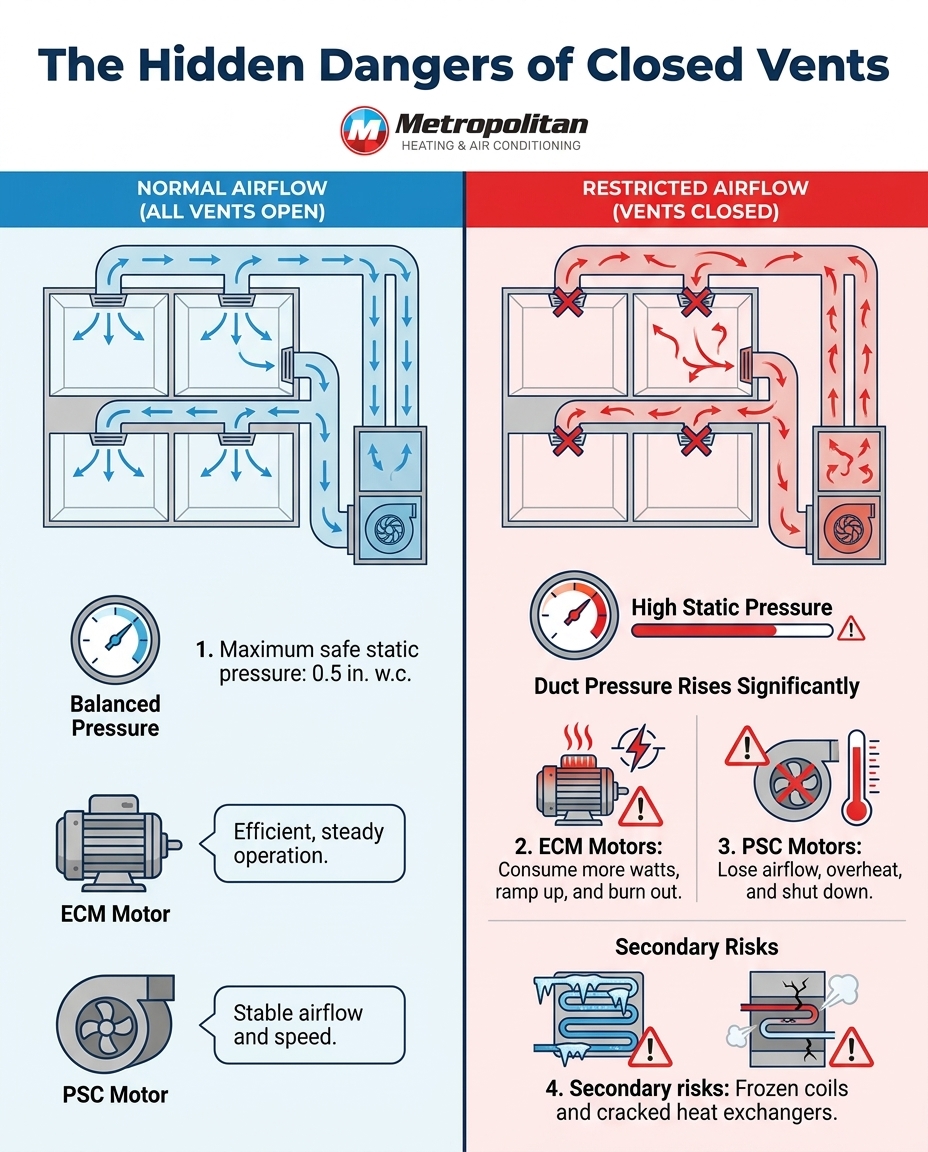
HVAC engineers measure this resistance using a metric called inches of water column (in. w.c.). Standard residential systems are heavily engineered to operate within strict static pressure limits (inches of water column), typically maxing out at a total external static pressure of 0.5 in. w.c. At Metropolitan Heating & Air Conditioning, we believe in true homeowner education—which means breaking down technical concepts like this so you can make informed decisions about your home. Think of 0.5 in. w.c. as the maximum safe blood pressure for your ductwork. If the pressure rises above this limit, the "heart" of your system (the blower motor) has to work dangerously hard.
Every time you close a supply vent, you increase the resistance in the ductwork. The total volume of air your system was designed to move suddenly has fewer places to go. The static pressure inside the ducts begins to climb, pushing past that safe 0.5 in. w.c. threshold. This imbalance not only stresses the mechanical parts but also disrupts the temperature balance across your entire house. If you are scheduling professional heating services because certain rooms are always too cold, our team typically finds that the culprit is an underlying airflow imbalance, not a lack of heating power.
How Closed Vents Create Dangerous Static Pressure
The Problem: The Blower Motor Operates Blindly
Your heating and cooling system does not know when you close a vent. There is no sensor telling the blower motor to slow down or produce less air because the guest bedroom is empty. The motor simply turns on and attempts to push the exact volume of air it was calibrated to deliver. When a vent is shut off, that air hits a dead end.
The Cause: Invisible Pressure Buildup
Because the air cannot escape through the closed vent, it backs up into the ductwork. This creates a massive increase in static pressure. You can think of your home's ductwork like a human circulatory system. If you block a major artery, the heart doesn't stop pumping; it just pumps harder against the blockage, raising the pressure everywhere else in the body. In your home, this invisible pressure buildup forces the air to find other ways out, often squeezing through tiny leaks in the duct seams and escaping into your attic or crawlspace.
The Solution: Keeping the Pathways Clear
The only way to relieve this dangerous pressure is to keep all registers fully open. Pushing a system past its safe static pressure limits (inches of water column) leads directly to emergency failures. Our repair team sees this pattern frequently in the field. For example, we recently helped a Scarborough homeowner who experienced an AC emergency during the hottest days of summer. Their system was struggling against restricted airflow and finally shut down completely during a severe heat wave. One of our technicians had to come out quickly to fix the unit and restore the airflow balance, getting the system up and running again. Leaving vents open prevents this exact type of mid-season emergency.
ECM vs. PSC Motors: How Restricted Airflow Destroys Your Blower
Not all blower motors react to high static pressure the same way, but both common types will eventually fail when forced to operate with closed vents. Understanding what kind of motor you have helps explain exactly how the damage occurs. The two primary types of residential blower motors are Electronically Commutated Motors (ECM) and Permanent Split Capacitor (PSC) motors.
• ECM (Variable Speed) — Technology Level: Modern, high-efficiency — Reaction to Closed Vents (High Static Pressure): Increases RPMs and consumes more electricity to force air through. — Ultimate Failure Mode: Motor burns out from overworking and excessive electrical draw.
• PSC (Single Speed) — Technology Level: Older, standard-efficiency — Reaction to Closed Vents (High Static Pressure): Loses airflow volume, unable to push against the resistance. — Ultimate Failure Mode: Motor overheats due to lack of cooling airflow and trips safety switches.
Whether you are comparing single-stage vs. two-stage furnaces or evaluating your current setup, you must respect the static pressure limits (inches of water column) of your specific equipment. Neither of these motor reactions results in the energy savings homeowners hope for when they close a vent.
The ECM Reaction: Ramping Up to Failure
Electronically Commutated Motors are smart, variable-speed motors designed to maintain a specific airflow volume regardless of conditions. When you close a vent and increase the static pressure, the ECM detects the resistance. Its programming tells it to push harder to maintain the target airflow. The motor will continuously ramp up its RPMs, consuming significantly more watts in the process. Instead of lowering your utility bill, closing vents causes an ECM to use maximum electricity until the strain eventually burns out the motor entirely.
The PSC Reaction: Overheating and Shutdowns
Permanent Split Capacitor motors are older, single-speed workhorses. They do not have the smart technology to adjust their speed. When they encounter the high static pressure caused by closed vents, they simply cannot push the air through the ducts. The airflow volume drops drastically. Because the blower motor relies on the air passing over it to keep itself cool, this sudden drop in airflow causes the motor to overheat. It will run dangerously hot until internal safety switches trip, shutting the entire system down.
Beyond the Blower: Secondary Damage to Coils and Heat Exchangers
The blower motor is usually the first component to suffer from closed vents, but the damage doesn't stop there. HVAC systems rely on a constant, precise volume of air moving over the internal coils to manage heat transfer. When static pressure rises and airflow drops, a dangerous ripple effect damages the most expensive components in your system.
During the cooling season, your air conditioner's evaporator coil relies on warm return air to keep the internal refrigerant from dropping below freezing. When you close vents and restrict that warm air from reaching the coil, the temperature of the coil plummets. The natural condensation on the coil freezes into a solid block of ice. A frozen coil completely blocks airflow, strains the outdoor compressor, and can cause severe water damage when it eventually thaws.
During the heating season, the risk is even more severe. Your furnace relies on airflow to carry the generated heat away from the heat exchanger and into your home. If vents are closed, that intense heat becomes trapped inside the furnace. Over time, this trapped heat causes the metal heat exchanger to expand, warp, and eventually crack. A cracked heat exchanger is a critical safety failure that requires immediate replacement of the furnace.
Our crew at Metropolitan Heating & Air Conditioning sees how quickly these failures escalate during the peak winter heating and summer cooling extremes in Scarborough. During a recent stretch of extreme cold with a -30 windchill, we responded to a call where a local homeowner's rooftop furnace failed completely because the system was pushed beyond its limits. They required our emergency service and a full replacement to get the heat back on the next business day. High static pressure also exacerbates existing duct leakage, pulling unconditioned, dusty air from your attic or walls into your living space, which severely degrades your indoor air quality.
Safe Alternatives for Managing Temperatures in Unused Rooms
If closing vents damages your system, how do you handle a guest room that is too hot or a storage room you rarely use? You still have safe, effective options to manage your home's comfort without violating your system's static pressure limits (inches of water column).
1. Keep all vents fully open: The simplest and safest approach is to ensure every supply and return register in your home is fully open and unobstructed by furniture or rugs. This maintains the natural equilibrium your system was designed to handle.
2. Invest in professional HVAC zoning: If you truly want different temperatures in different rooms, a professional zoning system is the correct solution. Zoning uses motorized dampers inside the ductwork, paired with a specialized bypass duct and variable-speed equipment, to safely redirect air without causing dangerous pressure spikes.
3. Check insulation and window sealing: Often, a room feels uncomfortable not because of airflow, but because of poor thermal boundaries. Adding weatherstripping to windows, upgrading room insulation, and using thermal curtains can stabilize a room's temperature without touching the HVAC vents.
4. Schedule a professional airflow balance check: If certain rooms are consistently uncomfortable even with all vents open, your ductwork may be improperly sized or leaking. A professional technician from our team can measure the static pressure and adjust the dampers at the duct trunk lines (near the furnace) to safely balance the airflow.
Protect Your System from Unnecessary Wear and Tear
The short answer to the vent-closing debate is simple: leaving your vents open is the easiest, most effective way to protect your blower motor and extend the life of your equipment. HVAC systems are precision machines. Proper airflow ensures the system operates safely within its designed static pressure limits, preventing the motor burnout, frozen coils, and cracked heat exchangers that plague restricted systems.
If you have been closing vents to manage the peak winter heating and summer cooling extremes in Scarborough, it is time to open them back up. If you suspect your system has already suffered airflow-related damage—such as strange noises from the blower, weak airflow, or frequent overheating—do not wait for a total failure. Reach out to our local experts for AC repair in Scarborough to have your static pressure tested and your system safely balanced.
Frequently Asked Questions
Does closing vents save money?
No, closing vents does not save money on your utility bills. Your HVAC system operates as a closed loop and produces the same amount of conditioned air regardless of open or closed registers. In fact, closing vents increases static pressure, causing modern variable-speed motors to consume more electricity as they work harder to push air through the restriction.
Will closing vents damage my AC or furnace?
Yes, closing vents causes significant mechanical damage over time. The restricted airflow forces the blower motor to overwork, leading to premature burnout. Additionally, the lack of proper airflow can cause your air conditioner's evaporator coil to freeze solid in the summer and your furnace's heat exchanger to overheat and crack in the winter.
How many vents can I safely close in my house?
You should not close any vents in your home. Residential HVAC systems are precisely balanced based on the total square footage and ductwork layout. Closing even one or two vents alters the static pressure of the entire system, shifting the system out of its safe operating range and putting unnecessary strain on the equipment.
What happens to the blower motor when vents are closed?
When vents are closed, the blower motor pushes against a wall of air resistance. An ECM (variable-speed) motor will ramp up its speed and consume excess wattage until it burns out. A PSC (single-speed) motor will lose its ability to move air, causing it to overheat and trigger internal safety shutdowns.
Can I partially close a vent instead of shutting it completely?
Partially closing a vent is still not recommended. Even a partial restriction increases the static pressure inside the ductwork and disrupts the airflow balance. If a specific room is receiving too much air, the safest solution is to have a professional technician adjust the dampers at the main duct trunk, rather than restricting the vent cover in the room itself.
Schedule Expert Service
Or Contact Us
Other Blogs
testimonials
hear what our satisfied clients have to say

where we operate
Service areas
contact us
Let’s get in touch!