

Bracing Your AC for Lake Ontario's Harsh Winter Conditions
Before the first major freeze hits the shoreline, preparing your exterior home equipment becomes a race against the elements. At Metropolitan Heating & Air Conditioning, we know that understanding the exact process for winterizing an AC condenser in high-wind areas of Pickering is the best way to ensure your cooling equipment survives until spring. Winter ice storms and high winds coming off Lake Ontario introduce a unique set of challenges that inland homes rarely face. As the temperature drops, homeowners are confronted with a highly specific concrete problem: how to protect the outdoor AC condenser from heavy ice accumulation and flying debris without wrapping it so tightly that trapped moisture causes severe internal rust.
The core decision point for any homeowner is choosing the correct breathable cover and the right securing method to withstand these high-wind lakefront conditions. Wrapping the unit incorrectly can actually cause more damage than leaving it completely exposed to the elements. If you want to protect your investment and extend the life of your air conditioning systems, our team stresses that taking the right protective measures before the snow flies is absolutely non-negotiable.
The unique climate challenge: The Lake Ontario waterfront is notorious for horizontal wind-driven snow and rapid freeze/thaw cycles. When precipitation is blown sideways at high velocities, it penetrates small openings in exterior equipment. If that moisture is then trapped by an improper cover during a temporary winter thaw, it creates a humid micro-environment inside your condenser that eats away at critical components.
Why Generic Winterization Fails in Pickering's Lakefront Microclimate
National hardware store chains and generic online tutorials often provide a one-size-fits-all approach to winterizing outdoor equipment. They usually recommend buying a heavy plastic tarp and wrapping the condenser tightly from top to bottom. While this might work in a dry, static climate, we have seen time and again that it is a recipe for disaster along the Pickering lakefront.
The physics of the local microclimate demand a more tailored approach. The shoreline experiences significantly higher wind gusts and more severe freeze/thaw cycles than inland neighborhoods just a few kilometers north. When horizontal, wind-driven snow blasts against a fully sealed plastic cover, it forces moisture up through the bottom of the unit. Because the plastic does not breathe, that moisture has nowhere to escape when the sun comes out and temperatures briefly rise.
At Metropolitan Heating & Air Conditioning, our deep local expertise in protecting HVAC equipment specifically for Lake Ontario's unique waterfront microclimates means we see firsthand what works and what fails. We consistently find that units suffocated under non-breathable plastic suffer from accelerated decay, whereas units protected with breathable, top-only strategies remain pristine. Proper AC maintenance in Pickering requires adapting to these specific environmental stressors rather than fighting them with generic solutions.
The Plastic Tarp Mistake: Understanding Trapped Moisture and Rust
The single most common mistake our technicians see homeowners make is assuming that blocking all snow and ice is the ultimate goal of winterization. In an effort to shield their equipment from winter ice storms and high winds, they purchase heavy-duty, non-breathable plastic tarps and tightly bungee them around the entire condenser. This well-intentioned action inadvertently creates a destructive greenhouse effect inside the casing.
The problem: Plastic tarps completely seal off the unit's natural airflow. Since the condenser sits on a concrete pad or brackets, ground moisture inevitably evaporates upward into the unit. Furthermore, the high ambient humidity blowing off the lake exacerbates moisture trapping during winter warm spells.
The cause: When the temperature fluctuates, condensation forms on the inside of the cold plastic tarp. Because there is no cross-ventilation, this condensation drips down onto the sensitive aluminum fins, copper coils, and electrical contactors. The unit sits in a damp, stagnant environment for months.
The solution: Addressing this moisture issue by using breathable protection is just as important as transitioning your home from AC to heat for the winter. You must prioritize airflow over total encapsulation.
The Mechanics of Galvanic Corrosion
To understand why trapped moisture is so destructive, you have to look at the materials inside your condenser. Air conditioners are built using a combination of dissimilar metals—primarily copper, aluminum, and steel. When we respond to spring repair calls, we frequently witness the aftermath of this chemical reaction:
• The chemical reaction: When dissimilar metals remain in constant contact with an electrolyte (in this case, standing water from trapped condensation), a process called galvanic corrosion begins.
• The damage: One metal acts as an anode and corrodes at an accelerated rate to protect the other. In an AC unit, the delicate aluminum fins and copper tubing bear the brunt of this decay.
• The outcome: Over a single winter, this continuous exposure to trapped moisture can cause refrigerant leaks, rusted electrical terminals, and a crumbling exterior frame. This internal damage is almost always worse than simply leaving the unit completely uncovered.
Step 1: Clearing Debris and Securing the Perimeter
Before you even think about covering the unit, you must prepare the physical space around it. In our years of servicing the area, we've found that failing to complete this crucial first step is a leading cause of preventable spring breakdowns along the Pickering lakefront.
1. Remove organic matter: Clear all fallen leaves, twigs, grass clippings, and summer debris from the base of the condenser. Use a soft-bristle brush to gently sweep away any material clinging to the exterior fins. Organic matter acts like a sponge, holding moisture directly against the metal casing and accelerating the rust process.
2. Establish a clear perimeter: Ensure there is at least a two-foot radius of completely clear space around the entire unit. Trim back any dormant bushes, ornamental grasses, or overhanging branches that could snap under the weight of heavy snow and fall into the fan grille.
3. Check the drainage path: Inspect the concrete pad or mounting brackets. Ensure that the ground slopes away from the unit. If melting ice and snow pool around the base of the condenser, the water will freeze, expand, and potentially warp the bottom of the casing or damage the delicate refrigerant lines.
Taking thirty minutes to thoroughly clear the perimeter in late autumn ensures your equipment sits in a dry, well-drained environment all winter long. Skipping this step often leads to severe operational issues that require professional AC repair services the moment you try to turn the system on in the spring.
Step 2: Selecting Breathable, Top-Only Protection
Once the area is clear, it is time to select the right cover. The goal is to block falling debris and heavy ice accumulation from entering the top fan grille while allowing uninterrupted airflow through the sides. Manufacturers explicitly design exterior condensers to withstand rain and snow; they are not designed to withstand falling icicles or heavy tree branches.
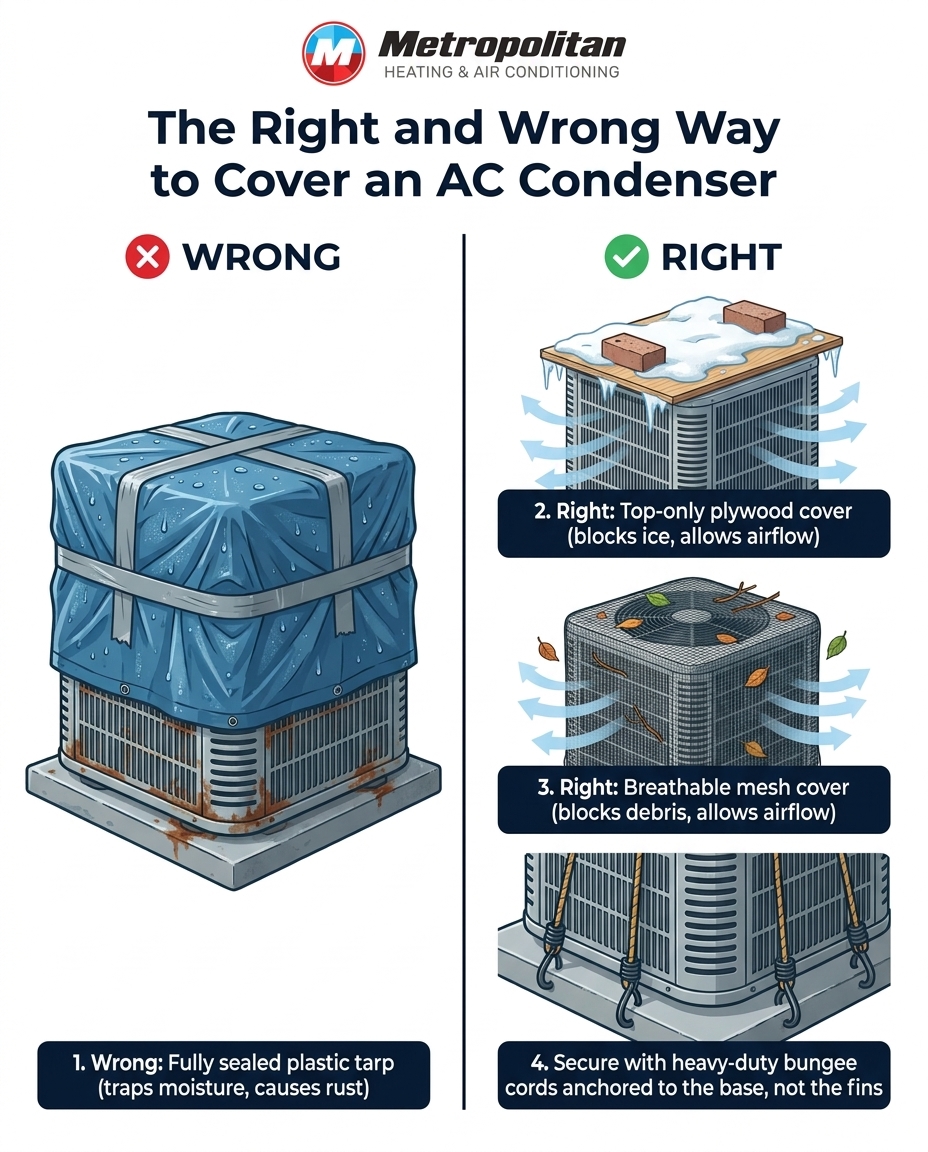
Our team considers top-only protection the gold standard for units exposed to winter ice storms and high winds. A simple piece of heavy plywood, cut to extend slightly past the edges of the unit, provides incredible defense against falling ice. Alternatively, purpose-built rigid top covers or heavy-duty breathable mesh wraps offer excellent protection while maintaining the cross-ventilation necessary to keep the internal components dry.
• Solid Plywood (Top Only) — Protection Level: Excellent against falling ice and heavy snow loads. — Airflow Capability: Maximum. Sides remain completely open for cross-ventilation. — Final Verdict: Highly Recommended. The safest, most effective method for high-wind areas.
• Breathable Mesh Cover — Protection Level: Good against leaves, twigs, and blowing snow. — Airflow Capability: Moderate to High. Allows moisture to evaporate naturally. — Final Verdict: Recommended. Great for keeping debris out while preventing rust.
• Non-Breathable Plastic Tarp — Protection Level: Blocks all external moisture and debris. — Airflow Capability: Zero. Traps ground condensation inside the unit. — Final Verdict: Not Recommended. Accelerates galvanic corrosion and destroys coils.
Step 3: Tie-Down Strategies for High-Velocity Wind Gusts
Having the right cover is only half the battle; keeping it attached during a severe gale is the other. The Pickering lakefront frequently experiences intense wind velocity data, and our technicians have seen winter storm gusts easily capable of lifting loose covers and turning them into destructive sails.
Addressing the challenge of severe wind events requires robust tie-down strategies. Loose ropes, twine, or placing heavy rocks on top of a piece of plywood are inadequate solutions that often fail during the first major blizzard.
• Use heavy-duty hardware: Opt for thick, weather-resistant bungee cords or ratcheting nylon straps. These materials maintain tension even when the temperature drops well below freezing, ensuring your cover does not shift.
• Anchor to the solid base: When hooking your straps, look for the solid steel base pan at the very bottom of the condenser. Hook the ends securely into the designated drainage holes or structural lips.
• Avoid the delicate fins: Never, under any circumstances, hook a bungee cord directly into the thin aluminum fins that wrap around the sides of the unit. The tension from the cord, combined with the vibration of the wind, will crush the fins, severely restricting airflow and damaging the system's efficiency.
• Prevent flapping: Ensure the cover is taut. A loose, flapping mesh cover or tarp acts like sandpaper against the painted exterior of the condenser. Over a long winter, this constant friction will strip the paint down to bare metal, inviting exterior rust.
Step 4: Safely Powering Down the Condenser
The final step in exterior winterization is a critical safety measure that protects the mechanical heart of your system: the compressor. While internal electrical modifications always require a licensed professional, safely turning off the exterior power disconnect is a standard homeowner-level task we highly recommend to prevent accidental activation during the winter months.
Locate the disconnect box: Look for a small, weatherproof metal box mounted on the exterior siding of your home, usually within a few feet of the condenser. This is the electrical disconnect switch.
Flip the switch: Open the lid of the box. Inside, you will typically find either a simple toggle switch or a pull-out disconnect block. Flip the switch to the "off" position, or pull the block out, flip it upside down to the "off" orientation, and reinsert it. Close the weatherproof lid securely.
Why this matters: Winter ice storms and high winds are often punctuated by random, unseasonably warm days. If your thermostat is accidentally switched to "cool," or if a smart thermostat runs a diagnostic cycle on a warm January afternoon, the AC will try to turn on. If the unit is covered by plywood or mesh, or if the fan blades are frozen solid in a block of ice, the compressor will strain against the restriction and rapidly burn itself out. Powering down at the exterior disconnect box is a completely safe, non-invasive step that guarantees the equipment remains dormant until you are ready to remove the covers in the spring.
Frequently Asked Questions About Winter AC Protection
Should I cover my AC unit in winter?
Yes, but only the top. Covering the top of the unit protects the internal fan motor and grille from falling ice and heavy snow accumulation along the Pickering lakefront, while leaving the sides open ensures proper airflow.
What happens if I wrap my AC in plastic?
Wrapping your AC in a non-breathable plastic tarp traps ground moisture inside the casing. We consistently see this trapped condensation lead to rapid galvanic corrosion, rusting out electrical components and delicate copper coils long before spring arrives.
How do you protect an AC condenser from ice?
The most effective method is using a rigid, top-only cover, such as a piece of secured plywood. This acts as a physical shield against falling icicles from your roof eaves without suffocating the unit.
Do I need to turn off AC power in winter?
Absolutely. Turning off the power at the exterior electrical disconnect box prevents the system from accidentally turning on during an unseasonably warm day, which could destroy the compressor if the unit is covered or frozen solid.
How do I secure an AC cover against high lakefront winds?
Use heavy-duty, weather-resistant bungee cords or ratcheting straps. Anchor the hooks securely to the solid metal base pan of the condenser, ensuring the cover is taut enough that it won't flap and scrape the paint.
Can trapped moisture ruin my AC condenser coils?
Yes. When moisture is trapped inside a covered unit, it acts as an electrolyte between the dissimilar metals of the coils and fins. This causes accelerated corrosion, leading to severe structural decay and potential refrigerant leaks.
Ensure Your Cooling System Survives the Winter Freeze: The Exact Process for Winterizing an AC Condenser in High-Wind Areas of Pickering
Preparing your exterior equipment for the harsh realities of the Pickering lakefront doesn't have to be complicated, but it does require precision. Using breathable covers, establishing a clear perimeter, employing heavy-duty tie-downs, and safely disconnecting the power is the safest way to protect an AC unit from the elements. There is a profound peace of mind that comes from knowing your condenser is shielded from brutal ice storms without slowly suffocating under a layer of trapped moisture and plastic.
Don't wait for the first major blizzard to assess your exterior equipment. If you are unsure about the condition of your system or want a professional eye to ensure everything is mechanically sound before the deep freeze sets in, reach out to our team at Metropolitan Heating & Air Conditioning for comprehensive Pickering HVAC services. Schedule your seasonal assessment today to guarantee that your cooling system is fully protected, properly winterized, and ready to perform flawlessly when the warm weather finally returns.
Schedule Expert Service
Or Contact Us
Other Blogs
testimonials
hear what our satisfied clients have to say

where we operate
Service areas

contact us
Let’s get in touch!