
The Truth About Thermostat Upgrades and Heating Efficiency
Upgrading your home's climate controls is often treated as a magic bullet for high utility costs, but simply screwing a new piece of plastic to the wall does not automatically guarantee lower energy consumption. Homeowners frequently ask about Smart Thermostats vs. Programmable Thermostats: Which Actually Lowers Your Heating Bill? The truth is that determining if the AI learning features, geofencing, and remote sensors of a smart thermostat actually reduce winter heating consumption compared to a strictly scheduled programmable thermostat requires looking beyond the marketing hype.
Many homeowners struggle to determine if advanced automation features translate to real-world energy reduction during the unpredictable Scarborough winter heating season. The core decision point comes down to deciding whether the higher upfront cost of a smart unit is justified over a standard programmable model for your specific household routine and existing heating equipment. To ensure your upgrade truly improves your overall HVAC system efficiency, you need an objective, hype-free breakdown of how these different technologies actually interact with your furnace.
The Reality of Programmable Thermostats: Rigid Schedules and Manual Holds
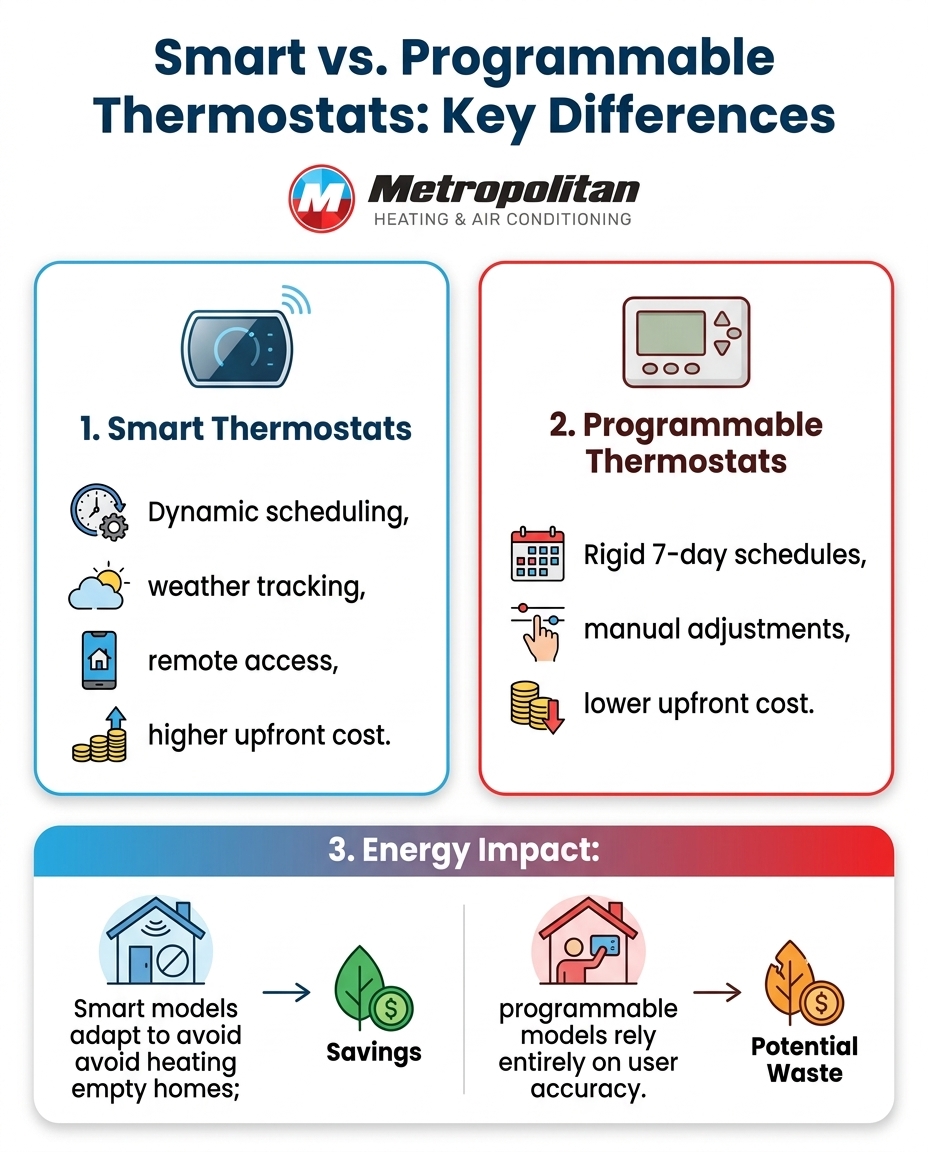
Programmable thermostats were the original solution to reducing energy waste, operating on a very simple premise: your heating system should not run at full capacity when you are asleep or away from home. These devices rely entirely on user-defined, rigid schedules to dictate when the temperature should drop (a setback) and when it should recover to a comfortable level.
A typical programmable thermostat offers a few standard scheduling formats for Scarborough homes:
• 7-Day Programming: Allows for a unique heating schedule for every single day of the week, ideal for highly varied routines.
• 5-2 Day Programming: Offers one consistent schedule for Monday through Friday, and a separate schedule for the weekend.
• 5-1-1 Day Programming: Provides a weekday schedule, plus distinct, separate schedules for Saturday and Sunday.
While the theory behind these rigid setbacks is sound, the real-world execution often falls short due to human error. In our years of servicing HVAC systems across Scarborough, the team at Metropolitan Heating & Air Conditioning consistently sees that a significant percentage of users find traditional programmable thermostats difficult to configure. Instead of navigating confusing menus to adjust for a day off work or an unusually cold afternoon, many homeowners simply press the "Hold" button. This overrides the programmed schedule entirely, effectively turning the device back into an old-fashioned manual thermostat and eliminating any potential energy savings.
Furthermore, a programmable thermostat only saves energy if the household maintains a highly predictable, unchanging routine. If your schedule fluctuates, rigid setbacks can sometimes cause the heating system to overwork if the pre-set recovery time doesn't align with sudden weather changes. When these rigid systems fail to maintain comfort, seeking professional heating services can help assess whether the issue is the thermostat's programming or an underlying mechanical fault.
How Smart Thermostats Handle Deep Winter Freezes
Where traditional programmable models rely on strict, unchanging clocks, smart thermostats utilize advanced AI and learning algorithms to dynamically manage your home's climate. One of the most significant advantages of this technology is its ability to execute precise temperature recovery algorithms—often referred to as "early start" features—during the harsh Scarborough winter heating season.
A standard programmable thermostat is reactive. If it is programmed to reach 21°C by 6:00 AM, it simply turns the furnace on at 6:00 AM. On a mild day, the house might warm up in twenty minutes. On a bitterly cold day, the house might remain chilly until 7:30 AM. Smart thermostats, however, are proactive. They spend their first few weeks learning the exact thermal mass of your specific home—calculating exactly how long it takes to heat up your square footage by a single degree.
By utilizing Wi-Fi weather tracking, a smart thermostat monitors incoming cold fronts. If a severe temperature drop is forecasted overnight, the thermostat will proactively adjust the heating cycle, starting the furnace earlier and running it at a more gradual, efficient pace to ensure the home reaches the target temperature precisely on time.
When extreme cold hits, heating systems endure immense strain. In one local instance our technicians responded to, a property's rooftop furnace completely failed during a brutal stretch of winter weather with a -30 windchill. While a new unit was successfully installed by the next business day to restore heating, this scenario highlights how hard equipment works during deep freezes. Smart thermostats help mitigate this mechanical strain. By optimizing gradual heating rather than forcing the furnace to run at maximum capacity to recover from a deep, rigid temperature setback, the system experiences less wear and tear while maintaining consistent comfort.
Geofencing and Remote Access: Adapting to Real-Time Schedules
The modern household rarely operates on the strict 9-to-5 schedule that traditional programmable thermostats were designed to accommodate. Shift work, hybrid remote working arrangements, and unpredictable after-school activities mean that a house might be empty on a Tuesday afternoon or fully occupied on a Thursday morning. This is where location-based automation—known as geofencing—dramatically impacts energy consumption for Scarborough homes.
How Geofencing Works:
• Establishing a Perimeter: The smart thermostat app uses the GPS location of the smartphones belonging to the household members to create a virtual boundary (a geofence) around the property.
• Detecting Vacancy: When the last smartphone crosses the boundary and leaves the neighborhood, the thermostat automatically enters an energy-saving "Away" mode, dialing back the heat.
• Proactive Recovery: When the first smartphone re-crosses the boundary on the way home, the thermostat detects the return trip and begins heating the house before the occupant even walks through the front door.
This dynamic adjustment eliminates the energy waste of heating an empty house when schedules unexpectedly change. If you are asked to stay late at the office, a programmable thermostat will blindly heat your empty living room to 21°C at 5:00 PM. A smart thermostat, realizing you haven't breached the geofence, will keep the heating system in its efficient setback mode until you actually begin your commute.
Additionally, the value of remote access via mobile apps cannot be overstated. The ability to make instant adjustments from the couch, the office, or the airport without needing to interact with the physical wall unit ensures that homeowners remain actively engaged with their energy consumption, leading to greater real-world efficiency gains than rigid 7-day programming.
System Compatibility: Matching the Thermostat to Your Furnace
A common misconception is that a premium smart thermostat will automatically force an old, inefficient furnace to perform better. In reality, thermostat efficiency is heavily dependent on the existing HVAC equipment. Pairing a high-end thermostat with an incompatible or failing furnace will not yield the expected utility savings for Scarborough homes.
One of the primary technical requirements for most modern smart thermostats is a C-wire (common wire). This wire provides continuous 24-volt power to the thermostat's Wi-Fi radio and digital display. Many older homes lack this specific wire. While some workarounds exist, forcing a smart thermostat to run without proper continuous power can lead to dropped connections and erratic furnace cycling. Professional assessment is crucial to determine if new thermostat wiring needs to be pulled through the walls.
More importantly, the interaction between thermostat types and specific furnace stages dictates overall efficiency. Furnaces generally come in single-stage, two-stage, or modulating varieties. Understanding the cost comparison of single-stage vs. two-stage furnaces is vital, as an advanced smart thermostat acts as a precise conductor for a two-stage system. It can intelligently command the furnace to run in its lower, more energy-efficient stage for longer periods, providing a low-and-slow heat that maintains perfect comfort without the energy-heavy on/off cycling of a single-stage unit.
System compatibility is critical before the cold sets in. In a typical scenario our team handles during the fall with cooler weather approaching, one of our technicians will quickly and efficiently repair a failing furnace so it is fully operational for winter. That same proactive, evaluative approach applies to thermostat upgrades. Working with an honest, local expert ensures your home's specific layout and existing HVAC equipment are thoroughly assessed to recommend the right thermostat, rather than simply upselling you on the most expensive gadget on the market.
Side-by-Side Comparison: Smart vs. Programmable Capabilities
To make the best decision for your household during the Scarborough winter heating season, it helps to view the capabilities of both technologies side-by-side. While both aim to reduce utility consumption, their methods and upfront costs differ significantly.
• Core Technology — Programmable Thermostats: Rigid, time-based scheduling — Smart Thermostats: AI learning, Wi-Fi, and geofencing
• User Intervention — Programmable Thermostats: Requires manual programming and updates — Smart Thermostats: Set-and-forget automation after learning phase
• Energy Tracking — Programmable Thermostats: Basic current-temperature displays only — Smart Thermostats: Detailed monthly energy reports and usage dashboards
• Weather Adaptation — Programmable Thermostats: None (reacts only to indoor temperature) — Smart Thermostats: Proactive adjustments based on local weather forecasts
• Initial Investment — Programmable Thermostats: Budget-friendly upfront cost — Smart Thermostats: Higher premium upfront cost
When to Choose a Programmable Thermostat
• Highly Predictable Routines: Ideal for households where occupants leave and return at the exact same time five days a week without fail.
• Budget-Conscious Upgrades: Best for situations where keeping the initial installation cost as low as possible is the primary goal, and advanced Wi-Fi features are not desired.
• Simple Heating Needs: Sufficient for basic single-stage furnaces where advanced staging control is not required.
When to Upgrade to a Smart Thermostat
• Fluctuating Schedules: Ideal for multi-user households, shift workers, and those who frequently work from home or travel unpredictably.
• Multi-Stage Equipment: Best for maximizing the efficiency and comfort levels of two-stage or modulating heating equipment.
• Data-Driven Homeowners: Perfect for those who want detailed energy reports to actively track and reduce their carbon footprint and utility consumption over time.
Navigating Utility Incentives and Energy Programs
One factor that can heavily influence the decision between these two technologies is the availability of energy programs designed to offset initial installation costs. Because Energy Star certified smart thermostats are proven to reduce overall heating runtime through optimized scheduling and geofencing, many government and utility organizations actively encourage their adoption.
Provincial utility incentive programs frequently offer generic rebates for upgrading to qualifying smart models in Scarborough homes. These programs recognize that widespread adoption of smart climate controls reduces the overall strain on the energy grid during peak winter months. However, these incentives are rarely applicable to basic programmable models.
Because these programs frequently update their funding pools and qualifying equipment lists, homeowners are strongly advised to verify current programs, eligibility criteria, and deadlines directly with their local utility provider before making a purchase. Furthermore, many of these incentives stipulate that the equipment must be installed by a licensed contractor. Professional installation not only ensures compliance with rebate requirements but also guarantees proper system integration and safe electrical wiring, protecting the lifespan of your furnace.
Choose the Right Thermostat Upgrade with Local Expertise
While smart thermostats offer superior dynamic adjustments, extreme cold recovery, and unparalleled convenience, the right choice ultimately depends on your household's lifestyle and the capabilities of your existing HVAC equipment. A basic programmable unit can still serve a highly structured household well, but for most modern families, the adaptive nature of a smart thermostat provides a much more reliable path to reduced energy consumption.
To ensure that your investment actually translates into lower utility bills for your Scarborough homes, professional assessment is non-negotiable. Connecting a high-tech thermostat to a failing furnace will not solve underlying mechanical inefficiencies. By consulting with our Scarborough heating experts at Metropolitan Heating & Air Conditioning, you receive an honest evaluation of your home's heating infrastructure, ensuring your next upgrade delivers the lasting comfort and efficiency you deserve.
Frequently Asked Questions
What is the exact difference between programmable and smart thermostats?
The exact difference lies in automation and connectivity. A programmable thermostat relies on rigid, manual schedules inputted by the user to adjust temperatures. A smart thermostat connects to Wi-Fi, uses learning algorithms to study your habits, tracks local weather, and automatically adjusts the temperature based on your real-time location and preferences.
Do smart thermostats actually save money on winter heating bills?
Yes, smart thermostats can effectively lower energy consumption when paired with compatible equipment. They achieve this by eliminating the energy wasted on heating empty homes and by using proactive recovery algorithms that run the furnace more efficiently during deep freezes. However, the exact reduction in your utility bill depends heavily on your home's insulation and the condition of your furnace.
Is it worth upgrading to a smart thermostat if I have an older furnace?
Upgrading can be worth it for the convenience of remote access and geofencing, but an older furnace may limit the potential efficiency gains. A smart thermostat cannot fix mechanical wear and tear or force a single-stage, aging furnace to operate like a modern, high-efficiency unit. A professional evaluation should be done to ensure the older control board can even communicate with a modern smart device.
Does turning down the thermostat at night really save money?
Yes, setting back the temperature at night reduces the total amount of thermal energy your home loses to the cold outdoors, which means your furnace runs less frequently overall. The temporary energy required to reheat the house in the morning is almost always less than the energy that would have been spent maintaining a high temperature all night long. Smart thermostats optimize this morning recovery to make it as efficient as possible.
Do I need a C-wire to install a smart thermostat in my home?
In most cases, a continuous C-wire (common wire) is required to provide stable, 24-volt power to the Wi-Fi radio and digital screen of a smart thermostat. While some models offer power-extender kits or claim to run on batteries, lacking a dedicated C-wire often leads to dropped connections and erratic furnace behavior. A licensed technician can usually pull new wire or install an adapter safely.
How does geofencing work for home heating control?
Geofencing uses the location services on your smartphone to create a virtual perimeter around your property. When you and your phone leave that perimeter, the thermostat detects that the house is empty and automatically switches to an energy-saving mode. When you cross back into the perimeter on your way home, it triggers the furnace to begin heating so the house is comfortable by the time you arrive.
Schedule Expert Service
Or Contact Us
Other Blogs
testimonials
hear what our satisfied clients have to say

where we operate
Service areas
contact us
Let’s get in touch!