

Is a Two-Stage Furnace Worth the Investment for Ontario Homeowners?
Are you struggling to choose between standard and premium heating tiers when deciding on a single-stage vs. two-stage furnaces for Toronto winters: a direct cost comparison? Upgrading your home's heating system is a major decision, and most homeowners quickly run into a concrete problem: trying to balance a higher initial investment against the promise of long-term utility savings. You know you need reliable warmth, but deciding whether the operational efficiency of a two-stage system justifies its premium over a standard single-stage unit can feel overwhelming without objective data.
For comprehensive heating services and guidance, understanding how these systems operate is the first step toward making a confident choice. The fluctuating Toronto winter—which swings violently from a deep freeze one week to a mild shoulder season the next—demands a lot from your heating equipment. If you are planning to stay in your home for the next decade or longer, the relative cost comparison between these two technologies becomes less about the upfront installation and more about long-term natural gas consumption. We will break down exactly how these systems differ mechanically and financially, helping you determine which tier aligns best with your homeownership goals.
Under the Hood: Single-Stage vs. Two-Stage Mechanics Explained
To understand the financial and comfort differences between these systems, you have to look under the hood at the core mechanics of two-stage vs single-stage gas valves. The gas valve is the heart of your furnace, dictating exactly how much fuel is burned and how intensely the system operates during a heating cycle.
The Single-Stage Mechanism
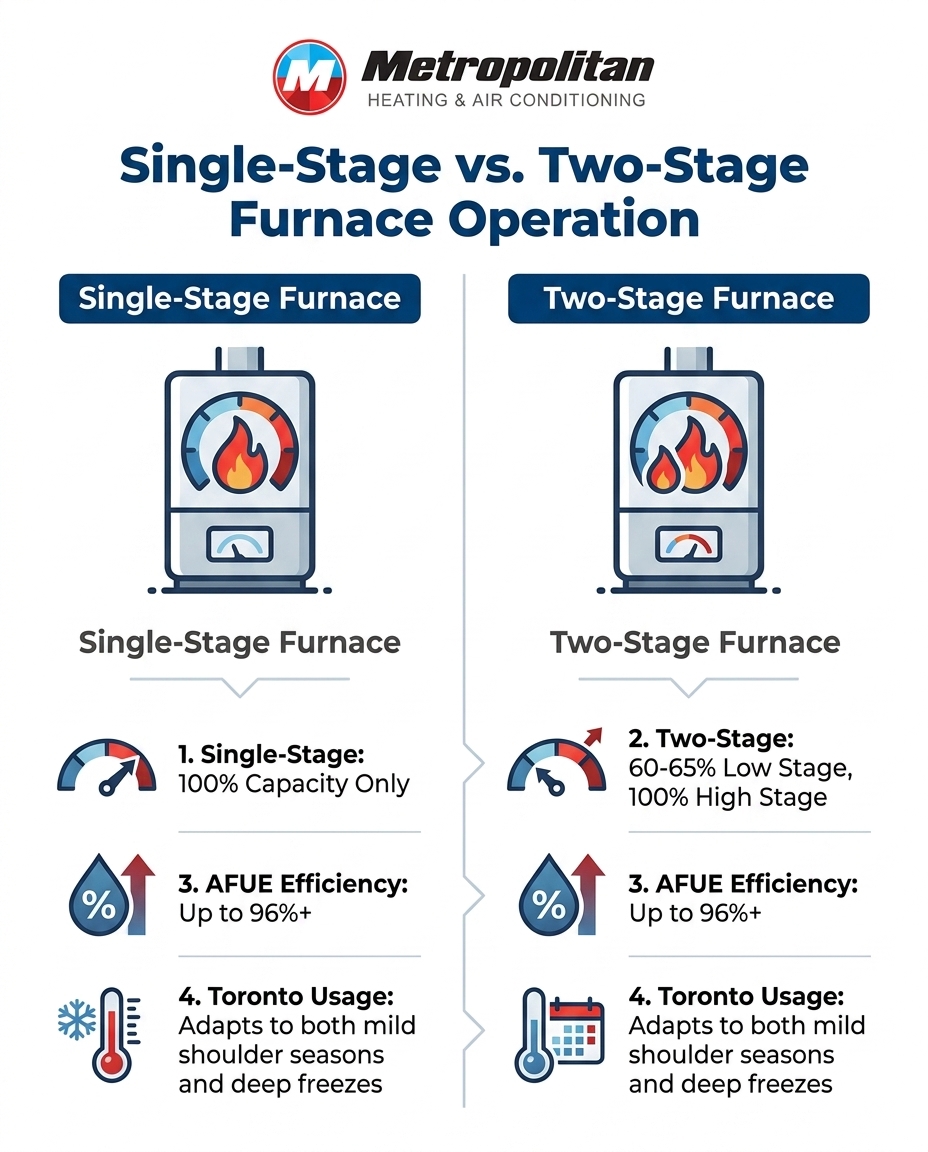
A single-stage furnace is straightforward: it has exactly one operational speed. Whenever your thermostat calls for heat, the gas valve opens to 100% capacity. The furnace fires up at maximum output, blasts hot air into your living spaces until the target temperature is reached, and then shuts down completely. Think of it like driving a car with a gas pedal that only has two positions: fully released or pushed entirely to the floor. While this mechanism is incredibly reliable and time-tested, it leads to frequent on-and-off cycling, which can create noticeable temperature swings and put extra wear and tear on mechanical components like the blower motor and heat exchanger.
The Two-Stage Advantage
A two-stage furnace, by contrast, features a gas valve with two distinct output levels: a low setting and a high setting. During the vast majority of the heating season, the furnace operates on its first stage, which typically utilizes only 60% to 65% of its total capacity. If the outdoor temperature drops significantly and the first stage cannot keep up with the thermostat's demand, the system automatically kicks into the 100% capacity second stage to bridge the gap.
The mechanical benefits of this two-stage approach include:
• Reduced mechanical stress: Longer, lower-capacity run times reduce the harsh start-and-stop wear and tear on the system's internal components.
• Fewer ignition cycles: Because the system runs continuously at a lower speed, the igniter and gas valve do not have to engage and disengage as frequently.
• Gentler heat delivery: The lower stage provides a steady, gentle flow of warmth rather than a sudden, overwhelming blast of hot air.
A Secondary Benefit: Enhanced Air Filtration
Beyond simply heating your home, the mechanics of a two-stage system offer a significant secondary benefit for your family's health. Because the blower motor runs for longer durations at a lower speed, your home's air is continuously circulating through the furnace filter. This frequent air turnover captures more dust, dander, and airborne particulates. If you are looking to improve indoor air quality and HVAC filtration, the longer operational cycles of a two-stage unit provide vastly superior air scrubbing compared to a single-stage unit that sits idle for long stretches.
The Toronto Climate Test: Deep Freezes vs. Shoulder Seasons
The true value of a two-stage gas valve becomes incredibly apparent when you evaluate it against the fluctuating Toronto winter. Southern Ontario is notorious for its unpredictable weather patterns, which essentially force your heating system to perform two completely different jobs depending on the month.
Navigating the Unpredictable Shoulder Seasons
During the shoulder seasons of November and March, daytime temperatures often hover just a few degrees above freezing. The heating load required to keep a home comfortable during these weeks is relatively mild. When a single-stage furnace activates in November, its 100% capacity output is massive overkill. It quickly overheats the immediate space, satisfies the thermostat in a matter of minutes, and shuts down. This phenomenon, known as short-cycling, wastes natural gas and leaves the home feeling stuffy and unevenly heated.
A two-stage furnace is tailor-made for these mild weeks. By operating almost exclusively on its 60-65% low stage, it perfectly matches the mild heating load of a Toronto shoulder season. It sips natural gas, runs quietly in the background, and maintains a perfectly even temperature without ever needing to engage its high gear.
Conquering January Polar Vortexes
Of course, a Toronto winter inevitably brings severe cold snaps. When the January polar vortex arrives and overnight temperatures plummet below -15°C, that 60% capacity will no longer suffice. This is when the two-stage furnace seamlessly shifts into its 100% capacity second stage, delivering the intense, heavy-duty heating power required to combat a deep freeze.
Real-world adaptability in action: One Toronto homeowner experienced this firsthand when their rooftop furnace failed during a severe winter cold spell. Because they needed emergency service during the coldest stretch of weather, a technician was dispatched to evaluate the system, and a new, adaptable unit was installed the next business day, restoring reliable heat when it mattered most. Having a system that adapts to extreme cold without wasting energy during mild weeks provides unparalleled peace of mind.
Relative Cost Comparison: Initial Investment vs. Long-Term Utility Savings
Evaluating the financial return on investment (ROI) for a heating upgrade requires looking past the initial installation day. While we cannot predict future utility markets, we can break down the relative cost comparison based on natural gas consumption rates and operational efficiency.
The Initial Investment: There is no avoiding the fact that a two-stage system requires a higher upfront installation investment compared to a baseline single-stage unit. The internal components—specifically the two-stage gas valve and the variable-speed blower motor that typically accompanies it—are more complex and sophisticated to manufacture and install. If your primary goal is the absolute lowest day-one cost, a single-stage unit will always win that specific metric.
The Long-Term Utility Savings: The financial equation flips when you look at the system's lifespan. Modern high-efficiency two-stage furnaces frequently achieve Annual Fuel Utilization Efficiency (AFUE) ratings of 96% or higher. An AFUE rating of 96% means that 96 percent of the natural gas consumed is successfully converted into usable heat for your home, with only 4 percent lost as exhaust. Because a two-stage system spends the majority of its life operating at that highly efficient 60-65% capacity, the reduction in overall natural gas consumption is substantial.
As a leading provider of Toronto HVAC services, Metropolitan Heating & Air Conditioning consistently advises homeowners to consider Ontario's specific utility landscape. With regional natural gas rates and evolving carbon pricing initiatives, the cost of consuming fossil fuels is a major factor in home overhead. A system that actively reduces your monthly gas consumption acts as a long-term hedge against rising utility costs. Furthermore, high-efficiency heating upgrades often qualify for generic energy rebates or utility incentive programs. While you should always verify current local programs and tax credits with your utility provider, these incentives can significantly offset the premium of a two-stage upgrade.
Comfort and Consistency: Eliminating Cold Spots in Older Homes
While financial ROI is important, the day-to-day experience of living in the home is often the deciding factor for our clients. This is especially true for older homes in the Toronto and Scarborough areas, which frequently suffer from aging ductwork, imperfect insulation, and drafty windows.
The Problem with Single-Stage Heating in Older Homes
In a home with older ductwork, a single-stage furnace often exacerbates existing comfort issues. Because the system fires at 100% capacity and shuts off quickly, the heated air does not have enough time to reach the furthest corners of the house. This creates a frustrating cycle: sudden blasts of hot air near the vents, followed by rapid cooling as soon as the system shuts down. The result is a home plagued by noticeable cold spots, particularly in upstairs bedrooms or additions located far from the furnace room.
The Two-Stage Comfort Solution
The gentler, continuous airflow of a two-stage gas valve solves this stratification problem. Because the system runs longer on its lower setting, it has the time required to push warm air completely through the duct network, reaching those distant rooms and mixing the ambient air more evenly. This continuous circulation virtually eliminates cold spots and prevents the temperature from fluctuating wildly between cycles.
Consider the experience of another local customer who reached out in the spring to replace a 28-year-old, leaking furnace. During the neat and tidy installation process, the technicians took the time to explain exactly how their new system would operate differently than the aging unit, answering all their questions about the upgraded mechanics. That customer immediately noticed how much quieter and more consistent the new system was.
Indeed, noise reduction is a major comfort benefit. Because the lower stage operates with significantly less force, it is vastly quieter than a single-stage system firing at full blast. If your furnace room is located near a living space or bedroom, upgrading your furnace installation to a two-stage model can drastically reduce the distracting operational noise that echoes through your vents.
Feature Comparison Matrix: Single-Stage vs. Two-Stage
To help synthesize the mechanical and financial differences, we have compiled a direct feature comparison matrix. This scannable breakdown highlights how these two technologies stack up across the criteria that matter most to Ontario homeowners.
• Initial Investment — Single-Stage Furnace: Lower upfront installation requirement. — Two-Stage Furnace: Higher premium for advanced components.
• Operational Capacity — Single-Stage Furnace: 100% output only (On/Off). — Two-Stage Furnace: 60-65% Low Stage / 100% High Stage.
• Energy Efficiency (AFUE) — Single-Stage Furnace: Standard high efficiency (often 95-96%). — Two-Stage Furnace: Maximized high efficiency (up to 96%+ with reduced gas waste).
• Temperature Consistency — Single-Stage Furnace: Prone to temperature swings and cold spots. — Two-Stage Furnace: Even, continuous heating with excellent air mixing.
• Ideal Toronto Season Usage — Single-Stage Furnace: Struggles with short-cycling in mild shoulder seasons. — Two-Stage Furnace: Adapts perfectly to both mild autumns and deep winter freezes.
• Operational Noise — Single-Stage Furnace: Noticeable "whoosh" when firing at maximum capacity. — Two-Stage Furnace: Whisper-quiet operation during the majority of the low-stage cycle.
Frequently Asked Questions About Furnace Staging
Is a two-stage furnace worth the extra investment in Ontario?
Yes, for homeowners planning to stay in their property long-term, the utility savings and comfort improvements typically justify the initial premium. Because Ontario experiences long winters with varying degrees of cold, the mechanical adaptability of a two-stage system prevents the energy waste associated with short-cycling. Over a 15- to 20-year lifespan, the reduction in natural gas consumption helps offset the higher upfront installation requirement.
Does a two-stage furnace save on monthly gas bills?
Yes, by operating at 60-65% capacity during milder weather, it consumes less natural gas than a system firing at 100% every cycle. Instead of blasting maximum heat and shutting down repeatedly, the furnace sips fuel to maintain a steady baseline temperature. This optimized AFUE efficiency percentage translates directly to reduced gas consumption during the lengthy autumn and spring shoulder seasons.
Why does a two-stage furnace run longer?
It runs longer on a lower setting to provide gentle, continuous heat, which is actually more efficient than rapidly cycling on and off. Just as a car gets better gas mileage cruising steadily on the highway rather than stopping and starting in city traffic, a furnace operates more efficiently when it runs continuously at a lower capacity. This longer runtime also allows the system to filter your indoor air more thoroughly and mix the ambient air to eliminate cold spots.
What is the difference between single and two-stage heating?
A single-stage has one speed (high), while a two-stage has a low and high speed to adapt to current temperature demands. The single-stage gas valve opens fully every time the thermostat calls for heat, delivering 100% capacity regardless of whether it is slightly chilly or freezing outside. The two-stage gas valve defaults to a lower, fuel-conserving setting and only utilizes its maximum capacity when severe weather dictates the need for extra power.
Are two-stage furnaces quieter?
Yes, because they spend the majority of their time running on the lower, less powerful stage, producing less airflow noise. The sudden, loud "whoosh" of air rushing through the vents is a hallmark of a single-stage system kicking into high gear. By contrast, the 60% capacity operation of a two-stage unit creates a gentle, whisper-quiet airflow that most homeowners barely notice running in the background.
Secure Reliable Winter Comfort for Your Toronto Home
Ultimately, when evaluating single-stage vs. two-stage furnaces for Toronto winters: a direct cost comparison, the right choice depends entirely on your homeownership timeline and comfort goals. While single-stage units are incredibly reliable and require a lower initial investment, two-stage systems offer undeniably superior indoor comfort and optimized natural gas efficiency for Toronto's unique, fluctuating climate. If you are tired of battling cold spots, excessive operational noise, and the energy waste of short-cycling during the shoulder seasons, upgrading to a two-stage unit is a highly recommended long-term solution. To determine exactly which tier fits your home's ductwork and your family's needs, reach out to the Scarborough heating experts at Metropolitan Heating & Air Conditioning to book an objective, professional evaluation today.
Schedule Expert Service
Or Contact Us
Other Blogs
testimonials
hear what our satisfied clients have to say

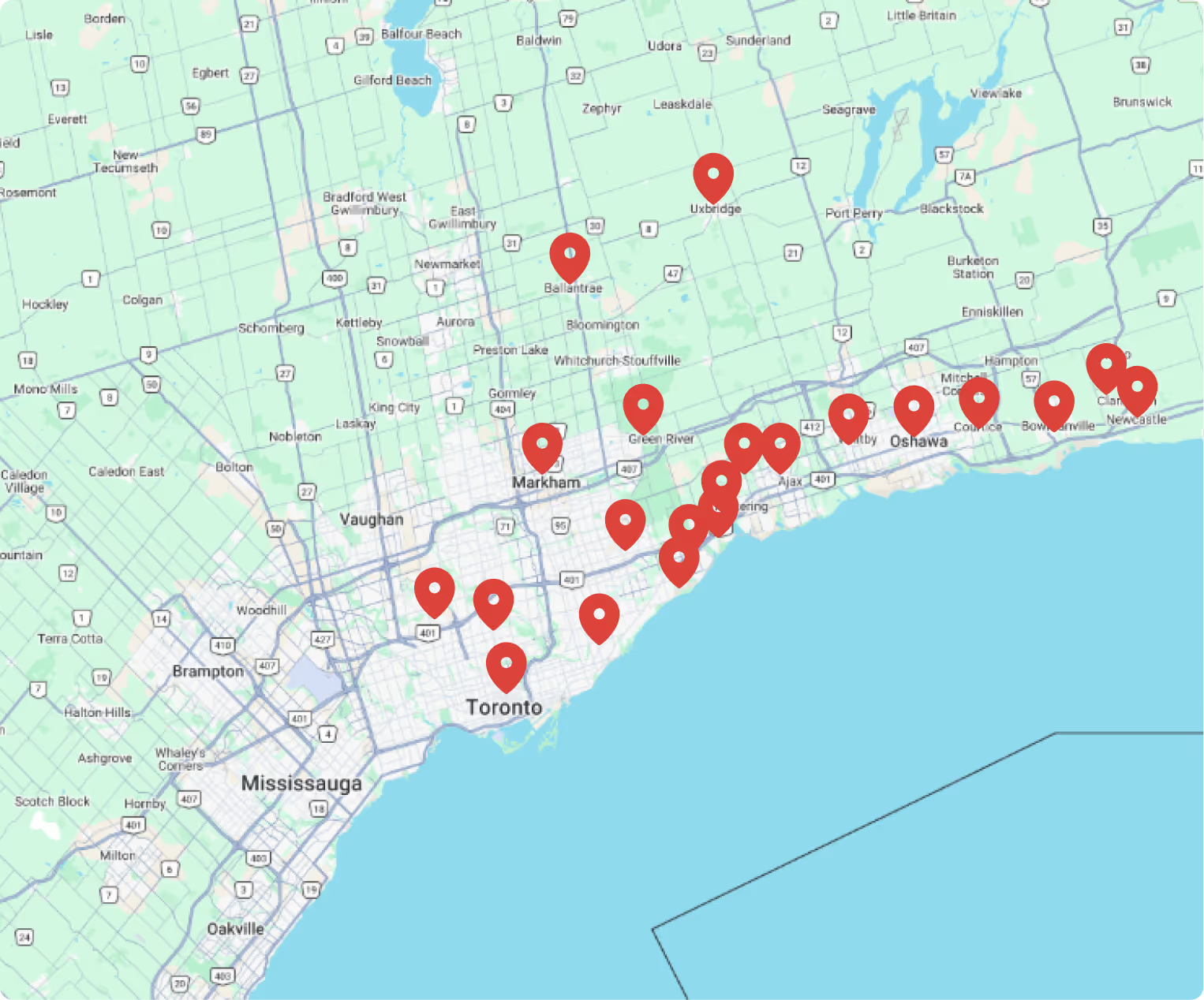
where we operate
Service areas
contact us
Let’s get in touch!