
Battling Autumn Dampness on the Shores of Lake Ontario
If you are addressing humidity issues in Ajax lakeside properties, the struggle usually starts with a frustrating morning routine: wiping down weeping windows while trying to shake off a damp indoor chill. Here at Metropolitan Heating & Air Conditioning, our team frequently helps homeowners whose mornings begin exactly this way. As summer fades into the transitional fall months, homeowners along the water face a distinct set of indoor air quality challenges. Your thermostat might say the house is 70 degrees, but the heavy, moisture-laden air makes it feel much colder and far less comfortable.
Many homeowners find themselves at a crossroads during this season. You have to decide whether standard heating and cooling adjustments are enough to manage the moisture, or if your home requires a dedicated dehumidification strategy. In our experience, relying on basic thermostat tweaks often falls short when you live directly on the waterfront. Before you resign yourself to another season of musty odors and condensation, exploring professional indoor air quality solutions and keeping up with your AC maintenance in Ajax can make a massive difference in your daily comfort.
Why Lake Ontario Creates Unique Fall Humidity Challenges
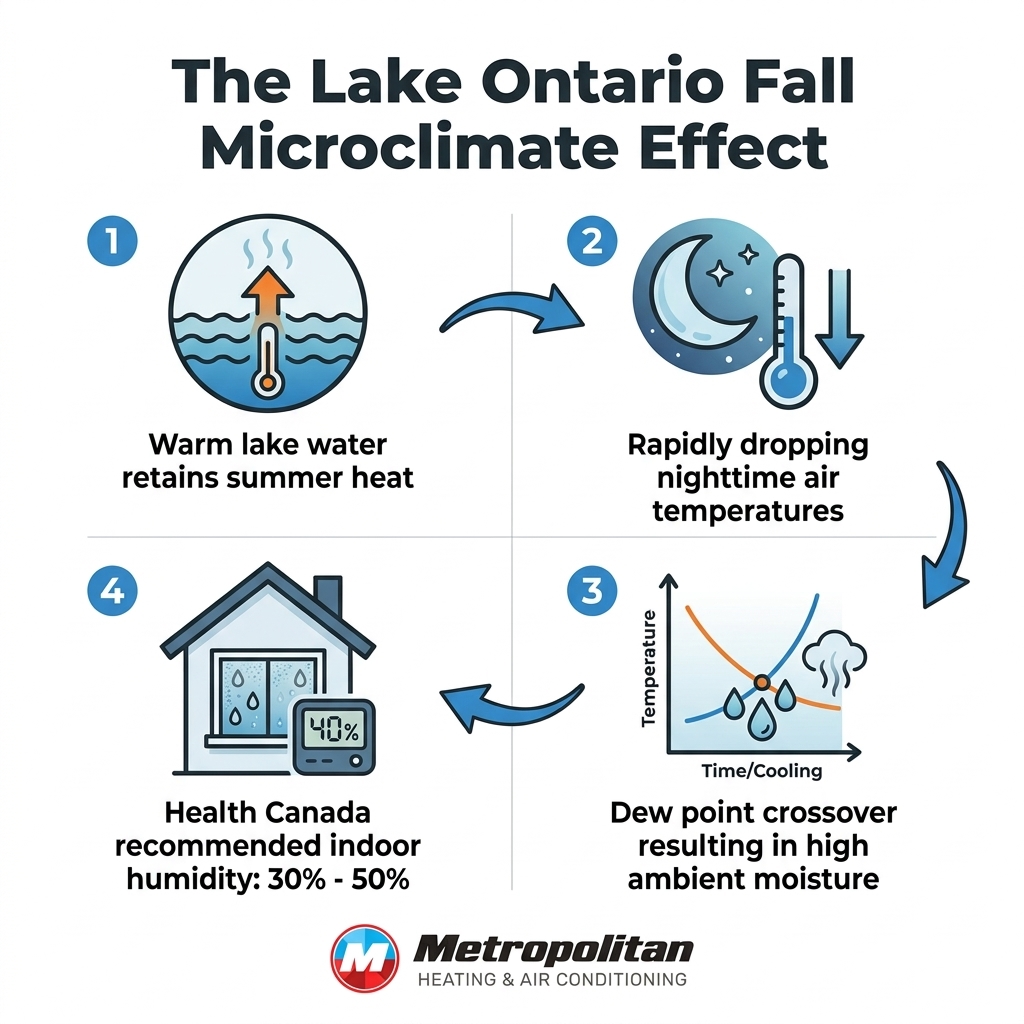
To effectively manage the moisture in your home, you have to understand the specific meteorological physics at play outside your front door. Lake Ontario acts as a massive thermal reservoir. Throughout the summer, the deep waters absorb and store an immense amount of solar heat. As the calendar flips to October and November, the ambient air temperature drops significantly, but the lake water remains relatively warm.
This temperature difference creates a highly localized microclimate. Warm breezes coming off the lake carry high levels of evaporated moisture. When this warm, humid air pushes inland and collides with rapidly dropping nighttime air temperatures around your property, the air loses its ability to hold that moisture. This dynamic drastically increases ambient outdoor humidity, which inevitably finds its way inside your house. While inland neighborhoods might experience crisp, dry autumn days, we consistently see Ajax Lakeside properties near Lake Ontario facing a constant barrage of heavy, moisture-rich air.
Generic, national-level advice often suggests simply opening a window to let the house "breathe." However, our local HVAC experts know that in a lakeside microclimate, doing so often invites more moisture indoors, entirely defeating the purpose.
The Science of Dew Point Crossovers
Understanding the dew point: The dew point is the specific temperature at which air becomes 100% saturated with water vapor. When the air cools below this threshold, the vapor condenses into liquid water.
How it affects your home: During the fall, your home's exterior walls and window panes chill rapidly after sunset. When the warm, moisture-heavy indoor air comes into contact with that cold glass, it hits the dew point instantly. This crossover is the exact phenomenon responsible for the heavy window condensation you see every morning. It is not just an annoyance; it is a clear visual indicator that your indoor air holds more water than the structure can handle.
Recognizing the Signs of Excess Moisture in Your Lakeside Home
Identifying high indoor humidity early can save you from costly structural repairs and health concerns down the road. During the transitional fall months, the symptoms often masquerade as simple seasonal changes, but paying close attention to your home's behavior is critical.
Over years of servicing Scarborough and Ajax lakeside homes, our technicians at Metropolitan Heating & Air Conditioning routinely spot these primary indicators that a property is holding onto too much moisture:
• Persistent window condensation: While a light fog on a freezing morning is normal, heavy water droplets pooling on the window sills indicate a serious humidity imbalance.
• A clammy or damp feeling: If your bedding, upholstery, or clothing feels slightly damp to the touch despite the furnace running, the air is saturated.
• Lingering musty odors: Unpleasant smells in basements, crawlspaces, or closets often point to hidden moisture accumulating in dark areas.
• Warping wood surfaces: Hardwood floors, wooden doors, and cabinetry that stick or buckle are absorbing excess water from the air.
Health Canada guidelines strongly recommend keeping indoor humidity levels between 30% and 50%. Dropping below 30% leads to dry skin and respiratory irritation, but climbing above 50% creates an environment where biological growth thrives. The risks of ignoring excess moisture are severe. Prolonged exposure to high humidity can lead to mold proliferation, degraded drywall, and structural rot.
It is important to differentiate between normal morning dew on the outside of your windows and problematic, persistent condensation on the inside of the glass. Exterior dew is a natural weather event; interior condensation means your home's air quality needs immediate professional attention.
Why Your Standard Furnace Cycle Might Not Be Enough
A common misconception is that turning up the heat will simply dry out the house. While a furnace does lower the relative humidity by raising the air temperature, it does not actually remove any water vapor from the environment. The moisture is still there, just suspended in warmer air.
During the transitional fall months, temperatures often hover in the mild 50s and 60s. Because the house does not need a massive amount of heat to reach your target temperature, your furnace will run in very short cycles. It turns on, quickly warms the space, and shuts off. These abbreviated cycles do not provide enough continuous airflow to effectively manage indoor moisture levels. A pattern we see often is homeowners constantly bumping up the thermostat to combat high humidity, resulting in an uncomfortably overheated home that still feels clammy.
This is why ensuring your entire HVAC system is fully operational and safely transitioned for the season is vital. You need equipment that responds properly to sudden cold snaps without short-cycling. Unpredictable weather demands reliable machinery. For example, our dispatch team recently helped a local homeowner who experienced an unexpected cooling failure from Thursday night to Friday morning during a warm spell. One of our technicians arrived the next morning and fixed the issue in ten minutes, ensuring the home could properly circulate and condition the air again. Whether you need sudden cooling or steady heating, system reliability is the foundation of air quality.
If you are unsure whether your system is ready for the seasonal shift, reviewing a guide on transitioning your Ajax home from AC to heat can help you identify potential cycle issues before the deep freeze sets in.
Whole-Home Dehumidification: A Necessity for Lakeside Living?
When standard heating and cooling adjustments fail to keep your windows dry, you face a significant decision point regarding dedicated dehumidification. For Ajax Lakeside properties near Lake Ontario, the moisture load often exceeds what passive ventilation can handle.
Many homeowners start with portable, room-sized dehumidifiers. While these units are fine for a single damp basement corner, our team finds they fall short when trying to manage an entire house. At Metropolitan Heating & Air Conditioning, we often recommend a whole-home dehumidifier because it integrates directly into your existing HVAC ductwork. As your system pulls air through the return ducts, it passes over the dehumidifier's specialized coils. The unit extracts the excess water vapor, drains it safely away, and sends dry, comfortable air back through your supply vents.
One of the greatest advantages of a whole-home system is that it operates independently of your cooling cycle. On a crisp, 60-degree fall day, you do not want your air conditioner running just to remove humidity. A dedicated whole-home dehumidifier pulls the moisture out without dropping the temperature, providing perfect comfort without overcooling the space.
Portable vs. Whole-Home Systems
Understanding the differences can help you make an informed decision for your lakeside property:
• Coverage Area — Portable Dehumidifier: Limited to a single room or open area. — Whole-Home Dehumidifier: Treats every room connected to the ductwork.
• Maintenance — Portable Dehumidifier: Requires daily manual emptying of heavy water buckets. — Whole-Home Dehumidifier: Drains automatically into the home's plumbing system.
• Energy Efficiency — Portable Dehumidifier: Often consumes high electricity for minimal output. — Whole-Home Dehumidifier: Highly efficient, leveraging existing HVAC airflow.
• Aesthetics & Noise — Portable Dehumidifier: Takes up floor space and generates noticeable noise. — Whole-Home Dehumidifier: Hidden away in the utility room, operating quietly.
Balancing Ventilation and Cooling for Optimal Air Quality
While dedicated dehumidification is highly effective, everyday habits and mechanical ventilation also play a large role in managing your indoor environment. Localized moisture from cooking, showering, and laundry can quickly push a balanced home into the danger zone.
The role of exhaust fans: Always run your kitchen range hood and bathroom exhaust fans when generating steam. Leave them on for at least 15 minutes after you finish cooking or showering to ensure the humid air is fully expelled from the building rather than settling on your windows.
Using AC during fall heatwaves: The transitional fall months are notorious for sudden, unseasonably warm afternoons. During these brief heatwaves, utilizing your cooling system is an excellent way to temporarily aid in dehumidification. Air conditioners naturally strip moisture from the air as a byproduct of the cooling process. When those warm fronts hit, you need your equipment to respond instantly. Another local customer recently found their AC was not working right when they needed it to clear out thick, muggy air. A Metropolitan Heating & Air Conditioning technician arrived and fixed the AC unit in under 20 minutes, proving that fast, efficient service makes all the difference for maintaining indoor air quality.
If your system struggles to keep up during these weather swings, exploring professional cooling services ensures your equipment is ready to handle sudden humidity spikes.
Finally, we advise caution about opening windows for "fresh air." If the ambient outdoor humidity is higher than your indoor humidity—which is incredibly common near the lake in autumn—opening a window will only invite more moisture inside, worsening your condensation problems.
Tailoring Your HVAC System to the Ajax Microclimate
Addressing moisture near the waterfront requires a specialized approach. Generic HVAC advice simply does not account for the heavy moisture load generated by Lake Ontario. A strategy that works perfectly for a home forty miles inland will often leave a lakeside property feeling damp and uncomfortable.
A professional assessment is necessary to determine the exact dehumidification capacity required based on your home's square footage, insulation levels, and proximity to the water. Sizing a whole-home dehumidifier is a precise science; an undersized unit will run constantly without making an impact, while an oversized unit will short-cycle and fail to properly dry the air.
Furthermore, DIY installations of whole-home systems are strongly discouraged. Integrating new equipment into existing ductwork requires a licensed technician to ensure proper static pressure, safe electrical connections, and correct drainage routing. Improper installation can damage your furnace or lead to hidden water leaks inside your walls.
Working with our team at Metropolitan Heating & Air Conditioning means you get solutions designed specifically for the Lake Ontario microclimate. Our technicians hold deep local expertise across Scarborough and the Durham Region, meaning they understand these specific environmental challenges and can configure your system to handle the heavy autumn moisture loads effectively. If you live in the area, partnering with experts in HVAC services in Ajax ensures your home is protected by professionals who know the local weather patterns inside and out.
Frequently Asked Questions About Lakeside Indoor Air Quality
How do I stop window condensation in the fall?
The most effective way to stop window condensation is to lower your indoor relative humidity. Our team recommends achieving this by running exhaust fans during showers and cooking, ensuring your HVAC system has proper airflow, and utilizing a whole-home dehumidifier. Simply wiping the windows down removes the visible water but does not solve the underlying air quality issue.
Do lake houses need dedicated dehumidifiers?
Yes, properties situated near large bodies of water generally require dedicated dehumidification, especially during seasonal transitions. The constant influx of moisture from lake breezes easily overwhelms standard air conditioning and heating cycles. A whole-home dehumidifier provides the continuous moisture removal necessary to protect the home's structure and maintain comfort.
Why does my house feel damp in the autumn?
Your house feels damp because mild autumn temperatures cause your furnace to run in very short cycles. These brief heating periods warm the air but shut off before they can circulate enough air to effectively dry out the environment. Combined with high outdoor humidity from the lake, this results in a clammy, uncomfortable indoor climate.
What is the ideal indoor humidity in Ontario?
Health Canada recommends maintaining indoor relative humidity between 30% and 50%. Staying within this range prevents the air from becoming too dry for respiratory health while keeping it dry enough to inhibit mold growth and window condensation. Monitoring this with a digital hygrometer helps you stay in the safe zone.
Does living near Lake Ontario make your house more humid?
Yes, in our experience, living near Lake Ontario significantly increases your home's exposure to ambient moisture. The lake retains summer heat well into the fall, and when cool autumn air blows across the warm water, it absorbs massive amounts of evaporation. This heavy, humid air is then pushed directly into coastal neighborhoods.
Why isn't my furnace removing the moisture from the air?
Furnaces are designed to add heat, not to actively extract water vapor. While heating the air lowers the relative humidity percentage by expanding the air's capacity to hold water, the physical moisture remains inside the house. To actually remove the water, you need a system with an evaporator coil, such as an air conditioner or a dedicated dehumidifier.
Achieve Lasting Comfort in Your Ajax Lakeside Property
While the Lake Ontario microclimate presents unique challenges for Ajax Lakeside properties near Lake Ontario, achieving perfect indoor comfort is highly achievable. You do not have to accept weeping windows and a clammy living room as a normal part of autumn. Transitioning away from seasonal dampness requires more than just turning up the furnace; it requires a targeted approach to moisture control.
By understanding the local weather dynamics and investing in the right equipment, you can protect your home's structure and breathe easier. Schedule a professional evaluation with Metropolitan Heating & Air Conditioning today to explore whole-home dehumidification, and do not forget to book your AC maintenance in Ajax to ensure your entire system is prepared for whatever the lake effect brings this season. Additionally, qualifying high-efficiency installations may be eligible for general utility incentive programs or energy rebates—we always advise homeowners to verify current programs with their utility provider to maximize their investment.
Schedule Expert Service
Or Contact Us
Other Blogs
testimonials
hear what our satisfied clients have to say

where we operate
Service areas
contact us
Let’s get in touch!