

Uncovering the Hidden Dangers Inside Aging Heating Systems
If you have ever wondered why we insist on checking the heat exchanger during every fall furnace service, the answer comes down to a silent, invisible threat that standard maintenance often misses. You turn on your thermostat on the first freezing evening of the year, hear the familiar hum of the blower motor, and feel warm air coming from the vents. From the outside, the equipment seems to be doing its job perfectly. However, our team at Metropolitan Heating & Air Conditioning knows that a system that successfully produces heat is not automatically a safe system. Behind that metal casing, intense thermal stress is occurring, and over time, that stress can lead to microscopic structural failures.
For anyone evaluating their home heating systems, understanding these hidden risks is the first step toward lasting peace of mind. The heat exchanger is arguably the single most critical safety component inside your unit. Its job is to manage the volatile combustion process safely. As temperatures drop and Scarborough's freezing winter heating season begins, your family relies on this equipment to run continuously for months. Assuming it is safe simply because the air feels warm is a risk you should never take.
The core problem: Aging furnaces—especially mid-2000s builder-grade models common in Scarborough neighborhoods like Guildwood—frequently develop microscopic hairline cracks in the metal. These fissures are completely invisible to the untrained eye and often go unnoticed during a superficial visual glance. This creates a critical decision point for homeowners. You can settle for a basic "clean and check" that merely changes the filter and wipes down the sensors, or you can require a rigorous, specialized inspection that guarantees the structural integrity of the unit. We believe that when your family's health is on the line, the rigorous approach is the only acceptable standard.
The Anatomy of a Heat Exchanger and Why Metal Fatigue Occurs
To understand why these cracks form, you have to look at the immense physical workload this component handles every single day. The heat exchanger acts as the physical barrier between two completely separate air streams. On the inside of the metal chamber, toxic combustion gases—created by burning natural gas—are safely contained and vented outside your house. On the outside of the chamber, the clean air from your home is blown across the hot metal, warmed up, and pushed back through your ductwork.
Because these two air streams must never mix, the metal barrier must remain perfectly intact. But physics and time work against it.
The Science of Thermal Expansion
Every time your thermostat calls for heat, the burners ignite, and the internal temperature of the heat exchanger spikes to hundreds of degrees (often exceeding 400°F) in a matter of seconds. The metal rapidly expands under this intense heat. Once your home reaches the target temperature, the burners shut off, and the cold return air rapidly cools the metal, causing it to contract.
This endless cycle of expanding and contracting happens thousands of times per season. Over ten to fifteen years, this constant movement causes metal fatigue. The steel loses its flexibility, becomes brittle, and eventually fractures at the weakest stress points.
We often see the long-term results of this natural wear-and-tear process firsthand. During a recent spring replacement in Agincourt, our technicians removed a 1998 single-stage furnace that had developed significant structural leaks. The homeowner was replacing the old furnace and wanted a neat, tidy installation with clear explanations of the new technology. Seeing the severely degraded state of that old heat exchanger reinforced exactly why aging units require such close, ongoing monitoring. Metal fatigue is not a sign of a defective unit; it is an unavoidable law of physics, making annual professional testing absolutely essential.
The Silent Hazard of Carbon Monoxide in Tightly Sealed Homes
When a heat exchanger finally fractures, the immediate danger is carbon monoxide (CO) exposure. Carbon monoxide is a byproduct of the combustion process. It is a completely colorless, odorless, and tasteless gas, which is exactly why it earns the title of "the silent killer." You cannot see it leaking into your ductwork, and you cannot smell it circulating through your living room.
Cracked heat exchangers are one of the primary sources of residential CO exposure. When the blower motor kicks on, it creates positive pressure across the outside of the cracked metal. This pressure dynamic can force toxic combustion gases out of the exhaust chamber and directly into the clean air stream being distributed to your bedrooms and living spaces.
The compounding climate factor: During Scarborough's freezing winter heating season, homes are locked down tight. Windows stay shut, heavy weatherstripping seals the doors, and natural ventilation drops to near zero. Modern, energy-efficient building practices—especially in homes built or renovated after 2012 to meet stricter insulation codes—create a tightly sealed home envelope. While this is fantastic for reducing your utility bills, we frequently warn our customers that it creates a highly dangerous environment if a CO leak occurs. With no fresh air entering the house to dilute the gas, even a microscopic leak can accumulate to dangerous levels over days or weeks.
Many homeowners assume their standard ceiling smoke detectors will alert them to a furnace issue, but traditional fire alarms do not detect carbon monoxide. Even basic CO detectors mounted high on walls often only sound an alarm when gas concentrations reach extreme, life-threatening levels of 70 parts-per-million (PPM) or higher. For true indoor air quality safety, specialized prevention at the source is required before the gas ever enters the living space.
The Shortfalls of a Standard 'Clean and Check' Tune-Up
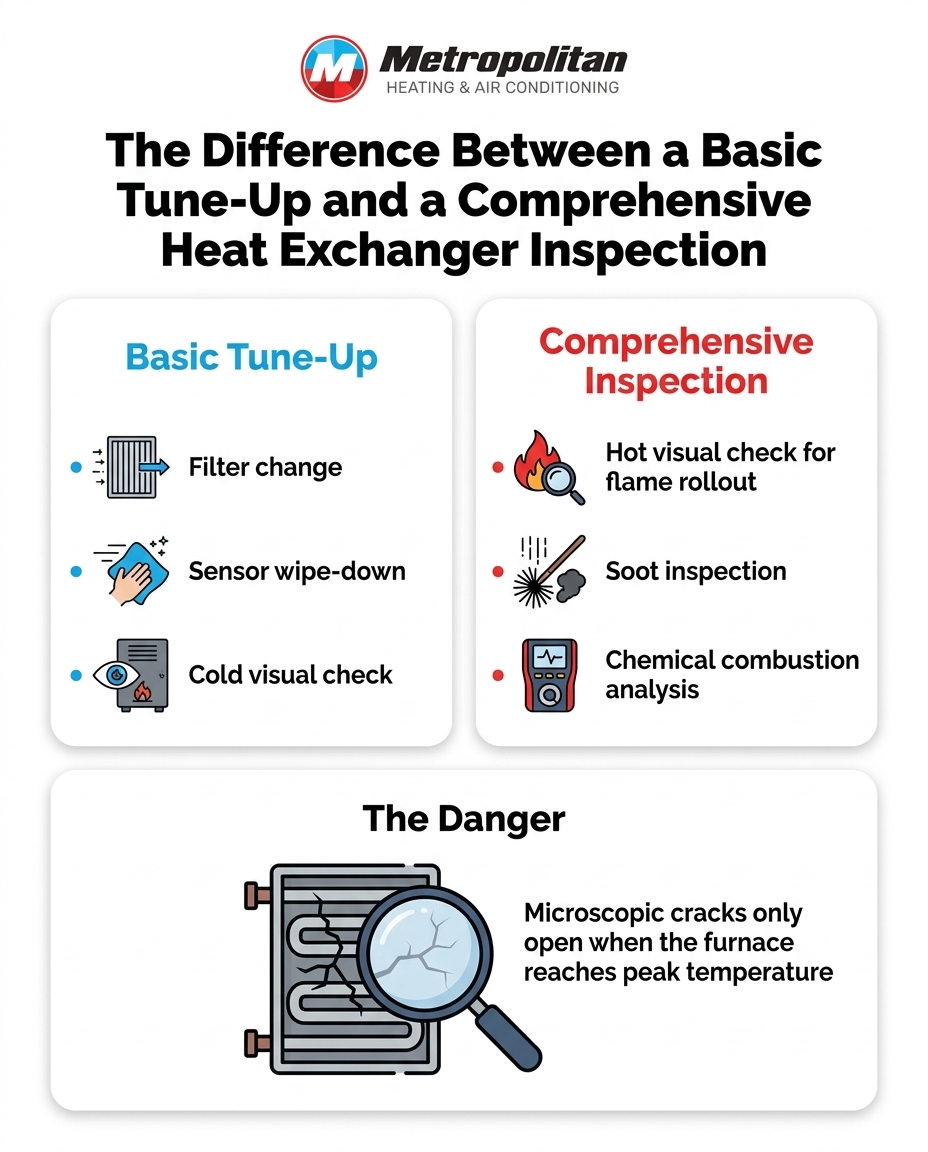
Not all furnace maintenance is created equal. The industry is flooded with low-cost "tune-up" specials that promise to prepare your system for winter in under twenty minutes. These basic visits typically focus on the easiest, most visible tasks: replacing the one-inch air filter, vacuuming out the bottom cabinet, and wiping dust off the flame sensor.
While a clean furnace runs more efficiently, a basic tune-up completely misses the mark on safety. The biggest shortfall of a standard visual check is that it is usually performed while the furnace is cold. Microscopic hairline cracks in a heat exchanger are notorious for closing up tight when the metal is at room temperature. A technician shining a flashlight into a cold furnace will likely see nothing but solid metal.
However, once the burners ignite and the metal heats up, thermal expansion forces those invisible cracks to open wide, allowing toxic gases to escape. A cold visual inspection provides a false sense of security. To truly guarantee safety, a specialized methodology is required.
• Visual Check State — Standard "Clean & Check": Performed while the furnace is cold and off. — Comprehensive Safety Inspection: Performed while the system is actively running and hot.
• Tools Utilized — Standard "Clean & Check": Flashlight and basic hand tools. — Comprehensive Safety Inspection: Combustion analyzer, inspection cameras, chemical sensors.
• Focus Area — Standard "Clean & Check": Filters, basic airflow, and surface dust removal. — Comprehensive Safety Inspection: Structural integrity, gas pressure, and exhaust safety.
• Safety Guarantee — Standard "Clean & Check": Assumes safety if the unit turns on. — Comprehensive Safety Inspection: Scientifically verifies no CO is leaking into the home.
Relying on a superficial 15-minute check is a gamble. This is why Metropolitan Heating & Air Conditioning's comprehensive fall furnace maintenance plan includes rigorous, 60-minute operational testing of the heat exchanger while the system is under full thermal load.
Our Uncompromising Visual Inspection Standards
Establishing true safety requires strict business methodology. At Metropolitan Heating & Air Conditioning, we do not guess when it comes to your family's well-being. By following a documented, step-by-step process, our technicians can identify the earliest warning signs of metal fatigue long before a catastrophic failure occurs.
When cooler weather arrives during our peak October through December appointment window, we frequently receive calls from homeowners experiencing strange furnace behavior. In one recent fall appointment in Rouge Park, a customer simply wanted honest answers and professional service for their older unit. By applying our strict visual inspection methodology, our technicians were able to provide a clear, factual assessment of the system's safety, leaving the work area clean and the homeowner fully informed.
Here is exactly what our technicians look for during the visual phase of a comprehensive inspection:
1. Flame Rollout Observation: We observe the burner flames right as the blower motor kicks on. If a crack exists, the change in air pressure will often cause the flames to "dance," flicker, or roll backward out of the chamber.
2. Flame Color Analysis: A healthy natural gas flame burns a crisp, steady blue. If the flame is burning yellow or orange, it indicates incomplete combustion, often caused by a cracked exchanger altering the oxygen mix.
3. Soot Accumulation Checks: We inspect the areas around the burners and exhaust flues. Black soot buildup is a major red flag that the combustion gases are not venting properly.
4. Rust and Corrosion Inspection: Condensation and moisture can pool in aging systems, rusting the metal from the inside out. Heavy corrosion is usually a precursor to a structural fracture.
These specific observations require a trained eye and professional tools. It is not something a homeowner can verify with a DIY flashlight check. If you are scheduling furnace service in Scarborough, ensuring your technician follows these uncompromising visual standards is vital.
Advanced Chemical Testing: Catching Invisible Leaks
Even the most thorough visual inspection has its limits. Because the most dangerous cracks only expand when the furnace is running at peak temperature, visual checks alone cannot definitively rule out a leak. This is where advanced chemical testing becomes the definitive tool in our safety methodology.
Chemical testing removes all the guesswork from furnace safety. Using specialized combustion analysis equipment, our technicians can read the exact chemical makeup of the gases inside your exhaust flue and the air coming out of your vents. This scientific approach allows us to detect active carbon monoxide leaks at the parts-per-million (PPM) level, often catching trace amounts as low as 9 PPM before they escalate into a crisis.
How the process works:
• Baseline Readings: We first take a baseline reading of the ambient air in your basement or utility room to ensure no background CO is present.
• Active Load Testing: The furnace is turned on and allowed to run until it reaches its maximum operating temperature, forcing any hidden hairline cracks to expand and open.
• Chemical Probe Analysis: A highly sensitive probe is inserted into the exhaust stream and the supply ductwork. If combustion gases are crossing the metal barrier and entering the clean air stream, the analyzer instantly registers the chemical shift.
This professional visual and chemical CO testing methodology is a non-negotiable requirement for our team when ensuring winter safety. It is the only way to scientifically prove that the air circulating through your home is completely free of toxic exhaust.
What Happens If We Find a Cracked Heat Exchanger?
Discovering a cracked heat exchanger is stressful, but having clear, actionable next steps helps homeowners make the right decision for their property. The most important fact to understand is that a cracked heat exchanger cannot be patched, welded, or temporarily repaired with high-temperature sealants. The extreme thermal expansion and contraction will instantly break any patch applied to the metal.
Immediate Safety Protocols:
If a crack is chemically or visually confirmed, safety regulations require immediate action. The technician must shut down the system and disconnect the gas supply to the appliance to prevent carbon monoxide from flooding the home. As certified professionals, we treat this not as a suggestion, but as a strict protocol designed to save lives.
Once the immediate danger is neutralized, you generally have two options:
• Replacing the Component: If your furnace is relatively young (under ten years old) and the heat exchanger is still covered by the manufacturer's warranty, replacing just the broken component might make sense. However, the labor required to completely dismantle and rebuild the furnace is extensive.
• Upgrading the Entire System: If the unit is an older 80% AFUE model that is over twelve to fifteen years old, out of warranty, and showing other signs of wear, investing heavy labor into an aging machine is rarely a wise choice. In these cases, upgrading to a new furnace (such as a modern 96%+ AFUE system) provides better energy efficiency, a fresh warranty, and total peace of mind. Note that upgrading to high-efficiency equipment may qualify for generic energy rebates or provincial utility incentive programs, though we always advise verifying current programs with your provider.
Age, overall efficiency, and warranty status play the major roles in this decision, and a Metropolitan Heating & Air Conditioning technician will walk you through the exact math for your specific situation.
Frequently Asked Questions About Furnace Safety Inspections
How do professionals test a heat exchanger for leaks?
Our technicians use a combination of hot visual inspections and scientific chemical testing. First, we visually inspect the burner chamber for soot, rust, and flame disruption (like a yellow flame or flame rollout) while the system is running. Next, we use specialized combustion analysis equipment to chemically test the air stream for carbon monoxide while the unit is at peak temperature, which catches expanding hairline cracks that cold visual checks miss.
Why is a cracked heat exchanger dangerous?
A cracked heat exchanger is dangerous because it breaks the physical seal between toxic exhaust gases and the breathable air in your home. When the metal fractures, carbon monoxide and other combustion byproducts are forced into your ductwork and distributed into your living spaces. Because CO is colorless and odorless, this leak can lead to severe health issues or even fatalities before anyone realizes there is a problem.
What happens if a heat exchanger cracks?
If a heat exchanger cracks, the furnace immediately becomes a critical safety hazard and can no longer be operated. By law and safety protocol, a licensed technician must shut down the equipment and disable the gas supply to prevent carbon monoxide poisoning. The homeowner must then decide whether to replace the broken component or upgrade the entire heating system.
Can a cracked heat exchanger be repaired?
No, a cracked heat exchanger cannot be safely repaired, welded, or patched. The extreme temperature swings inside the furnace cause the metal to constantly expand and contract, which will quickly break any temporary sealant or weld. The only safe and approved solutions are to replace the heat exchanger component entirely or install a new furnace.
How often should a heat exchanger be inspected?
A heat exchanger should be professionally inspected at least once a year. The ideal time for this inspection is in September or October, right before the heavy winter heating season begins. Annual testing ensures that any metal fatigue or microscopic cracks are caught before the furnace is required to run continuously for months on end.
Prioritize Your Family's Safety Before the Cold Sets In
The transition into winter should be a time of comfort, not a time to worry about the unseen mechanics of your heating system. The silent threat of carbon monoxide is real, but it is entirely preventable with the right professional oversight. Standard filter changes are simply not enough to verify the structural integrity of aging metal.
By relying on specialized visual and chemical testing, our Metropolitan Heating & Air Conditioning technicians remove the guesswork from winter preparation. A proper, rigorous inspection provides the ultimate reassurance that the warm air filling your home before the January deep freeze is clean, safe, and completely free of exhaust gases. Schedule your comprehensive fall maintenance visit today, and head into the freezing months knowing your family's safety is fully protected.
Schedule Expert Service
Or Contact Us
Other Blogs
testimonials
hear what our satisfied clients have to say

where we operate
Service areas
contact us
Let’s get in touch!