
When Winter Storms Trigger Commercial Heating Emergencies
Understanding the anatomy of a rooftop HVAC unit failure becomes critical when peak winter freezing rain advisories threaten to bring your commercial operations to a sudden halt. At Metropolitan Heating & Air Conditioning, our team knows that as temperatures drop and moisture fills the air, exposed commercial equipment faces an immediate, compounding threat. Ice accumulation and severe wind shear do not just cause your heating to run inefficiently; they trigger a cascading series of mechanical chain reactions that can destroy internal components.
For facility managers and building owners, recognizing the early warning signs of ice-related mechanical stress is the single most important factor in preventing a total catastrophic breakdown. In our experience, if you wait until the building is freezing, the internal damage is already done. To protect your property, you need a clear, technical understanding of how these mechanical failures happen step-by-step, allowing you to intervene before a minor issue becomes a major emergency.
To ensure your facility remains operational through the harshest weather, it is essential to rely on professional HVAC systems maintenance and emergency response protocols.
The Physical Assault on Exposed Rooftop Equipment
Commercial rooftop units (RTUs) are fundamentally different from residential or sheltered basement systems because they bear the absolute brunt of severe weather without any structural shielding. While indoor systems operate in a controlled climate, an RTU is an exposed metal box fighting against the elements 24 hours a day.
The Vulnerability of the Commercial Roofscape
In our years of providing commercial heating support, we've seen firsthand how Scarborough commercial and industrial districts exposed to lake winds face a uniquely hostile environment during the winter months. Unlike properties located further inland, buildings near Lake Ontario experience intense, sustained gusts that carry heavy moisture. When this moisture meets freezing temperatures, the result is driving freezing rain that attacks equipment horizontally.
The Physics of Horizontal Freezing Rain
Gravity usually pulls rain straight down, allowing the protective hoods of commercial equipment to deflect water away from sensitive internal parts. However, high wind shear changes the physics of precipitation. Winds whipping across a flat commercial roof drive supercooled water droplets sideways, forcing moisture deep into the exhaust flues, intake louvers, and electrical housing of the unit. The moment this supercooled water makes contact with the freezing metal chassis of the equipment, it instantly flashes into solid ice.
• Freezing Rain — Impact on Sheltered Systems: Minimal to none; protected by building structure. — Impact on Exposed Commercial RTUs: Direct contact; rapid ice accumulation on all exterior surfaces.
• High Wind Shear — Impact on Sheltered Systems: Drafts may affect ambient room temperature slightly. — Impact on Exposed Commercial RTUs: Forces moisture horizontally into intakes; disrupts flue draft pressures.
• Rapid Temp Drops — Impact on Sheltered Systems: System cycles on normally to meet thermostat demand. — Impact on Exposed Commercial RTUs: Metal components contract, belts stiffen, and lubricants thicken.
Because of these extreme environmental baselines, our technicians providing professional HVAC services in Scarborough must always account for wind-driven ice penetration when diagnosing equipment failures. This horizontal moisture assault sets the stage for the first phase of mechanical breakdown.
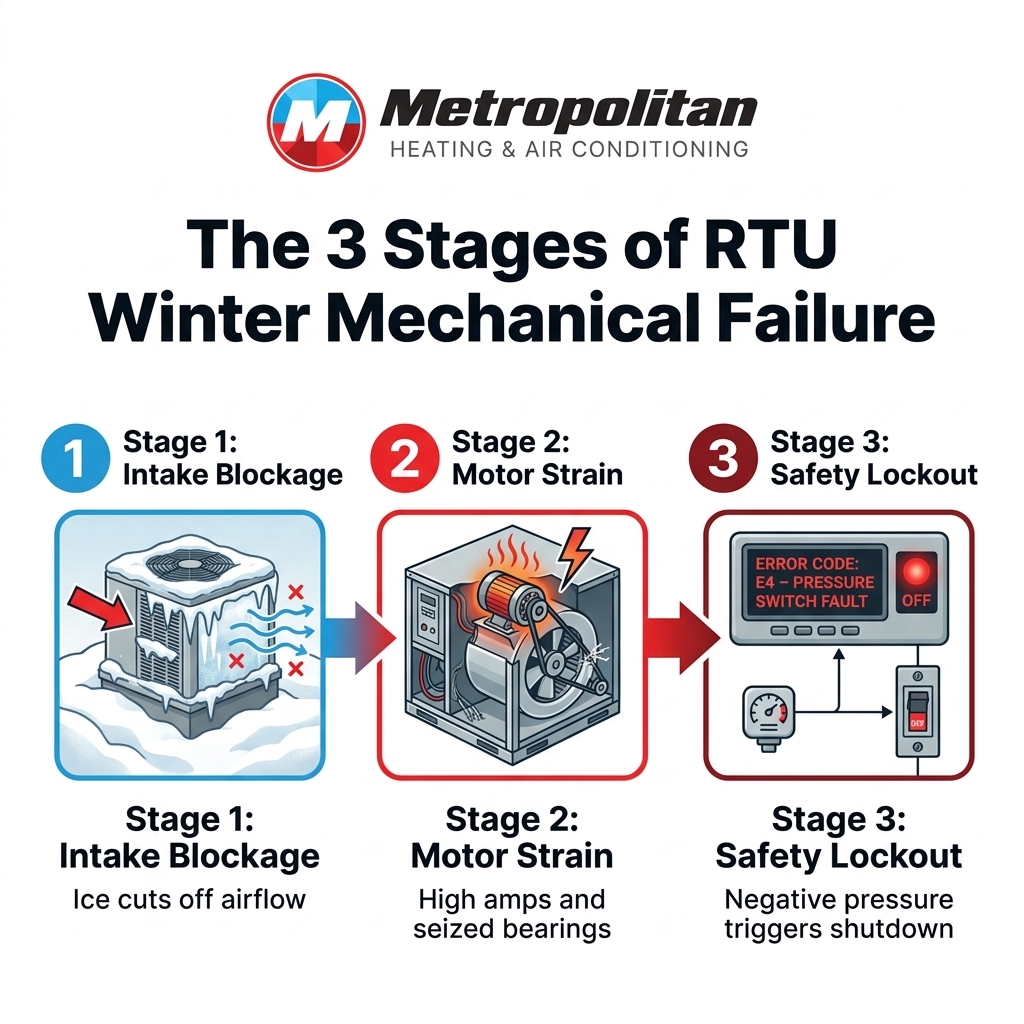
Stage 1: Intake Blockages and Airflow Starvation
The mechanical chain reaction begins at the point of entry: the air intake. Every combustion heating system requires a steady, unobstructed flow of oxygen to burn fuel safely and effectively. When a winter storm hits, this vital airway is the first component to fail.
The Mechanics of Air Intake Failure
1. Rapid Ice Glazing: As freezing rain is blown sideways into the unit, it coats the metal louvers of the fresh air intake vents. Because metal conducts cold efficiently, the rain freezes on contact, slowly reducing the gap between each louver blade.
2. Total Airflow Starvation: Within a matter of hours, the ice bridges the gaps entirely, forming a solid, impenetrable sheet over the intake. The unit is now effectively suffocating, completely starved of the oxygen required for the combustion process or heat exchange.
3. Internal Negative Pressure: With the intake blocked, the heavy-duty blower motors inside the unit continue trying to pull air into the system. This creates a massive internal negative pressure imbalance. The system is working significantly harder, consuming more electricity, and straining internal mounts just to pull a fraction of the necessary air.
We often remind facility managers who rely on our commercial cooling services that they are accustomed to checking for blocked intakes during the summer months to clear pollen, dust, and debris. However, our winter service calls reveal that ice forms much faster and creates a rigid, structural blockage that cannot be simply brushed away. This sudden airflow starvation forces the internal components to work far beyond their designed capacity, leading directly to the next stage of failure.
Stage 2: The Strain on Draft Inducer Motors
Once the intake is blocked and airflow is choked, the mechanical stress transfers deep into the heart of the rooftop unit. The primary victim of this airflow starvation is the draft inducer motor, a critical component responsible for pulling combustion gases through the heat exchanger and safely venting them out of the building.
Problem: Choked Airflow and High Amp Draws
Under normal conditions, the draft inducer motor spins freely, moving a predictable volume of air. When the intake is sealed by ice, the motor suddenly faces massive physical resistance. It is trying to pull air through a vacuum. To maintain its required rotational speed against this resistance, the motor must pull higher electrical amps. This spike in electrical current generates excess heat within the motor windings, slowly degrading the internal insulation.
Cause: Ice Weight and Bearing Stress
Simultaneously, the driving freezing rain often breaches the exhaust flue, depositing ice directly onto the draft inducer fan blades. Even a few ounces of uneven ice accumulation throws the high-speed fan off balance. This imbalance acts like a heavy, vibrating weight on the motor shaft, transferring severe mechanical stress directly into the motor bearings. The combination of high electrical heat and violent physical vibration causes the bearings to grind, overheat, and eventually seize completely.
Solution: Recognizing the Breaking Point
If the system is allowed to continue running in this state, the inducer motor will either burn out electrically or seize mechanically. Understanding why commercial units fail differently during deep freezes is crucial here. During a recent winter when windchills plummeted to -30, our emergency dispatch team responded to a local Scarborough business that experienced a complete rooftop furnace failure due to this exact sequence. The motor strain reached a breaking point, the unit failed during the coldest stretch of weather in years, and our crew had to install a completely new unit the next business day to restore heating. Catching the strain before the motor burns out is the only way to avoid costly component replacement.
Stage 3: Flue Pressure Drops and Safety Lockouts
The final stage of the mechanical chain reaction is the system's own self-defense mechanism. Modern commercial RTUs are equipped with highly sensitive safety controls designed to prevent catastrophic hazards, such as fires or carbon monoxide leaks. When the physical assault of the storm becomes too great, these safeties trigger a hard shutdown.
Wind Shear and Negative Pressure
High wind shear whipping across the flat expanse of a commercial roof does more than drive rain; it dramatically alters atmospheric pressure. As gale-force winds blow directly across the top of the RTU exhaust flue, they can create a strong vacuum effect, or conversely, force air back down the pipe. This erratic pressure environment makes it impossible for the system to vent toxic combustion gases safely.
The Role of Safety Pressure Switches
Inside the unit, a small but vital component called a pressure switch monitors the draft inducer motor and the flue pressure. If the switch detects that the motor has seized (Stage 2), or that the wind shear is preventing proper venting, it immediately trips. The switch is designed to fail safe—meaning if it cannot confirm a clear, safe path for exhaust gases, it refuses to allow the heating cycle to continue.
The Final Lockout Sequence
Once the pressure switch trips, the unit's main control board initiates a safety lockout. It immediately shuts down the gas valve and halts the ignition sequence to prevent carbon monoxide from backing up into your building's ductwork. While this lockout keeps your tenants and employees safe from toxic gas, it leaves the building entirely without heat in the middle of a winter storm. The chain reaction we see so frequently is now complete: what started as ice on a louver has resulted in a completely disabled heating system.
Early Warning Signs of Mechanical Stress for Facility Managers
Because our service team sees how rapidly the progression from Stage 1 to Stage 3 can happen during a severe weather event, we urge facility managers to be vigilant. You do not need to be an HVAC technician to spot the signs that a commercial RTU is actively failing. By monitoring the environment inside the building and listening carefully, you can identify mechanical stress before the safety lockout occurs.
Strict Safety Warning: Never attempt a DIY roof inspection during a winter storm. High winds, ice accumulation, and freezing rain make commercial roofs incredibly dangerous. Diagnosing and repairing commercial heating systems requires licensed professionals with the proper safety harnesses and technical training, which is exactly how our Metropolitan Heating & Air Conditioning crews operate.
Instead of going on the roof, monitor these critical indicators from safely inside the building or from a sheltered vantage point:
• Auditory grinding or whining: If you can hear a high-pitched whine or a heavy grinding sound vibrating through the ceiling directly below the RTU, the draft inducer motor bearings are actively failing. This is the sound of metal-on-metal friction.
• Frequent short-cycling: If the heating turns on, runs for only two or three minutes, and then shuts off abruptly without reaching the set temperature, the internal safeties are likely tripping and resetting repeatedly.
• Uneven heating across building zones: A sudden drop in air volume from the supply vents in specific zones indicates that the internal blowers are struggling against a blocked intake.
• Unusual vibration through the ductwork: Ice accumulation on the main blower wheels will cause severe off-balance vibrations that travel down the sheet metal ductwork into the occupied spaces below.
If you notice any of these symptoms, the mechanical chain reaction has already started. Professional intervention is required immediately to halt the damage.
Breaking the Chain Reaction: The Role of Rapid Emergency Response
Once a commercial rooftop unit begins to fail under the weight of winter ice and wind shear, time is the most critical factor. A minor motor strain can easily be corrected if caught early, but if left running, our technicians often find it quickly escalates into a total motor burnout or cracked heat exchanger, requiring a massive capital expense to replace.
Breaking this chain reaction requires immediate, targeted action. When a Metropolitan Heating & Air Conditioning commercial technician arrives on site, their first priority is safely thawing the intake louvers and exhaust flues using specialized, non-destructive heating equipment. Once the airway is clear, our technician will systematically test the electrical amp draws on the draft inducer and main blower motors to ensure they have not sustained permanent damage. Finally, they will recalibrate the pressure switches and reset the safety lockouts, verifying that the system can vent combustion gases safely despite the ongoing wind shear.
Having a partner with dedicated commercial HVAC expertise and rapid emergency dispatch capabilities is essential for businesses facing sudden rooftop unit failures. Commercial equipment requires a completely different diagnostic approach than residential systems, especially during severe weather events. By securing a reliable commercial HVAC partner before the peak winter freezing rain advisories hit, facility managers can ensure that their buildings remain warm, safe, and operational, no matter what the storm brings.
Frequently Asked Questions
What causes a rooftop HVAC unit to stop working in winter?
A rooftop unit typically stops working in winter due to ice accumulation blocking airflow or high wind shear disrupting the exhaust flues. When intake louvers freeze over, the system is starved of air, forcing internal motors to overwork. This mechanical strain eventually triggers internal safety switches, which shut the entire unit down to prevent fires or carbon monoxide leaks.
How does ice affect commercial HVAC units?
Ice adds massive physical weight to moving parts and creates rigid structural blockages over air intakes. When freezing rain coats the fan blades or louvers, it throws high-speed motors off balance, destroying the internal bearings. Furthermore, ice blocks the vital oxygen supply needed for safe combustion, forcing the system to pull higher electrical currents until components fail.
What are the signs of a failing commercial rooftop HVAC unit?
The most common signs we tell our clients to look out for include grinding or whining noises vibrating through the ceiling, short-cycling where the heat turns off prematurely, and weak airflow from the vents. You may also notice uneven heating across different zones of your commercial space. These symptoms indicate that the unit is struggling against physical resistance and requires immediate professional inspection.
How long do commercial rooftop HVAC units last in harsh climates?
In harsh climates with heavy freezing rain and high wind exposure, commercial rooftop units generally last between 15 and 20 years with rigorous preventative maintenance. However, units that are repeatedly allowed to freeze over without prompt professional intervention will experience accelerated mechanical wear. Regular inspections and rapid emergency repairs are vital to maximizing the lifespan of the equipment.
Why is my commercial heater blowing cold air during a storm?
If your commercial heater is blowing cold air, the system has likely entered a safety lockout phase. The main blower fan continues to circulate air through the building, but the gas ignition sequence has been disabled by a safety switch. This usually happens when wind shear or ice prevents the unit from venting toxic combustion gases safely.
Can high winds cause a commercial furnace to shut down?
Yes, severe high winds can create a vacuum effect or negative pressure inside the exhaust flue of a commercial furnace. Internal pressure switches monitor this draft constantly to ensure safe operation. If the wind shear prevents exhaust gases from escaping properly, the switch will trip and shut down the furnace completely to protect the building's occupants.
Before the next winter storm threatens your property, ensure your commercial heating equipment is prepared to handle the elements. Taking proactive steps and relying on fast, professional intervention is the smartest way to protect your investment and keep your facility running smoothly.
Schedule Expert Service
Or Contact Us
Other Blogs
testimonials
hear what our satisfied clients have to say

where we operate
Service areas
contact us
Let’s get in touch!