

The Hidden Impact of Municipal Water Chemistry on Indoor Air Quality
Nearly 120 to 140 milligrams of dissolved minerals flow through every liter of municipal water supplying the region, which is why understanding Oshawa's Hard Water and Your Whole-Home Humidifier: What You Need to Know is a critical priority for local homeowners. That specific mineral concentration creates a unique, often overlooked challenge for anyone trying to maintain optimal indoor humidity during the dry season. While your heating equipment works to keep your living space warm, the local water chemistry is quietly working against the components designed to keep that air comfortable to breathe.
A typical pattern we see is homeowners following the generic maintenance schedules printed in the back of their equipment manuals. They assume a once-a-year pad replacement is sufficient. However, those broad recommendations fail entirely to account for regional water tables. The heavy calcium and magnesium deposits found in the Oshawa municipal water service area vs broader GTA municipalities force a critical decision: either adopt an accelerated maintenance schedule tailored to local conditions, or risk widespread equipment inefficiencies.
To fully grasp why this happens, you have to look at how these indoor air quality components integrate with your broader HVAC systems. Your whole-home humidifier does not operate in isolation. It relies on the furnace blower to distribute moisture, and it relies on the local water line to supply that moisture. When the water supply is heavy with minerals, the evaporative pad inside the unit calcifies at a highly accelerated rate. This rapid crusting blocks airflow, reduces humidity output, and eventually forces the entire heating system to work harder just to push air through your ductwork.
The Evaporative Process Explained
Your whole-home humidifier operates on a beautifully simple principle: warm air from the furnace passes through a water-soaked mesh pad, picking up moisture before circulating throughout your rooms. But this process leaves something behind. As pure water evaporates into the airstream, every single milligram of dissolved calcium, magnesium, and silica stays trapped on the mesh. Over weeks and months, these microscopic deposits build up into a thick, solid crust. Because local water contains such a high volume of these minerals, the pad transforms from a porous sponge into a solid brick much faster than most homeowners anticipate.
Understanding Oshawa's Water Hardness Levels Compared to the GTA
To truly understand why your evaporative pads are failing so quickly, we have to look at the hard data. The science of water hardness is typically measured in grains per gallon (gpg) or milligrams per liter (mg/L). Water drawn from Lake Ontario and processed for the Durham Region falls squarely into the "moderately hard to hard" category, consistently testing between 7 and 9 grains per gallon.
If you compare the mineral makeup of the Oshawa municipal water service area vs broader GTA municipalities, the hyper-local nature of this issue becomes strikingly clear. Some neighboring areas draw from different sources or blend their municipal supplies, resulting in softer water that is far gentler on mechanical equipment. Here in Oshawa, the high concentration of dissolved calcium and magnesium means your plumbing fixtures, water heater, and especially your humidifier bear a much heavier mineral load.
• Soft Water — Grains Per Gallon (gpg): 0 - 3.5 — Milligrams Per Liter (mg/L): 0 - 60 — Impact on Humidifier Pads: Pads easily last a full heating season.
• Moderate Water — Grains Per Gallon (gpg): 3.5 - 7.0 — Milligrams Per Liter (mg/L): 60 - 120 — Impact on Humidifier Pads: Pads require mid-season inspection.
• Oshawa Municipal Water — Grains Per Gallon (gpg): 7.0 - 9.0+ — Milligrams Per Liter (mg/L): 120 - 140+ — Impact on Humidifier Pads: Rapid calcification; requires frequent changes.
• Very Hard Water — Grains Per Gallon (gpg): Over 10.5 — Milligrams Per Liter (mg/L): Over 180 — Impact on Humidifier Pads: Severe scaling; whole-home softening highly recommended.
As water flows from your home's supply line across the humidifier's distribution tray, it trickles down through the aluminum or paper mesh of the evaporative pad. The furnace blower pushes hot, dry air through this wet mesh. The pure H2O turns into vapor and travels into your living space, leaving 100% of the dissolved minerals behind.
Because Oshawa's water is so mineral-dense, this separation process quickly coats the pad in a chalky, rigid layer of scale. This local water chemistry connects directly to the rapid crusting you observe when you open the humidifier casing. Addressing this hyper-local challenge is a core component of effective indoor air quality solutions, as a scaled-over pad cannot physically hold enough water to properly humidify your home.
How Extreme Winter Temperatures Accelerate Calcification Rates
Ontario winters are notorious for their bitter cold and biting winds. During severe cold snaps, your furnace runs nearly continuously just to maintain a baseline indoor temperature. What many homeowners do not realize is that this heavy heating usage directly accelerates the breakdown of your humidifier pad.
The compounding effect is simple but destructive: continuous furnace operation means continuous water flow across the humidifier pad. Every time the furnace fires up and the blower engages, the humidifier's solenoid valve opens, sending a steady stream of hard municipal water over the evaporative mesh. During a mild week, the system might only run a few hours a day. But during the peak winter heating season, that system is running around the clock. High mineral content combined with a massive volume of continuous water flow equals drastically accelerated calcification.
The Reality of Deep Freezes
Consider how hard your equipment works when the weather turns severe. During one particularly brutal winter cold snap, a local customer experienced a complete rooftop furnace failure right as the windchill plummeted to -30°C. A technician was routed immediately and managed to get a completely new unit installed by the next business day, restoring their heat during the absolute coldest stretch of weather. While that specific scenario involved a total system failure, it perfectly illustrates how extreme temperatures push your home's mechanical systems to their absolute limits.
When your furnace runs non-stop to fight off a -30°C windchill, it violently dries out the indoor air. To compensate, your humidifier runs non-stop, dumping gallons of hard water over the pad every single day. This intense usage rapidly scales the pad, drastically reducing its efficiency exactly when you need moisture the most. Understanding how water heaters and HVAC systems interact during these deep freezes can help you anticipate maintenance needs before a component completely fails.
Clear Signs Your Humidifier Pad Has Succumbed to Mineral Buildup
You do not need to be an HVAC technician to recognize when a humidifier pad has failed. Because the mineral buildup is so severe during the peak winter heating season, the physical evidence is usually obvious. Knowing what to look for can save your broader heating system from unnecessary strain and keep your indoor air comfortable.
Here are the undeniable symptoms that your evaporative pad is calcified and requires immediate replacement:
• Visible crusting and discoloration: A healthy pad looks like a clean, open honeycomb. A failed pad will have a thick, rigid white or yellow crust forming along the edges and blocking the porous openings.
• Plummeting indoor humidity: If your thermostat or hygrometer shows a noticeable drop in indoor humidity levels—and your skin feels dry and staticky—despite the system running constantly, the pad is likely too scaled to hold water.
• Water pooling or leaking: As the center of the pad solidifies with calcium, water can no longer trickle straight down. It channels outward, often spilling over the edges of the plastic frame and pooling around the base of the humidifier or leaking down the side of your furnace.
• Restricted airflow noises: A severely calcified mesh acts like a solid wall. You may notice the furnace blower motor sounding louder or straining harder to push air through the restricted passage.
• Clogged drainage tubes: The excess minerals can flake off and wash down into the humidifier's drain line, creating a sludge that eventually blocks the tube and causes water backups.
If you notice any of these signs, the pad has stopped functioning as a humidifier and has become a liability to your ductwork and furnace.
Why Generic Manufacturer Timelines Fail in Durham Region
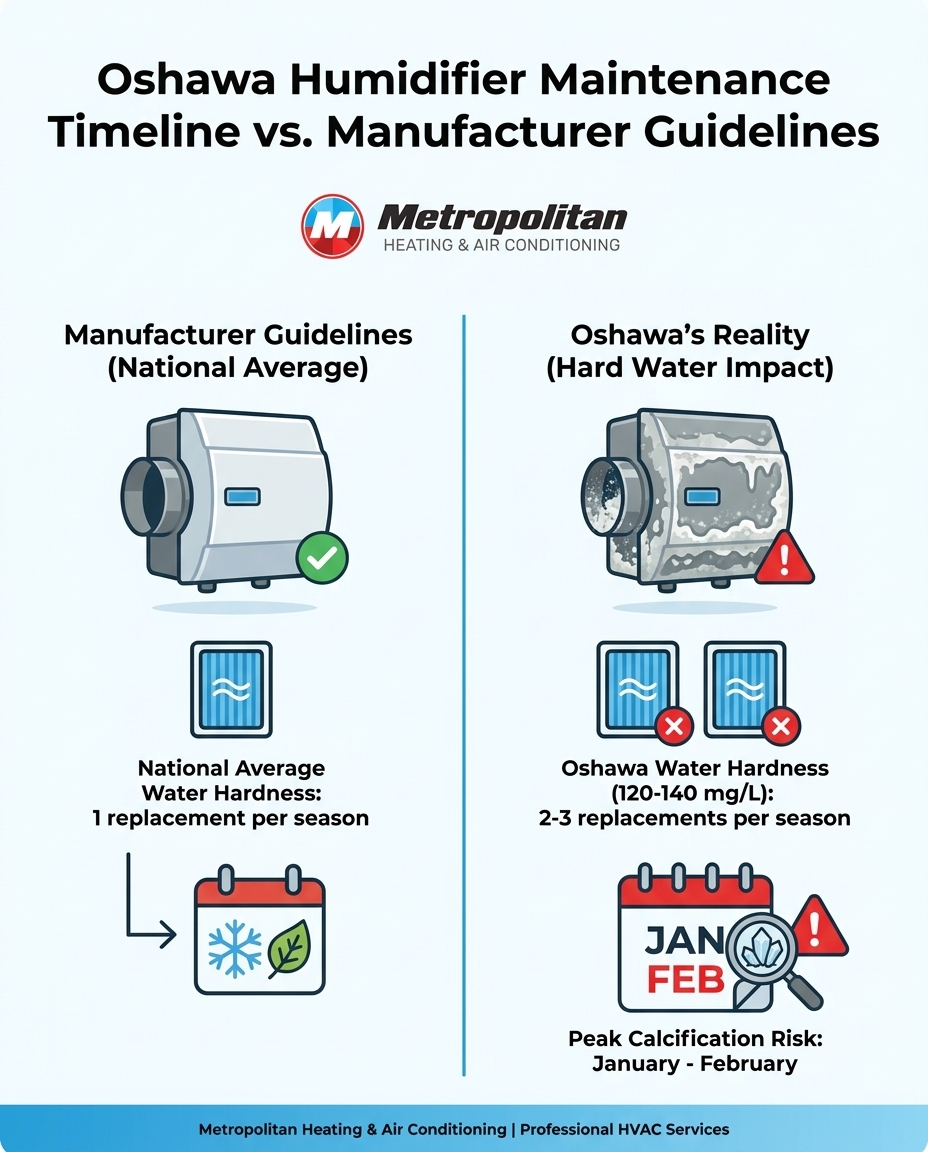
When you purchase a new whole-home humidifier, the standard HVAC manufacturer manual inside the box will almost always recommend changing the evaporative pad "once per season." For a homeowner in an area with naturally soft water, that timeline works perfectly. But applying that generic advice to our local region is a recipe for underperforming equipment and compromised air quality.
These manuals are written for a national audience. They assume a baseline, national-average water hardness of around 3 to 5 grains per gallon. They simply do not account for the Oshawa municipal water service area vs broader GTA reality, where the water tests at 120-140 mg/L of dissolved minerals.
Following a generic "once a year" timeline in this specific region guarantees that your humidifier will spend half the winter operating with a completely calcified pad. True local experts do not just read the manual; they adapt maintenance protocols based on decades of direct experience with Durham Region's municipal water. We know exactly how this specific water chemistry interacts with mechanical equipment, and we adjust our recommendations accordingly. Relying on specialized HVAC services in Oshawa ensures your equipment is calibrated for the actual environment it operates in, rather than a hypothetical national average.
The Domino Effect: How a Calcified Pad Restricts HVAC Airflow
It is easy to dismiss a calcified humidifier pad as a minor nuisance—something that just causes a bit of dry skin. But ignoring localized maintenance impacts the broader heating system in ways that can lead to significant, costly damage. The physical mechanism of a humidifier pad failure creates a dangerous domino effect throughout your ductwork.
As the dissolved minerals harden, they completely block the porous gaps in the aluminum or paper mesh. In a bypass humidifier system, air is supposed to flow freely from the supply plenum, through the wet pad, and into the return duct. When that pad turns into a solid wall of calcium, it acts exactly like a severely clogged air filter.
The Strain on Your Furnace
This blockage restricts the volume of air the blower motor can move. When airflow is restricted, the blower motor has to work much harder to push the same amount of air through the house. This increased electrical draw can cause the motor to overheat and wear out prematurely.
Furthermore, restricted airflow across the furnace's heat exchanger during the peak winter heating season means the heat generated by the burners is not being carried away fast enough. This can cause the internal temperature of the furnace to spike, repeatedly tripping the high-limit safety switch and forcing the system to shut down abruptly. What starts as a cheap, neglected component—a basic humidifier pad—can quickly threaten a major home investment by causing your furnace to short-cycle and overheat.
A Localized Maintenance Strategy for Oshawa Homeowners
Because the Oshawa municipal water service area vs broader GTA presents such a unique challenge, you need a proactive, customized approach to indoor air quality. Waiting until spring to check your humidifier is not an option here. To protect your equipment and keep your home comfortable, you must adopt an accelerated maintenance schedule.
Here is the actionable, authoritative solution tailored specifically for the local water supply:
• Inspect the pad every 3 to 4 weeks: During the heaviest months of winter, open the humidifier casing monthly. Check for chalky buildup, stiffness, and dry spots on the mesh.
• Replace the pad 2 to 3 times per season: Do not wait for a full year. Depending on your household water usage and furnace run times, you will likely need a fresh pad in late autumn, another in mid-January, and potentially a third before spring.
• Consider whole-home water softening: The most permanent complementary solution is installing a whole-home water softener. By removing the calcium and magnesium before the water ever reaches your humidifier, you protect the evaporative pad—along with your water heater, dishwasher, and plumbing fixtures.
• Schedule professional preventative maintenance: Have a local technician calibrate the system for local conditions. They can ensure the humidistat is communicating properly with the furnace and that the water supply valve is delivering the correct volume without overflowing.
By shifting from a reactive mindset to a localized, proactive strategy, you eliminate the stress of mid-winter breakdowns and ensure your system runs at peak efficiency.
Frequently Asked Questions About Hard Water and Humidifiers
How often should I change my humidifier pad with hard water?
With Oshawa's hard water, expect to change it 2 to 3 times during the heating season. During the peak winter heating season, the continuous flow of mineral-heavy water scales the pad rapidly. Inspecting it monthly ensures you catch the buildup before it restricts your furnace's airflow.
Does hard water ruin humidifiers?
It doesn't ruin the unit itself, but it rapidly scales the evaporative pad and can clog drainage tubes if not maintained. The plastic housing and solenoid valves are generally resilient, but the hard water minerals will quickly destroy the functional mesh pad. Regular cleaning of the internal tray and drain line is required to prevent permanent damage.
How do you prevent calcium buildup in a whole-home humidifier?
The most effective prevention is treating the water supply with a softener before it reaches the unit, alongside frequent pad replacements. If softening the entire home's water isn't feasible, you must commit to an accelerated maintenance schedule. Ensuring the humidifier is perfectly level also helps water flow evenly, reducing localized mineral crusting.
How do I know if my humidifier pad is calcified?
Look for a rigid, chalky white or yellow buildup on the mesh, often accompanied by a drop in indoor humidity. You might also notice water pooling around the base of the unit because the scale has blocked the normal downward drainage path. If the pad feels like a stiff brick rather than a flexible sponge, it is severely calcified.
Can I clean a calcified humidifier pad instead of replacing it?
No, evaporative pads are designed for replacement. Attempting to clean them usually destroys the special coating that holds water. Soaking the pad in vinegar or scraping off the calcium will ruin the porous structure, meaning water will simply run straight down the drain without actually humidifying your air.
Protect Your Indoor Comfort with Local Expertise
Managing the unique water chemistry of the Oshawa municipal water service area vs broader GTA municipalities demands a proactive, customized approach to indoor air quality. Standard manuals simply do not account for the heavy mineral load that accelerates pad calcification and threatens your broader HVAC system.
Fortunately, keeping your home perfectly humidified during the harshest winter months is straightforward with the right professional guidance. By adopting an accelerated maintenance schedule and relying on technicians who understand Durham Region's specific environmental challenges, you can protect your equipment and breathe easier all season long. Reach out to schedule a thorough inspection and ensure your system is properly calibrated for the local climate.
Schedule Expert Service
Or Contact Us
Other Blogs
testimonials
hear what our satisfied clients have to say

where we operate
Service areas
contact us
Let’s get in touch!