

The Sunk Cost Dilemma: Facing a Major Heating Breakdown
A common myth in home maintenance is that patching up an aging appliance is always the most responsible financial move, but when you are weighing the options of repairing a 15-year-old furnace vs. financing a new high-efficiency unit, that quick fix can actually become a financial trap. You hear a grinding noise, the blower motor stops, or the heat exchanger cracks just as the Scarborough winter heating season approaches. Your immediate instinct is to simply replace the broken part and get the heat running again. However, pouring significant funds into an out-of-warranty system often leads to a cycle of compounding failures.
If you are facing a major breakdown, you need a reliable way to evaluate your next steps. For comprehensive guidance on your heating replacement and services, or if you are interested in financing a new high-efficiency unit, establishing a clear plan is essential.
At Metropolitan Heating & Air Conditioning, what we walk our Scarborough customers through daily is an objective, pressure-free evaluation. Before you sign off on a massive repair bill for an aging system, it helps to understand the exact factors that dictate when a furnace has reached the end of its useful life. Usually, homeowners facing this dilemma notice a few undeniable symptoms:
• Frequent short-cycling: The system turns on and off constantly without ever reaching the set temperature.
• Uneven heating: Certain rooms remain freezing while others are stiflingly hot.
• Unusual operational noises: Banging, rattling, or squealing sounds that indicate severe mechanical wear.
• Rising utility bills: The system works twice as hard to produce the same amount of heat it did a decade ago.
By stepping back and looking at the entire lifespan of your equipment, you can make a choice that protects both your household budget and your family's comfort.
The 15-Year Milestone: What Happens to Out-of-Warranty Systems
Understanding the physical realities of an aging HVAC system is the first step in making an informed decision. According to organizations like Natural Resources Canada (NRCan) and ENERGY STAR, the average lifespan of a well-maintained gas furnace is typically 15 to 20 years. Once a unit crosses that 15-year threshold, it enters a phase where major components begin to reach the end of their engineered lifecycle. Operating a 15-year-old out-of-warranty furnace means you are assuming one hundred percent of the financial risk for every part that fails.
One of the most significant hurdles homeowners face with older systems is the logistical nightmare of sourcing replacement parts. Manufacturers eventually stop producing components for legacy models. When a proprietary control board or a specific inducer motor fails on a 15-year-old unit, finding a replacement can take days or even weeks. Our technicians at Metropolitan Heating & Air Conditioning frequently see supply chain delays for out-of-warranty parts, and expedited shipping often adds unexpected premium fees to your repair bill.
The Chain Reaction of Component Failure
Another crucial factor is the compounding risk of mechanical fatigue. A furnace is a complex ecosystem of moving parts, electrical sensors, and combustion chambers. When one major component fails, it usually means the surrounding components have been subjected to the same decade and a half of wear and tear.
The domino effect: Replacing a burnt-out blower motor might get the air moving again, but the stress of the new, powerful motor can quickly expose weaknesses in an aging heat exchanger or a fragile control board. Our team strictly advises against looking at a repair in isolation. Instead of focusing on the isolated cost of a single fix, it is wiser to look at the repair cost as a percentage of a brand-new system. Sinking a large percentage of a new unit's value into a temporary fix often guarantees you will be facing another breakdown shortly after.
The Severe Winter Failure Risk in Scarborough
Evaluating a furnace breakdown is not just a financial exercise; it is heavily dependent on the climate you live in. The Scarborough winter heating season is notoriously harsh, with temperatures frequently dropping well below freezing. In this environment, continuous, reliable heating is a fundamental safety necessity, not just a matter of indoor comfort.
When you rely on a failing 15-year-old furnace, you are gambling with your home's infrastructure. If a breakdown occurs during a deep freeze and you are forced to wait weeks for an obsolete, out-of-warranty part to arrive, the consequences can be severe. A home left without heat for even a short period faces the immediate risk of frozen and bursting water pipes, which can cause catastrophic structural water damage.
One of our Scarborough customers experienced this firsthand during the coldest stretch of weather in years. Their rooftop furnace failed completely overnight while windchills plummeted to -30. Because waiting for obsolete parts to ship was simply not a safe option, our team at Metropolitan Heating & Air Conditioning provided emergency service and installed a new, reliable unit the next business day. The rapid response restored heat to the property quickly, preventing severe cold-weather damage and keeping the household safe.
To protect your home during extreme weather, consider the hidden risks of delaying an upgrade:
• Vulnerable plumbing: Pipes in exterior walls can freeze in a matter of hours when the heating system fails.
• Space heater hazards: Relying on portable electric heaters overloads household circuits and introduces significant fire risks.
• Health and safety: Prolonged exposure to freezing indoor temperatures is dangerous, particularly for vulnerable family members.
Our Field Diagnostic Framework: When to Stop Repairing
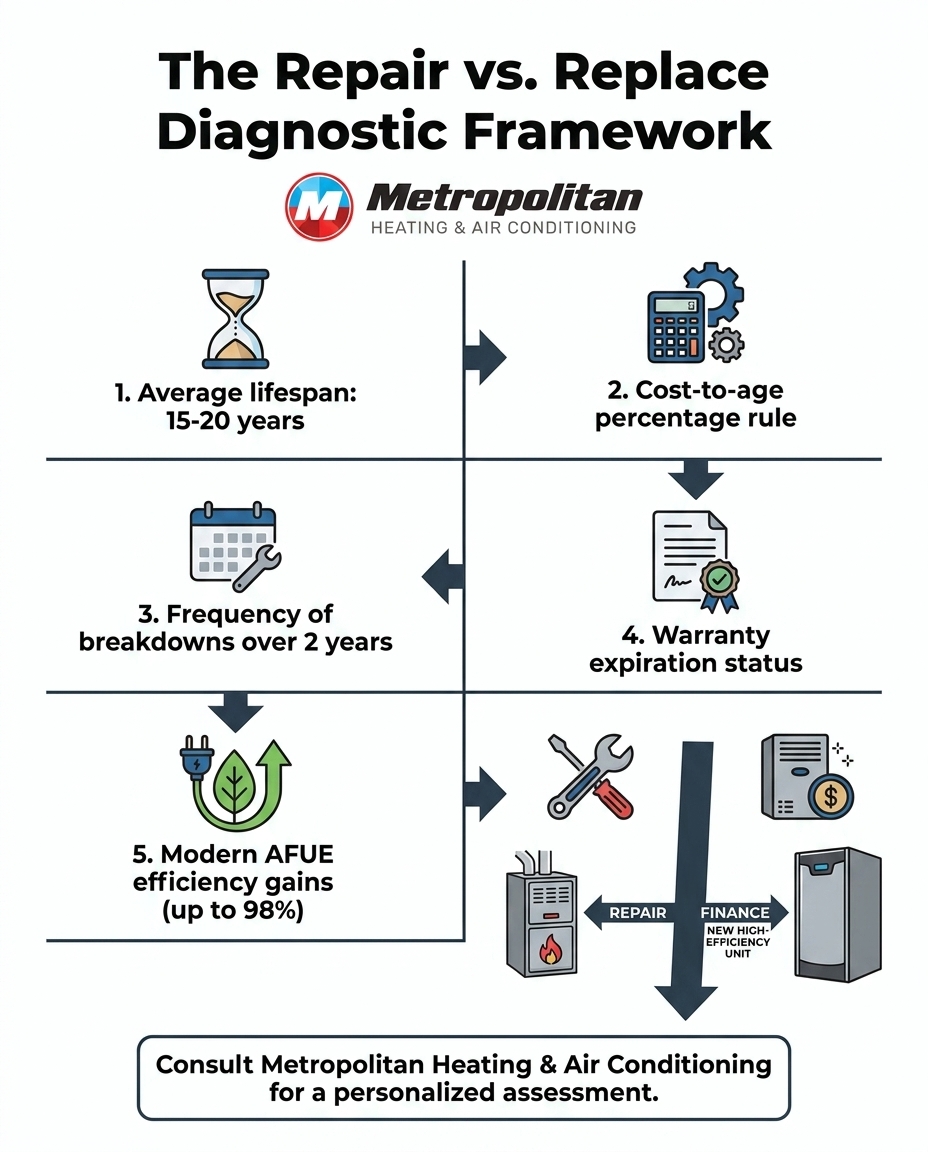
To help homeowners navigate this stressful decision, we rely on a transparent, consultative approach. We share the exact objective decision matrix our technicians use in the field, completely free from pushy sales tactics. With our extensive experience serving the area, our daily field diagnostic experience at Metropolitan Heating & Air Conditioning proves that evaluating a few core metrics provides a clear, undeniable answer to the repair-versus-replace question.
When assessing a failing system, we walk through the following structured framework:
1. Evaluate the Warranty Status: The moment a manufacturer's warranty expires, all financial liability shifts to the homeowner. If the unit is past its 10- or 15-year warranty mark, any major component failure requires serious scrutiny before proceeding with a repair.
2. Track the Breakdown Frequency: We review the system's history over the past two heating seasons. If the furnace has required multiple service calls, sensor replacements, or emergency resets recently, the unit is signaling a systemic decline rather than an isolated issue.
3. Assess the Cost-to-Age Ratio: We calculate whether the quoted repair exceeds a sensible percentage of the cost of a new installation. If the repair requires a massive investment just to keep a degraded system limping along, replacement is almost always the mathematically sound choice.
4. Compare Technological Generations: We look at the existing technology versus current standards. For instance, comparing single-stage vs. two-stage furnaces reveals massive differences in comfort and efficiency that a 15-year-old single-stage unit simply cannot match.
Calculating the Cost-to-Age Ratio
The cost-to-age ratio is the most powerful tool in our diagnostic framework. To use it, you take the estimated repair cost (expressed as a percentage) and weigh it against the age of the equipment. A widely accepted industry standard is the "5,000 rule." You multiply the age of the equipment by the estimated cost of the repair. If the resulting number exceeds 5,000, replacing the unit is the better financial decision.
Alternatively, a simpler percentage rule applies: if a furnace is over 15 years old and the repair cost approaches or exceeds a third of the cost of a new, high-efficiency replacement, sinking more money into the old system becomes financially unsound. Our goal is to prevent you from paying for a new furnace piece by piece, only to still be left with a 15-year-old core system.
Financing as a Predictable Budgeting Strategy
One of the main reasons homeowners hesitate to replace an aging furnace is the perceived upfront burden. However, it is essential to reframe financing from a mere payment option into a strategic tool for predictable monthly comfort. When a 15-year-old out-of-warranty furnace breaks down, it forces an unpredictable, out-of-pocket emergency repair spike. You are suddenly forced to drain cash reserves for a temporary fix.
Financing allows you to bypass the cycle of emergency repairs and upgrade to high-efficiency technology immediately. Instead of waiting for the system to fail completely on the coldest night of the year, you can secure a stable, predictable monthly investment. This proactive approach gives you total control over your household budget. To see how these upgrades can fit into your financial plan, you can review current HVAC installation promotions.
Furthermore, upgrading to a modern system often opens the door to generic provincial and federal energy efficiency rebates available in Ontario for qualifying high-efficiency upgrades. While programs and qualification criteria change, replacing an outdated, energy-wasting unit with a certified high-efficiency model frequently makes you eligible for incentives that help offset the overall investment.
Beyond rebates, the most significant financial benefit of financing a new unit is the peace of mind that comes with comprehensive manufacturer warranties. A new installation resets the clock, ensuring that if a component fails in the next decade, you are protected from the sudden, massive out-of-pocket expenses associated with older units.
Efficiency Gains: Old Technology vs. Modern AFUE Ratings
The financial math of replacing a furnace extends far beyond the initial installation or repair quote. You must also factor in the month-over-month operational costs. This is where Annual Fuel Utilization Efficiency (AFUE) ratings become a critical part of the conversation. AFUE measures how efficiently a furnace converts fuel into usable heat.
Modern high-efficiency furnaces can achieve AFUE ratings of up to 98 percent. This means that for every unit of energy consumed, 98 percent is converted directly into heat for your home, with only a tiny fraction escaping as exhaust. In contrast, a 15-year-old furnace might have been rated at 80 or 90 percent when it was brand new. However, after a decade and a half of mechanical wear, soot buildup, and general degradation, its actual operational efficiency is likely much lower.
The cost of energy waste: When you choose to repair a degraded 15-year-old model, you are actively choosing to continue paying higher utility bills. The system must run longer and burn more fuel to maintain the temperature on your thermostat. Over the course of a long, severe winter, this energy waste adds up significantly.
In our experience installing high-efficiency systems across Scarborough, we have seen that the long-term utility consumption differences play a massive role in the overall financial decision. The monthly savings generated by a 98 percent AFUE furnace can often help offset the predictable monthly cost of financing the new unit, making the upgrade a highly efficient use of your household budget.
Side-by-Side: Repairing vs. Upgrading Your System
To synthesize these themes and help you make a final, confident decision, it helps to look at a direct, scannable comparison. Evaluating the short-term realities against long-term benefits clarifies exactly what you are paying for.
• Reliability — Repairing a 15-Year-Old Furnace: Short-term fix; high risk of secondary component failures. — Financing a New High-Efficiency Unit: Long-term reliability with brand-new, factory-tested components.
• Financial Predictability — Repairing a 15-Year-Old Furnace: Unpredictable future repair costs and sudden emergency spikes. — Financing a New High-Efficiency Unit: Stable, predictable monthly financing investment.
• Parts Availability — Repairing a 15-Year-Old Furnace: Potential wait times and supply chain delays for obsolete parts. — Financing a New High-Efficiency Unit: Readily available modern components; minimal downtime.
• Energy Efficiency — Repairing a 15-Year-Old Furnace: Degraded performance resulting in high monthly utility waste. — Financing a New High-Efficiency Unit: Optimized performance with AFUE ratings up to 98 percent.
• Warranty Protection — Repairing a 15-Year-Old Furnace: Out-of-warranty; homeowner bears 100% of the financial risk. — Financing a New High-Efficiency Unit: Comprehensive new manufacturer warranties included.
Recently, a local Scarborough customer reached out to Metropolitan Heating & Air Conditioning about a 28-year-old leaking furnace that was severely past its prime. Instead of pushing a fast replacement, our team took the time to explain this exact diagnostic framework, answering all their questions so they understood the pros and cons clearly. They chose to upgrade, and the resulting neat, tidy installation provided immediate peace of mind and vastly improved comfort.
If you are tired of wondering if your aging system will make it through the night, consulting with experienced Scarborough HVAC technicians ensures you get an objective evaluation tailored to your specific home and equipment.
Secure Your Home's Winter Comfort Today
Making an objective, mathematically sound decision about your heating system protects both your home's safety and your household budget. Relying on an aging, out-of-warranty furnace during a severe cold snap is a risk that often leads to uncomfortable nights, frozen pipes, and massive emergency repair bills.
Our years of field experience at Metropolitan Heating & Air Conditioning prove that evaluating the cost-to-age ratio and understanding the compounding risks of old equipment is the best way to move forward. Having a predictable, reliable high-efficiency heating system in place before the worst of winter hits gives you ultimate peace of mind. We encourage you to explore flexible financing options today to make the transition to a modern, high-efficiency unit seamless, affordable, and stress-free.
Frequently Asked Questions
Is it worth repairing a 15-year-old furnace?
In most cases, sinking significant funds into a 15-year-old furnace is not mathematically sound. At this age, systems are typically out of warranty, meaning you bear the full financial risk of the repair. Additionally, fixing one part often leads to a chain reaction where other aging components fail shortly after. It is usually more practical to invest that money toward a reliable, modern replacement.
When should you replace your furnace instead of repairing it?
You should strongly consider replacing your furnace when the cost of a repair exceeds a significant percentage of a new unit's value. Other major indicators include frequent breakdowns over the past two seasons, rising utility bills due to degraded efficiency, and the expiration of the manufacturer's warranty. If your system requires obsolete parts that take weeks to arrive, replacement is the safer choice.
How long do high-efficiency furnaces last?
A modern, well-maintained high-efficiency gas furnace typically lasts between 15 and 20 years. To achieve this maximum lifespan, the system requires annual professional maintenance, regular filter changes, and prompt attention to minor operational issues. Proper sizing and professional installation also play a massive role in how long the equipment will operate reliably.
Should I finance a new furnace or pay for repairs?
Financing a new furnace is often the smarter budgeting strategy because it replaces unpredictable, massive emergency repair spikes with a stable, predictable monthly investment. Instead of draining cash reserves to keep a failing, inefficient system limping along, financing allows you to enjoy the immediate utility savings and warranty protection of a brand-new unit.
Are there generic rebates available for high-efficiency furnace upgrades in Ontario?
Yes, there are frequently generic provincial and federal energy efficiency rebates available in Ontario for qualifying high-efficiency upgrades. These programs are designed to incentivize homeowners to replace older, energy-wasting units with modern equipment that meets strict performance standards. Because program details change regularly, it is best to verify current qualifications with your utility provider or HVAC contractor.
How do technicians calculate the cost-to-age ratio for furnace repairs?
Technicians calculate the cost-to-age ratio by weighing the estimated repair cost against the age of the equipment. A common method is multiplying the age of the unit by the repair cost; if the result exceeds a specific threshold, replacement is recommended. Alternatively, if a repair on an older unit approaches one-third of the cost of a new installation, the framework strongly advises upgrading instead of repairing.
Schedule Expert Service
Or Contact Us
Other Blogs
testimonials
hear what our satisfied clients have to say

where we operate
Service areas
contact us
Let’s get in touch!