
Waking Up to a System Failure: Do You Need Immediate Help?
Are you staring at a blank thermostat at 3:00 AM, wondering exactly what constitutes a true HVAC emergency in the middle of the night? At Metropolitan Heating & Air Conditioning, our team fields countless late-night calls from frantic homeowners experiencing exactly this. Waking up to a freezing house, strange metallic noises, or an unusual smell coming from your vents is a stressful experience. It is easy to panic when your home comfort system suddenly shuts down, especially during deep winter (sub-zero Scarborough nights) when the indoor temperature begins to plummet rapidly. However, in our years of serving the local community, we always remind customers that not every late-night malfunction requires an immediate dispatch from a technician.
The key to handling an unexpected breakdown is practicing objective HVAC triage. This means calmly evaluating the situation to determine if you are facing a genuine hazard to your health or property, or simply a nuisance breakdown that can wait a few hours. A nuisance issue might be a mild temperature fluctuation or a noisy fan motor, whereas a critical failure involves life-safety risks or the imminent threat of catastrophic water damage. When evaluating your home's HVAC systems for a potential emergency, understanding this difference prevents unnecessary stress and helps you make a safe, informed decision.
Identifying Immediate Life-Safety and Health Hazards
The absolute highest priority during any late-night equipment failure is life safety. Your heating and cooling equipment relies on high-voltage electricity, natural gas, or propane to operate. When these core components fail dangerously, protecting your family takes precedence over repairing the machinery. Certain warning signs indicate an immediate threat that requires you to evacuate the home and contact emergency responders before you even think about calling an HVAC technician.
If you ever detect the distinct "rotten egg" smell of a natural gas leak, you are facing a severe emergency. Natural gas is highly combustible. If you smell gas, do not turn on lights, do not unplug appliances, and do not use your cell phone inside the house. Evacuate all family members and pets immediately, leave the doors open to ventilate, and call your local gas utility or the fire department from a safe distance outside.
Responding to Carbon Monoxide Alerts
Carbon monoxide (CO) is a dangerous byproduct of incomplete combustion in gas furnaces. Because it is completely colorless, odorless, and tasteless, you cannot rely on your senses to detect it. You must rely strictly on your safety equipment.
• Trust the alarm: If your carbon monoxide detector alerts sound, treat it as a confirmed emergency.
• Evacuate immediately: Get everyone, including pets, out into the fresh air right away.
• Do not investigate: Never attempt to open the furnace cabinet or investigate the source of the leak yourself when CO is suspected. Let emergency services clear the home first.
Electrical Burning Smells vs. Normal Dust
Electrical hazards are another common source of late-night panic. It is important to differentiate between normal operational odors and dangerous electrical faults. When you turn your furnace on for the first time in the fall, it is entirely normal to smell a brief, dusty burning odor. This is simply the system burning off settled dust from the heat exchanger, and the smell usually dissipates within an hour.
However, an acrid, persistent smell of burning plastic or ozone is a major red flag. If you notice scorch marks near the unit, see sparking wires, or smell melting electrical components, you have an active fire hazard. If it is safe to do so without touching the unit itself, shut off the power to the system at your main electrical breaker panel, and contact emergency services.
The Threat of Property Damage During Extreme Weather
While summer air conditioning failures are incredibly uncomfortable, winter heating failures pose a direct threat to the structural integrity of your home. When a furnace dies entirely overnight, a house can lose heat at an alarming rate, especially during deep winter (sub-zero Scarborough nights). With Scarborough winter temperatures frequently dropping well below freezing, the risk of extreme indoor temperature drops accelerates rapidly.
The primary danger of a complete heating failure is the cascading effect it has on your plumbing. If the indoor temperature drops below 13 degrees Celsius (55 degrees Fahrenheit) for an extended period, the water sitting inside your pipes can begin to freeze. As water freezes, it expands, putting immense pressure on copper and PEX piping. A burst pipe can unleash hundreds of gallons of water into your drywall, flooring, and foundation before you even realize it has happened. This imminent threat of catastrophic water damage elevates a winter breakdown from a mere inconvenience to a true property emergency.
Our technicians recently helped a local homeowner who experienced this exact threat when their rooftop furnace failed during a severe stretch of weather with a -30 windchill. Recognizing the immediate danger to their property, they reached out to our team for help. We were able to install a new unit on the next business day, restoring the heat quickly and preventing the pipes from freezing. If you find yourself in a similar situation, monitoring your indoor temperature closely is critical while you arrange for HVAC services in Scarborough.
Nuisance Breakdowns: What Can Safely Wait Until Morning?
Fortunately, the vast majority of late-night HVAC issues are nuisance breakdowns. These are malfunctions that are certainly inconvenient and frustrating, but they do not put your life, health, or property at immediate risk. Recognizing these non-threatening issues can save you from a night of panic and allow you to safely go back to sleep until normal business hours resume.
A nuisance breakdown might include a blower motor that suddenly starts rattling, a system that runs continuously without reaching the set temperature, or a clogged air filter causing the unit to short-cycle. While these symptoms mean your system needs professional attention, they do not require a 3:00 AM emergency dispatch.
This is especially true for summer cooling failures. While a sudden AC shutdown during a heatwave is severely uncomfortable, it rarely poses the same immediate structural risks as a winter freeze. For example, one of our Scarborough customers had their air conditioning go down late on a Thursday night during the summer. Recognizing that it was not a safety hazard, they simply turned the system off and waited until morning. One of our technicians arrived the next day and had the AC up and running in ten minutes. When you need AC repair, shutting the system off at the thermostat and waiting for daylight is often the most prudent choice.
Tips for staying comfortable until morning:
• In winter: Gather extra blankets, close the doors to unused rooms to trap existing heat, and use safe, localized space heaters (keeping them far away from flammable materials).
• In summer: Open windows if the night air is cooler, utilize ceiling fans to create a wind-chill effect, and stay hydrated.
Safe Triage Steps to Take While Waiting for Dispatch
If you have determined that your situation is not a life-safety hazard but your system is still malfunctioning, there are a few safe, basic checks you can perform. It is critical to emphasize that homeowners should never attempt internal repairs on equipment that requires a licensed professional. Opening the furnace cabinet, handling refrigerant lines, or testing high-voltage capacitors can lead to severe injury or further damage to the unit.
However, you can safely check external factors that might be causing the issue. Sometimes, the solution is surprisingly simple.
1. Check the thermostat: Ensure the display is on. If it is blank, replace the batteries. Verify that it is set to the correct mode ("Heat" or "Cool") and that the temperature is set above or below the current room temperature as needed.
2. Verify the power switches: Check the dedicated power switch located near the indoor unit (it looks like a standard light switch) to ensure it wasn't accidentally bumped to the "OFF" position. Then, check your main electrical panel to see if the dedicated circuit breaker has tripped.
3. Inspect the air filter: A severely clogged air filter can restrict airflow so much that the system shuts itself down to prevent overheating. If the filter is caked in dust, replace it with a clean one.
If you perform these basic checks and the system still will not turn on, or if strange noises persist, safely turn off the thermostat and leave the system off. Understanding how water heaters and HVAC systems interact and share utility spaces means you should always err on the side of caution. If your carbon monoxide detector alerts sound at any point during your checks, evacuate immediately.
Your Late-Night HVAC Triage Checklist
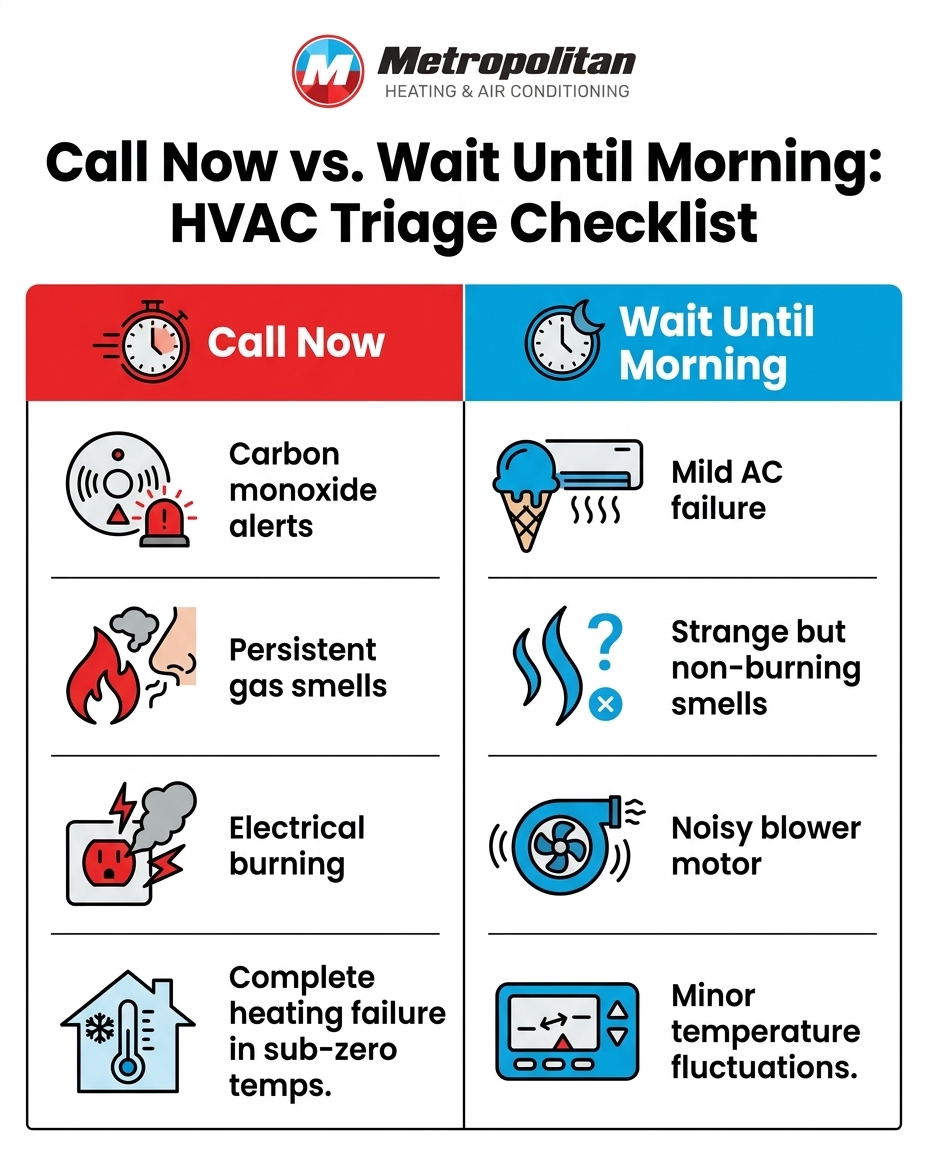
To help you make a clear, objective decision when you are half-awake and stressed, use this safety-first triage framework. It summarizes the criteria for immediate action versus issues that can safely hold off until sunrise.
• Carbon monoxide detector alerts sounding — Triage Category: Call Now (Life Safety) — Recommended Action: Evacuate immediately and call 911 or the gas company.
• Persistent "rotten egg" gas smell — Triage Category: Call Now (Life Safety) — Recommended Action: Evacuate immediately; do not use electrical switches.
• Acrid electrical burning smell or sparking wires — Triage Category: Call Now (Fire Hazard) — Recommended Action: Shut off breaker if safe, evacuate, and call emergency services.
• Complete heating failure during deep winter (sub-zero Scarborough nights) — Triage Category: Call Now (Property Risk) — Recommended Action: Call for emergency HVAC dispatch to prevent frozen pipes.
• Mild AC failure or warm air blowing in summer — Triage Category: Wait Until Morning — Recommended Action: Turn system off, use fans, and schedule normal service.
• Strange rattling, squealing, or non-burning smells — Triage Category: Wait Until Morning — Recommended Action: Turn system off to prevent damage and call in the morning.
Frequently Asked Questions About Late-Night HVAC Failures
Is a broken furnace considered an emergency?
A broken furnace is considered an emergency if the outside temperatures are below freezing and your indoor temperature is dropping rapidly. In deep winter conditions, a lack of heat can lead to frozen and burst water pipes, causing catastrophic property damage. If the weather is mild and your home is retaining heat, it is generally safe to wait until morning to schedule a repair.
Should I turn off my HVAC if I smell burning?
Yes, you should immediately turn off your HVAC system if you smell an acrid, electrical burning odor. A persistent smell of burning plastic or ozone indicates a potential electrical fire or melting components. Shut the system down at the thermostat, and if it is safe to do so, flip the dedicated breaker in your electrical panel before calling for professional help.
What is an HVAC emergency?
An HVAC emergency is any situation that poses an immediate threat to your life, health, or property. This includes suspected natural gas leaks, carbon monoxide detector alerts, electrical fires, and complete heating failures during sub-zero weather that threaten to freeze your plumbing. Minor leaks, strange noises, or mild discomfort do not typically qualify as true emergencies.
How cold does a house have to be for an emergency?
A house enters the emergency danger zone when the indoor temperature drops to 13 degrees Celsius (55 degrees Fahrenheit) or below during a winter freeze. At these temperatures, the water inside exterior-facing walls and uninsulated pipes is at a high risk of freezing and bursting. If your home is rapidly approaching this temperature, you need immediate heating assistance.
Will an overnight AC failure damage my home?
An overnight air conditioning failure will not cause structural damage to your home. While it can be incredibly uncomfortable to sleep in a warm, humid house, the lack of AC does not pose the same property risks as a winter heating failure. You can safely turn the system off, open windows or use fans, and wait for normal business hours to call a technician.
How do I safely turn off my system if I suspect an issue?
To safely turn off your system, start by switching your thermostat to the "OFF" position. If the system continues to run or if you suspect an electrical issue, locate your home's main electrical panel and flip the dedicated HVAC circuit breaker to the off position. Never attempt to open the equipment cabinet or pull internal disconnects if you suspect a serious electrical fault.
Secure Dependable Dispatch When You Need It Most
Understanding exactly what constitutes a true HVAC emergency in the middle of the night brings peace of mind when the unexpected happens. By using a safety-first triage framework, you can confidently determine whether you are dealing with a simple nuisance breakdown or a critical situation. When you know the difference, you can protect your home from the genuine threats of deep winter (sub-zero Scarborough nights) without panicking over minor inconveniences.
If your late-night triage indicates a genuine safety hazard or a severe property risk, do not hesitate to reach out for professional help. Working with our dedicated team at Metropolitan Heating & Air Conditioning ensures that you receive immediate attention when it matters most, without exploiting your panic for a minor fix. We provide dependable, prioritized dispatch for true safety-risk scenarios. If you are facing a critical overnight failure, contact us for reliable emergency heating service, and get the expert solution you need to restore your home's safety and comfort.
Schedule Expert Service
Or Contact Us
Other Blogs
testimonials
hear what our satisfied clients have to say

where we operate
Service areas
contact us
Let’s get in touch!