
Is Your Air Conditioner Running but Blowing Warm Air?
When you are trying to understand Why Your AC is Running but Not Cooling: Diagnosing the Mid-Summer Airflow Drop is the first critical step to restoring comfort in your home. Is your AC actually broken—or just struggling to keep up with the heat? It is a stressful moment when the afternoon temperatures peak, your thermostat reads a sweltering 80 degrees inside, and yet you can hear your system running continuously. You place your hand over the supply vent, only to feel room-temperature or distinctly warm air blowing out. The immediate panic is understandable, especially during a heatwave when a functioning cooling system is a necessity rather than a luxury.
When this happens, you are facing a specific mechanical disconnect. Your home's central cooling setup relies on two entirely separate components to keep you comfortable. The indoor blower fan is responsible for circulating air through the ductwork, while the outdoor compressor is responsible for actively extracting heat and cooling that air. If you feel warm air coming from the vents, the indoor fan is still doing its job, but the outdoor cooling cycle has completely stopped. To get your home comfortable again, you need to address the root cause of this failure before the system sustains permanent damage. Whether you are dealing with a frozen coil or a tripped safety switch, understanding your air conditioning systems is the key to knowing whether to turn it off, change the filter, or schedule emergency AC repair in Scarborough.
Understanding the Disconnect: Blower Fan vs. Compressor Mechanics
To understand why your vents are blowing warm air while the system sounds like it is working perfectly, you have to look at the mechanical reality of split-system air conditioners. In our years of experience repairing units throughout Scarborough, the team at Metropolitan Heating & Air Conditioning frequently sees homeowners confused by this exact issue. The term "split-system" refers to the fact that the equipment is divided into two main halves. Inside your home, usually in the basement or a utility closet, sits the air handler. This unit contains the evaporator coil and the blower fan. Outside your home sits the condenser unit, which houses the compressor, the condenser coil, and the outdoor fan.
These two halves communicate via electrical signals from your thermostat and physical refrigerant lines. When the system is operating normally, the indoor blower fan pulls warm air from your rooms, pushes it over the cold indoor evaporator coil, and blows the newly chilled air back into your living spaces. Meanwhile, the outdoor compressor pumps the heat-laden refrigerant outside to release that captured heat into the ambient air. However, these components operate on separate electrical circuits. If the outdoor compressor shuts down due to a mechanical failure, an electrical fault, or an automated safety switch, the indoor blower fan will often continue to run, blissfully unaware that the cooling process has stopped. It simply recirculates the existing warm air through your house.
The Danger of Liquid Refrigerant Flowback
One of the most common mistakes our technicians see homeowners make when they notice warm air blowing from the vents is leaving the system running in hopes that it will eventually "catch up." This is a dangerous gamble. If the airflow over the indoor evaporator coil is restricted, the heat exchange process halts. The refrigerant inside the coil relies on the warm air from your home to boil from a cold liquid into a warm gas.
Why this matters for your equipment:
• Phase change failure: Without enough warm airflow, the refrigerant never absorbs enough heat to turn into a gas.
• Compressor destruction: Compressors are designed to pump vapor, not liquid. If unevaporated liquid refrigerant travels down the suction line and enters the compressor, it can cause a catastrophic mechanical failure known as "liquid slugging."
• Complete system loss: A ruined compressor is often the most expensive component in the entire system, sometimes requiring a total unit replacement.
During a humid mid-summer in Southern Ontario, the environmental strain on these mechanical components is immense. The specific climate factors at play often trigger these mechanical disconnects, forcing the outdoor unit to shut down to protect itself while the indoor fan keeps pushing warm air.
The Physics Behind Frozen Evaporator Coils
When an air conditioner is running but fails to cool, a frozen evaporator coil is one of the most frequent culprits we encounter in the field. It sounds counterintuitive that an air conditioner could freeze solid in the middle of July, but the physics of refrigeration make it a very common reality. Your AC unit does not actually "create" cold air; it absorbs heat from the indoor air. As it absorbs this heat, the internal temperature of the evaporator coil drops significantly.
Under normal conditions, the constant flow of warm air from your home keeps the coil's temperature just above the freezing point. However, if something restricts that airflow—such as a heavily soiled air filter, blocked return vents, or a failing blower motor—the coil gets too cold. The moisture in the air condenses on the freezing metal fins and rapidly turns to ice. Once a thin layer of ice forms, it acts as an insulator, further blocking airflow and causing the ice block to grow exponentially until the entire coil is encased in a solid block of ice.
The Role of Latent Cooling in Humid Climates
To fully grasp why freezing happens so quickly, you must understand the difference between sensible cooling and latent cooling. Scarborough and the GTA's high summer humidity drastically increases the latent cooling load on your equipment, forcing systems to work overtime on moisture extraction and accelerating the potential for coil freezing.
• Sensible Cooling — What It Does: Lowers the actual temperature of the air in the room (what you see on the thermostat). — Impact on Your AC System: Requires steady airflow over the coil to transfer heat efficiently.
• Latent Cooling — What It Does: Removes humidity and moisture from the indoor air, making it feel less sticky. — Impact on Your AC System: Forces massive amounts of condensation to form on the evaporator coil.
During a humid heatwave, your system might extract 5 to 20 gallons of water daily from the indoor air. This massive latent cooling load means the evaporator coil is constantly dripping wet. If the airflow drops even slightly due to a dirty filter, or if the system is low on refrigerant (which also causes the coil temperature to plummet), that heavy condensation freezes instantly. The solid physical barrier of ice completely chokes off the air passing through the cooling fins, resulting in warm air at the vents and a struggling compressor outside.
How Clogged Condensate Drains Trigger System Shutdowns
If your evaporator coil is not frozen, the secondary major cause of a system blowing warm air is a clogged condensate drain line. As we established, a healthy air conditioner pulls gallons of moisture out of your indoor air every single day. All of that water drips off the evaporator coil into a shallow drain pan sitting beneath the unit. From there, gravity feeds the water into a PVC pipe—the condensate drain line—which routes the water safely outside or into a floor drain.
Because this drain pan and pipe are constantly dark, damp, and exposed to the dust particles that make it past your air filter, they become the perfect breeding ground for algae, mold, and sludge. Over months and years, this biological growth combines with dirt to form a thick, gelatinous clog in the narrow PVC pipe. Mid-summer heatwaves are the peak time for drain clogs because the system is extracting maximum moisture, quickly overwhelming a partially blocked pipe.
Why Float Switches Protect Your Home
In decades past, a clogged drain line meant the drain pan would simply overflow, sending gallons of water through your ceiling or across your basement floor. Today, modern air conditioning systems are equipped with a crucial safety device called a condensate float switch.
How the safety mechanism works:
• Water level rises: As the clog prevents water from escaping, the drain pan begins to fill up.
• The switch floats: A small, buoyant mechanism inside the switch rises with the water level.
• The circuit breaks: Once the water reaches a critical threshold, the switch trips and severs the low-voltage electrical connection to the outdoor compressor.
• The fan continues: Because the switch only cuts power to the cooling cycle, the indoor blower fan continues to run, blowing uncooled air through the home.
While the sudden loss of cooling is frustrating, this safety shutoff is actually the system protecting your property from severe water damage. One local Scarborough homeowner reached out to us during a hot summer day when their AC suddenly stopped working and the house grew uncomfortably warm. They needed urgent relief, and our technician Steve arrived promptly, diagnosing a blocked drain system and a tripped float switch, and had the AC fixed in under 20 minutes to restore comfort. The system did exactly what it was supposed to do: it stopped cooling to prevent a flood.
Immediate Safe Actions: What to Do Before Calling a Professional
When you realize your system is running but blowing warm air, your immediate actions dictate how quickly the system can be repaired. Continuing to run a struggling unit will only exacerbate the damage. Based on the hundreds of emergency calls our Metropolitan Heating & Air Conditioning team answers each summer, there are several safe, non-DIY-repair steps you can take to mitigate damage, prepare the system for professional diagnostics, and potentially restore baseline airflow.
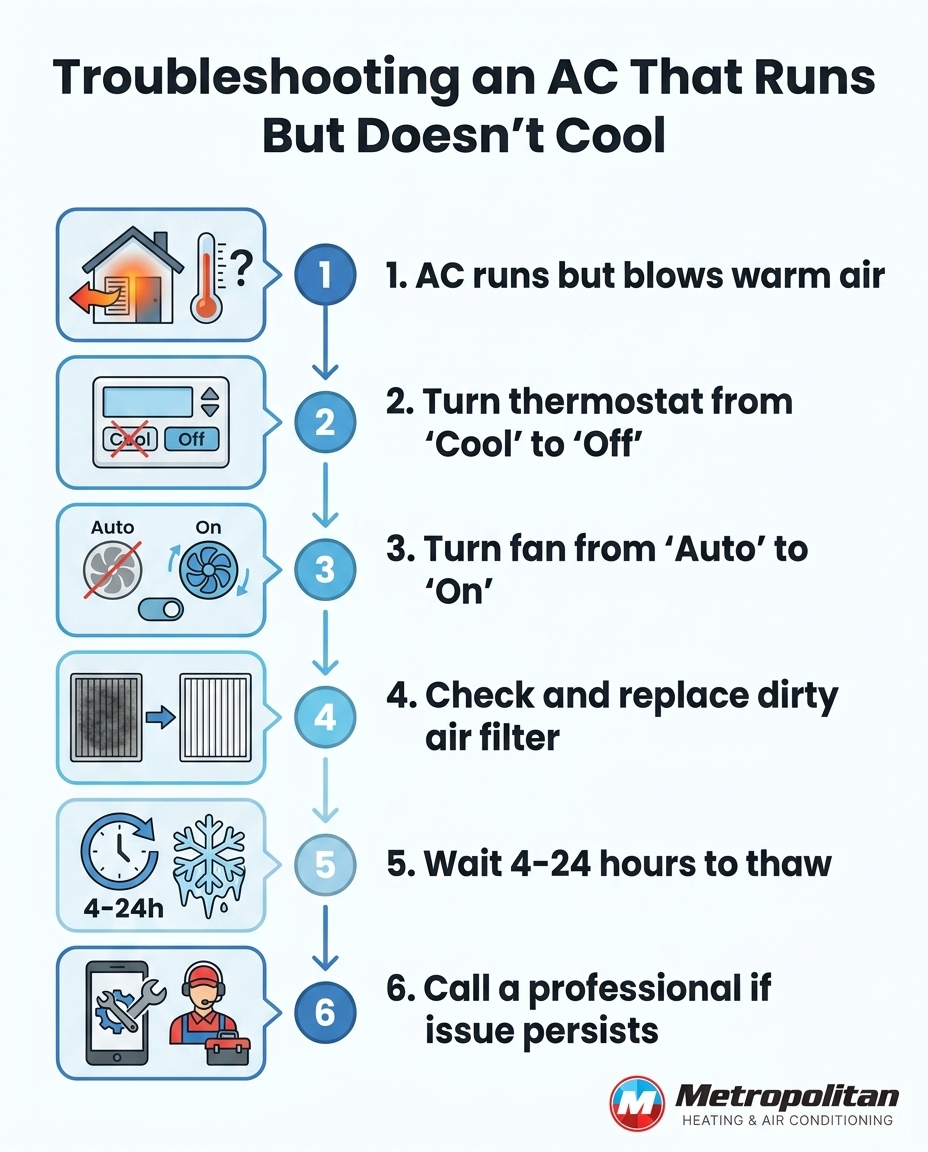
Step 1: Shut Down the Cooling Cycle
Walk to your thermostat immediately and switch the system from 'Cool' to 'Off'. Stopping the demand for cooling is absolutely critical. If the coil is frozen, continuing to demand cold air will only build a thicker block of ice and risk destroying the compressor via liquid refrigerant flowback. If the drain is clogged, stopping the cooling cycle stops the production of condensation, preventing any further water from backing up into the drain pan.
Step 2: Run the Fan to Accelerate Thawing
Once the cooling cycle is entirely off, look for the fan setting on your thermostat. Switch it from 'Auto' to 'On'. By forcing the indoor blower fan to run continuously while the outdoor compressor remains off, you are pulling the ambient warm air from your home and pushing it over the frozen evaporator coil. This ambient air acts as a safe, gentle heat source that helps melt the ice block much faster than leaving it to thaw passively.
Step 3: Inspect the Air Filter
While the system is thawing, locate your return air filter. Pull it out and hold it up to a light source. If you cannot see light shining through the material, the filter is severely clogged and must be replaced. A filter caked with dust and pet hair is the number one cause of restricted airflow and frozen coils. Replacing it restores the baseline airflow necessary for the system to function. Keeping up with routine AC maintenance and changing your filter every 30 to 90 days is the best defense against this specific failure.
Important Safety Warning: Never attempt to chip away ice from the delicate aluminum fins of the evaporator coil with a tool, as you will puncture the pressurized refrigerant lines. Furthermore, never attempt to unclog deep drain lines with harsh chemical drain cleaners, and never handle refrigerant yourself. These tasks require professional tools and licensing.
Frequently Asked Questions About Mid-Summer AC Failures
When a cooling system fails during a humid mid-summer in Southern Ontario, homeowners often have the same pressing concerns. Below are the definitive answers to the most common questions regarding airflow drops and system freezing, helping you understand the mechanics of your home comfort system while enhancing your indoor air quality through proper maintenance.
Why is my AC fan running but the air is warm?
The indoor blower fan is circulating air through your ductwork, but the outdoor compressor has stopped actively cooling that air. This disconnect usually happens due to an automated safety shutoff, a completely frozen evaporator coil blocking heat transfer, or an electrical failure at the outdoor unit. The fan continues to run because it operates on a separate circuit from the cooling machinery.
What causes an AC evaporator coil to freeze in high humidity?
Restricted airflow prevents the system from properly absorbing heat from your home, causing the internal temperature of the coil to drop below freezing. In high humidity, the massive amount of condensation pulled from the sticky indoor air freezes instantly upon contact with the cold metal. This creates a cascading effect where the ice further blocks airflow, causing the system to freeze solid very quickly.
Should I turn off my AC if it is not cooling?
Yes, you must immediately turn the cooling function off at the thermostat to prevent severe mechanical damage to the compressor. However, you should leave the fan setting to 'On' rather than 'Auto'. This stops the unit from trying to cool while using the ambient room air to help safely thaw any ice buildup inside the ductwork.
How do I fix an AC that is running but not cooling?
Start by turning the cooling cycle off to allow the system to thaw, and immediately check and replace a dirty air filter. If you restore airflow and the system still blows warm air after a few hours, professional diagnostics are required. You likely have a slow refrigerant leak or a deep condensate drain clog that requires specialized tools to resolve.
Will a frozen AC coil stop it from cooling entirely?
Yes, a frozen coil acts as a solid physical barrier inside your air handler. It completely blocks warm return air from passing through the cooling fins, meaning no heat exchange can take place. The blower fan will simply push the uncooled air around the ice block and back into your home, resulting in warm air at the vents.
How long does it take for a frozen AC coil to thaw?
It typically takes anywhere from 4 to 24 hours for a frozen evaporator coil to completely thaw, depending on the severity of the ice buildup and the ambient indoor temperatures. Running the fan continuously will speed up this process, but you must wait until the ice is entirely gone before attempting to turn the cooling cycle back on.
Fast, Professional Diagnostics When You Need Them Most
If you have shut down your system, replaced a dirty filter, and allowed ample time for any internal ice to thaw, yet the vents are still blowing warm air, you are likely dealing with a more complex mechanical failure. Issues like slow refrigerant leaks, failing blower motors, or deeply impacted condensate drain lines cannot be resolved with basic troubleshooting. Attempting to handle pressurized refrigerant or clear out sensitive plumbing without proper licensing often leads to further damage and voided warranties.
Another local resident recently found their air conditioner was not working properly right when they needed it most. Gord and our team arrived quickly, diagnosing the complex airflow drop and getting the system running quietly and efficiently again. Metropolitan Heating & Air Conditioning's expertise in diagnosing complex airflow issues quickly during peak summer heatwaves ensures you are never left waiting in discomfort. If your system is struggling to keep up, rely on professional cooling services to restore your home's comfort safely, accurately, and efficiently.
Schedule Expert Service
Or Contact Us
Other Blogs
testimonials
hear what our satisfied clients have to say

where we operate
Service areas
contact us
Let’s get in touch!