
The Illusion of the Clean Filter: Why Your AC Is Still Struggling
Changing your furnace filter every few months is a great habit, but assuming it covers all your maintenance needs is a costly misconception. In our years of servicing Scarborough homes, our team frequently hears homeowners ask, beyond the filter: what a proper air conditioning cleaning actually looks like, especially when their system seems to be running nonstop but the house still feels uncomfortably warm. Many homeowners experience reduced cooling efficiency because they mistakenly believe a clean filter equals a completely clean system. In reality, the internal evaporator and condenser coils inside your central split-system AC units are likely suffocating under layers of compacted debris. We often see this hidden grime drop a modern 16 SEER system's performance down to a 12 SEER equivalent. A simple surface dusting of the outer cabinet does nothing to restore true mechanical efficiency, leaving you paying higher energy bills for less comfort.
If you want to ensure your air conditioning systems operate smoothly without wasting electricity, understanding the mechanical difference between a basic wipe-down and a professional deep clean is the critical first step.
The hidden mechanics of airflow restriction:
• Bypassed debris: Even high-efficiency filters cannot catch 100% of airborne particles; microscopic dust inevitably slips through and settles on internal components.
• Micro-layer buildup: A layer of dust just one-hundredth of an inch thick on an evaporator coil can reduce system efficiency by over 5%.
• False confidence: Homeowners often hear their system running and assume all is well, not realizing the compressor is working overtime to compensate for restricted airflow.
The Mechanical Reality of Coil Suffocation
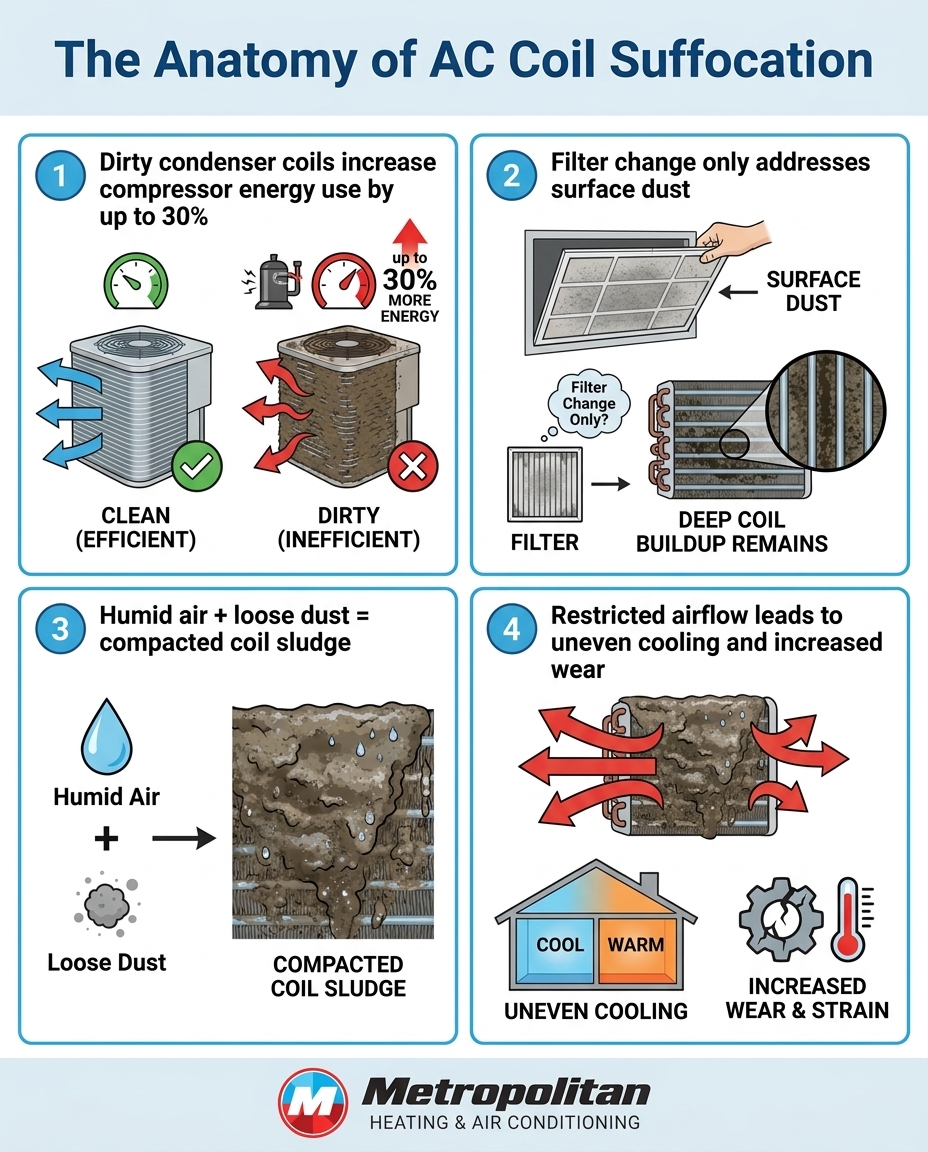
When debris bypasses the air filter, it doesn't just disappear. It settles directly onto the highly sensitive thermal transfer surfaces of your central split-system AC units. According to the U.S. Department of Energy, dirty condenser coils force the compressor to work significantly harder, which can increase the system's energy consumption by up to 30%. In our daily field work, we routinely find that a layer of dirt just 0.04 inches thick acts as an insulating blanket, trapping heat inside the system instead of allowing it to dissipate outside. As a result, your system runs longer cycles, struggling to reach the temperature set on your thermostat.
Mechanical removal of this embedded grime is vastly different from a light surface dusting. Our Metropolitan Heating & Air Conditioning technicians use specialized tools to penetrate the tiny, delicate aluminum fins that surround the coils. Because these fins are easily crushed or bent, attempting to scrub them with household brushes can cause permanent mechanical damage, severely restricting airflow even further. This is why true efficiency restoration requires professional AC maintenance in Scarborough rather than a DIY weekend project.
Evaporator vs. Condenser Coils
Understanding how your system suffocates requires looking at the two distinct halves of the mechanical cooling process. Each coil faces entirely different environmental threats.
• Evaporator Coil — Location: Indoors (above the furnace or air handler) — Primary Function: Absorbs heat and moisture from indoor air — Typical Debris Buildup: Pet dander, household dust, cooking oils, and biological growth (especially prevalent in older 1970s-1990s Scarborough bungalows)
• Condenser Coil — Location: Outdoors (the large metal cabinet) — Primary Function: Releases absorbed heat into the outside air — Typical Debris Buildup: Grass clippings, pollen (heavy during late May), dirt, leaves, and cottonwood seeds
While the indoor coil deals with the steady accumulation of household particulates, the outdoor unit is exposed to the elements 24/7. Both require a completely different chemical and mechanical approach to clean safely and effectively.
How High Humidity Accelerates Internal Grime Buildup
Your air conditioner does more than just lower the temperature; it acts as a massive dehumidifier for your entire home. During humid Scarborough summers, particularly throughout those muggy July and August heatwaves, the high summer dew points cause your system to pull gallons of moisture out of the indoor air every single day. This excessive condensation constantly coats the indoor evaporator coil in a layer of water. When loose household dust slips past the air filter and meets this wet surface, it doesn't just sit there like dry dust on a bookshelf—it turns into a compacted, sticky sludge.
Why humidity makes cleaning harder:
• Cement-like adhesion: The wet-dry cycling of the AC unit bakes the dust and moisture mixture onto the aluminum fins, creating a bond that standard vacuums cannot break.
• Biological growth: Dark, damp environments are breeding grounds for mold and mildew. If the sludge isn't removed, biological growth can quickly spread across the coil surface.
• Drainage blockages: As the heavy sludge washes down into the condensate drain pan, it frequently clogs the drain line. Our maintenance crews frequently pull out drain pans completely choked with this debris, which often leads to water backups in basements or utility closets.
Because this sticky grime is baked onto the metal, a simple wipe-down is entirely ineffective. The sludge fills the microscopic gaps between the cooling fins, choking off the very pathways the air needs to travel through. Removing it requires chemical breakdown, not just physical force.
Anatomy of a Professional Deep Coil Cleaning
A true deep cleaning of central split-system AC units is a methodical, highly technical process. It is designed to restore the equipment to factory-level performance without risking damage to the fragile components inside the cabinet. When our team performs this service, we follow a strict sequence of events to ensure every square inch of the heat transfer surface is cleared.
1. Safe Access and Isolation: The technician first disconnects all high-voltage power to the unit. They carefully remove the protective outer casing to expose the enclosed coil compartments, ensuring no electrical connections are stressed during panel removal.
2. Chemical Application: Instead of harsh household detergents, technicians apply specialized, non-corrosive foaming cleaners. These heavy-duty formulas are engineered to expand deep inside the coil fins, breaking down compacted sludge, biological growth, and baked-on dirt without etching the delicate aluminum.
3. Low-Pressure Rinsing: Once the chemical has lifted the debris, the coils are rinsed using controlled, low-pressure water flow. High-pressure power washers are never used, as they will instantly fold the aluminum fins flat and ruin the system.
4. Fin Straightening: Using specialized fin combs, the technician meticulously straightens any bent or crushed fins to ensure maximum, unobstructed airflow across the coil surface.
5. Comprehensive Inspection: With the components clean and visible, the technician can spot hidden issues. For instance, during a recent annual checkup on an older 3-ton unit in a Guildwood home, our thorough inspection alongside a cleaning revealed a small, hidden refrigerant leak that the homeowner hadn't noticed. By addressing it immediately, the system was fully restored before a major breakdown occurred.
The Critical Importance of Protecting Wires and Refrigerant Lines
One of the biggest risks of amateur cleaning attempts is the accidental damage to the vital lifelines of your central split-system AC units. Inside the cabinet, extremely fragile electrical wiring, delicate sensors, and highly pressurized copper refrigerant lines run tightly alongside the coils. Aggressive scrubbing, improper tool use, or yanking on panels can easily cause a wire to short out or, worse, crack a refrigerant line and release the system's vital cooling charge.
What our Metropolitan Heating & Air Conditioning installation team prioritizes when setting up a brand-new system is the exact same standard of meticulous care we apply to deep maintenance. We treat every wire and pipe with absolute precision. For example, when a local homeowner recently needed a completely new AC unit and modern R-410A coil installed, they noted how our team not only executed the complex technical setup flawlessly but left the job site spotless. We bring that identical methodology to deep cleaning. Treating maintenance with the same exacting standards as a new system setup ensures that the unit is not only clean but structurally sound and electrically safe. True efficiency restoration requires this level of mechanical respect.
The Compounding Impact of Airflow Restriction on Your Home
When the internal coils of your AC system are suffocating under a blanket of dirt, the consequences extend far beyond just the metal cabinet. The mechanical strain quickly translates into noticeable comfort and health issues throughout your living space, especially during humid Scarborough summers.
The ripple effects of a suffocating system:
• Uneven cooling: A suffocating system struggles to generate enough static pressure to push conditioned air to the furthest rooms of your home. You will likely notice the bedrooms upstairs remaining hot and stagnant while the main floor feels freezing.
• Degraded indoor air quality: Dirty, damp evaporator coils are notorious for circulating musty, "dirty sock" odors through the ductwork. If you are already focused on shielding your home against wildfire smoke or managing allergens, a contaminated coil will completely undermine those efforts by blowing biological particulates directly into your breathing air.
• Blower motor burnout: When airflow is restricted (sometimes by up to 40%), the indoor blower motor—especially sensitive variable-speed ECM motors—has to work much harder to pull air through the clogged fins. This added resistance increases the motor's operating temperature, wearing out the bearings prematurely and dramatically shortening the lifespan of an expensive component.
Connecting the concept of clean internal components to a healthier living environment is vital. A clean machine doesn't just cost less to operate; it actively contributes to a fresher, more comfortable home.
Moving from Reactive Fixes to Proactive System Care
The stark contrast between a superficial filter change and a comprehensive mechanical cleaning cannot be overstated. Waiting until your central split-system AC units are actively struggling to cool the house means you are already paying for wasted energy and putting unnecessary wear and tear on the compressor. Shifting your mindset from reactive repairs to proactive system care—such as booking a deep clean in early May before the summer rush—is the most effective way to protect your investment.
Regular, deep cleanings prevent the compounding costs of energy waste and premature part failure. By adopting a structured maintenance approach, you ensure that a professional is routinely monitoring the internal mechanics, applying non-corrosive treatments, and keeping the thermal transfer surfaces pristine. Enrolling in a preventative maintenance plan guarantees that your system receives this exacting level of care on a predictable schedule, keeping it running at peak efficiency year-round.
Integrating Air Quality Solutions
A holistic approach to home comfort often pairs mechanical deep cleaning with advanced filtration. Once the coils are professionally restored, upgrading your home's filtration or purification systems ensures that the internal components stay cleaner for longer, while simultaneously providing superior air quality for your family.
Frequently Asked Questions About Deep AC Cleaning
What does a professional AC cleaning include?
A professional cleaning goes far beyond a simple wipe-down of the outer cabinet. When our team handles a cleaning, it involves safely accessing the internal compartments of central split-system AC units to apply specialized, non-corrosive foaming chemicals to both the evaporator and condenser coils. Technicians also perform low-pressure rinsing, straighten bent aluminum fins, clear the condensate drain lines, and conduct a thorough mechanical inspection to catch hidden wear and tear.
Why is cleaning the AC evaporator coil important?
The evaporator coil is responsible for absorbing heat and pulling humidity out of your indoor air. Because it is constantly wet from condensation, it easily traps dust and pet dander, turning it into a thick, compacted sludge. Cleaning this coil prevents airflow restriction, stops musty odors from circulating through your home, and ensures the system doesn't freeze over due to poor thermal transfer.
How does a dirty AC coil affect cooling?
A dirty coil acts like a thick insulating blanket over the system's heat transfer surfaces. This prevents the refrigerant inside from effectively absorbing indoor heat or releasing it outside. As a result, the compressor has to run significantly longer cycles to reach your desired temperature, leading to uneven cooling, higher energy bills, and increased mechanical strain.
Can I clean my AC unit myself?
DIY cleaning is highly discouraged due to the extreme fragility of the internal components. Household brushes or high-pressure washers can easily crush the delicate aluminum fins, permanently restricting airflow. Furthermore, working around high-voltage electrical wiring and pressurized refrigerant lines without professional training poses serious safety risks and can result in costly damage.
How often should central split-system AC units be deep cleaned?
For optimal performance and longevity, we recommend central AC units receive a comprehensive deep cleaning and tune-up once a year, ideally in the spring (April or May) before the heavy cooling season begins. Regular annual maintenance prevents the compounding buildup of sludge and ensures the system operates at peak efficiency during the hottest months of the year.
What happens to an AC system when coils suffocate under compacted dirt despite a clean filter?
Even with a brand-new filter, suffocated coils force the system's blower motor and compressor to work against severe static pressure. The system will run continuously while failing to cool the home properly, drastically increasing your energy consumption. Over time, this constant mechanical strain leads to overheated motors, frozen indoor coils, and premature system failure.
Restoring True Cooling Efficiency to Your Home
True cooling efficiency requires far more than just swapping out a dirty furnace filter; it demands pristine internal mechanics. When you face the heavy demands of humid Scarborough summers, ensuring your coils are free of compacted sludge is the only way to guarantee reliable performance. Meticulous, professional care protects your investment, keeps your warranty intact, and restores your system to factory-level operation. If you are ready to experience the mechanical difference of a true deep clean, scheduling a professional tune-up is the smartest step you can take for your home's comfort.
Schedule Expert Service
Or Contact Us
Other Blogs
testimonials
hear what our satisfied clients have to say

where we operate
Service areas
contact us
Let’s get in touch!