
The Myth of the 'Bigger is Better' AC Upgrade
Buying a larger air conditioner doesn't mean you will finally push cold air to the top floor of your house. If you are wondering what happens when an AC unit is improperly sized for a Pickering townhome, the short answer is that a bigger system often makes your cooling problems worse. At Metropolitan Heating & Air Conditioning, our team frequently hears from homeowners who assume that stubbornly hot upstairs bedrooms are caused by a weak or undersized unit. They believe that upgrading to a massive, high-tonnage system will blast enough cold air to cool the entire structure evenly.
Here is the reality: an oversized system actually creates new comfort problems rather than solving your existing ones. Instead of delivering a steady, even flow of conditioned air, a system that is too large for your home will turn on, blast the main floor with freezing air, and shut off before that air ever reaches the upper levels. If you are exploring air conditioning solutions, understanding how these systems operate in multi-level structures is the first critical step toward true indoor comfort.
In many modern Pickering townhome developments, the architectural layout works against standard airflow rules. A massive air conditioner simply cannot overcome the basic physics of your home's design by brute force. To fix the issue, you have to look at how air actually moves through your house.
Understanding Vertical Airflow in Multi-Level Homes
To understand why oversized units fail, you first have to understand the architectural nuances of townhomes. Heating, ventilation, and air conditioning (HVAC) sizing is uniquely challenging in these structures because of how air naturally behaves.
The Physics of Heat Rise
Warm air naturally rises, while cold air sinks. In a multi-level structure, the heat from the main floor and the ambient heat from the roof both concentrate on the top floor. Your HVAC system has to work against gravity to push heavy, dense cold air up through the ductwork to reach those upper bedrooms. If the system doesn't run long enough, the cold air simply falls back down the staircases and settles on the main floor or in the basement.
Why Standard Square Footage Fails Multi-Level Homes
Standard square-footage sizing rules often fail to account for vertical layouts. A 1,500-square-foot single-story ranch home requires a very different cooling strategy than a 1,500-square-foot three-story townhome. In a single-story home, the air is distributed horizontally. The blower fan only needs enough power to push the air across one level. In a townhome, the air distribution behaves differently when forced up narrow stairwells and vertical duct runs.
When an inexperienced installer simply looks at the total square footage of Pickering townhome developments and slaps a large unit outside, they ignore the vertical challenge. The system has plenty of raw cooling power, but the airflow mechanics are completely unbalanced, leading to a host of frustrating symptoms.
Symptoms of an Improperly Sized Townhome AC
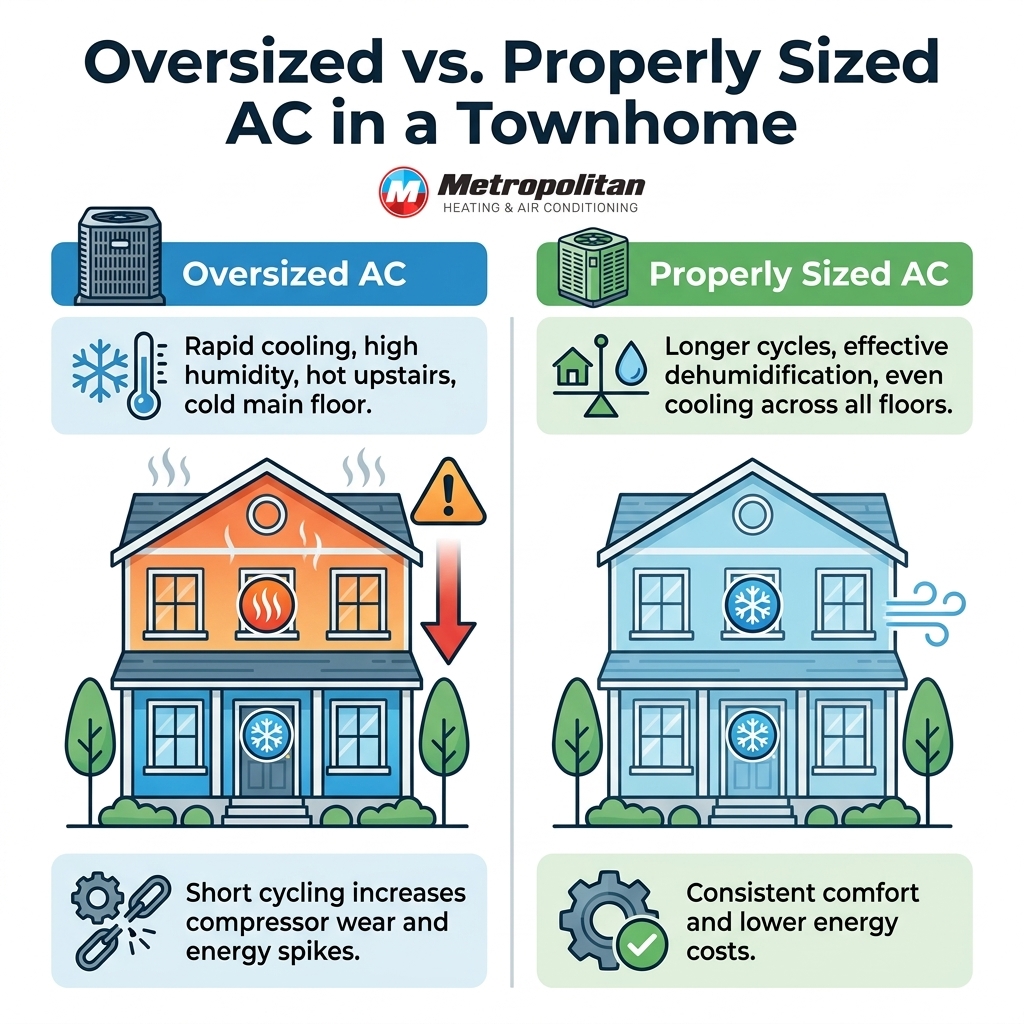
In our years of servicing HVAC systems across Scarborough and Pickering, we've found that the most common consequence of an oversized air conditioner is a mechanical behavior known as "short cycling." Short cycling occurs when the unit turns on, rapidly cools the immediate area around the thermostat, and shuts off entirely too fast—often within five to ten minutes. A properly sized system should run in longer, gentler cycles of 15 to 20 minutes to properly condition the whole house.
If you suspect your system is too large for your layout, look for these telltale signs:
• High humidity and clammy indoor air: The air feels cold, but your skin feels sticky. The system isn't running long enough to extract moisture from the air, a major issue during humid Southern Ontario summers.
• Hot upper floors and freezing main floors: You need a sweater in the living room, but you are sweating in the primary bedroom. The cold air never circulates upward.
• Unusually high energy bills: Air conditioners draw the most electricity during the startup phase. A system that starts and stops continuously pulls massive power surges, driving up your monthly costs.
• Loud, aggressive operation: When an oversized system kicks on, it often sounds like a jet engine starting up because it is pushing too much air through ductwork designed for a smaller volume.
• Cycle Length — Properly Sized AC: 15 to 20 minutes — Oversized AC (Short Cycling): 5 to 10 minutes
• Humidity Control — Properly Sized AC: Excellent (air is crisp and dry) — Oversized AC (Short Cycling): Poor (air feels cold but clammy)
• Temperature Balance — Properly Sized AC: Even cooling across all floors — Oversized AC (Short Cycling): Freezing main floor, hot upstairs
• Equipment Wear — Properly Sized AC: Normal expected lifespan — Oversized AC (Short Cycling): Premature compressor failure
The Humidity Trap: Why Your Rooms Feel Cold but Clammy
The Problem: You walk into your home and the air is technically cold, but it feels heavy, damp, and uncomfortable. You might even notice a musty smell or condensation forming on your windows.
The Cause: Air conditioners actually serve two distinct functions. They lower the temperature (known as sensible cooling) and they remove moisture from the air (known as latent cooling). Humid Southern Ontario summers require AC units to run long enough to adequately dehumidify the indoor air. The indoor evaporator coil gets very cold, and as warm indoor air blows over it, moisture condenses on the coil and drains away—much like water beads on a cold glass of iced tea.
However, this dehumidification process takes time. It usually takes about ten minutes of continuous operation before the coil gets cold enough to start pulling significant moisture out of the air. An oversized unit cools the ambient air too quickly and shuts off before moisture can be extracted. The system satisfies the thermostat's temperature setting but completely fails at its secondary job of dehumidification.
The Solution: A properly sized system runs in longer cycles. It gently lowers the temperature while continuously wringing moisture out of the air. The result is a crisp, comfortable environment that discourages mold growth and feels significantly cooler, even at a higher thermostat setting.
Why Your Upstairs Bedrooms Remain Uncomfortably Hot
If you live in one of the many Pickering townhome developments, you likely know the frustration of trying to sleep in an upstairs bedroom that feels like a sauna while the living room downstairs feels like a refrigerator. Short cycling is the direct cause of this severe temperature imbalance.
Because the oversized unit shuts off so quickly, the indoor blower fan stops circulating air prematurely. The chilled air never has enough time to be pushed all the way through the intricate vertical ductwork to the upper levels.
Consider where your thermostat is located. In most townhomes, the thermostat sits on the main floor, usually near a central hallway or living room. When the oversized AC kicks on, it dumps a massive volume of cold air directly into that main floor space. The thermostat registers that the target temperature (say, 72 degrees) has been reached in just a few minutes. It immediately halts the system. Meanwhile, the upstairs bedrooms are still baking at 80 degrees. The system simply doesn't run long enough to push the cold air upward and displace the trapped heat.
The Toll on Your Equipment: Unnecessary AC Repair
Beyond comfort issues, improper sizing causes severe mechanical damage to your HVAC system. The most stressful part of an air conditioner's operation is the startup phase. It takes a massive surge of electricity and significant mechanical effort to get the compressor motor spinning and the refrigerant flowing.
Short cycling forces the compressor to start and stop dozens of extra times per day. This constant starting and stopping is the equivalent of driving a car in heavy stop-and-go city traffic versus cruising smoothly on the highway. The continuous on-and-off jarring creates premature wear and tear on the compressor, the capacitors, and the contactors.
This premature wear leads to unexpected breakdowns, almost always during peak heat waves when the system is working its hardest. One local homeowner reached out to our team during a recent heat emergency on one of the hottest days of the summer when their system failed completely. Our technicians arrived quickly and got the AC up and running again very fast, but we always remind our customers that these emergencies are often preventable.
If you find yourself constantly searching for AC repair services, an oversized system might be the root cause. Frequent hvac repair pickering calls for blown capacitors or overheated compressors are classic symptoms of a unit that is simply too large for the space it is trying to cool. Humid Southern Ontario summers are demanding enough on equipment without the added stress of short cycling.
How Exact Load Calculations Solve the Sizing Puzzle
Proper HVAC sizing requires calculating heat gain from multiple factors, not just a generic square footage estimate. Guesswork leads to short cycling. Professional engineering leads to comfort.
At Metropolitan Heating & Air Conditioning, our experts utilize an exact load calculation process tailored for local architectural styles, engineering AC sizes specifically for Pickering townhome layouts. This scientific approach looks at the unique thermal dynamics of your home.
Here is what a proper load calculation evaluates:
1. Vertical Layout and Architecture: Factoring in open stairwells, high ceilings, and multi-level heat rise that drastically alter airflow requirements.
2. Window Orientation and Glazing: Calculating the solar heat gain from large, south-facing windows versus shaded, north-facing walls.
3. Insulation Quality: Assessing the R-value of the walls, attic, and basement to determine how well the home retains conditioned air.
4. Local Climate Data: Factoring in historical weather patterns to ensure the system can handle both peak heat and high humidity.
5. Occupancy and Appliances: Accounting for the heat generated by the people living in the home and large appliances like ovens and dryers.
By taking these variables into account, professionals ensure you get a unit that runs in longer, gentler cycles. If you need comprehensive Pickering HVAC services, insisting on a proper load calculation is the only way to guarantee effective dehumidification and even airflow to all floors.
Looking Ahead: Maintaining Optimal Comfort Year-Round
Proper sizing is just the first step; maintaining balanced airflow is a year-round commitment. The ductwork that struggles to push cold air upstairs in the summer is the exact same ductwork you rely on for warmth in the winter.
As seasons change, the way a multi-level home retains heat or cool air shifts entirely. In the winter, heat naturally rises to the top floor, which can leave the basement and main floor feeling drafty. Preparing the system for seasonal transitions ensures efficiency and prevents unexpected failures when the weather turns.
Regular maintenance ensures your blower motor is operating at peak capacity, your filters are clean, and your vents are unobstructed. If you want to keep your system running smoothly, learning about transitioning your home from AC to heat will help you maintain that careful balance through humid Southern Ontario summers and freezing winters alike.
Secure Long-Term Comfort for Your Townhome
Bigger is not better when it comes to multi-level cooling. Slapping a massive air conditioner onto a townhome layout will only result in short cycling, clammy air, high energy bills, and a top floor that remains stubbornly hot.
A properly calculated and sized system is the true fix. It will run long enough to pull the humidity out of the air and push the cold air all the way up through the ductwork to your bedrooms. If you are tired of battling the heat in your upper levels, exploring professional AC installation in Pickering ensures you get an exact load calculation tailored to your home's specific footprint. By choosing precision over sheer power, you can finally enjoy consistent, reliable comfort on every floor of your home.
Frequently Asked Questions
What happens if my AC unit is too big?
If your AC unit is too big, it will rapidly cool the immediate area and shut off before circulating air to the rest of the house. This process, called short cycling, prevents the system from running long enough to remove humidity from the air. Over time, it leads to uneven temperatures, clammy indoor air, and premature wear on the compressor.
Does an oversized AC use more electricity?
Yes, an oversized AC typically uses more electricity because it constantly turns on and off. Air conditioners draw the most power during the initial startup phase. When a large unit short-cycles all day, it pulls massive surges of electricity repeatedly, which drives up your monthly energy bills compared to a smaller unit running a steady cycle.
Why is my upstairs so hot even with AC?
Your upstairs remains hot because the AC likely shuts off before the blower can push cold air to the top floor. Warm air naturally rises, trapping heat in upper bedrooms. If the thermostat on the main floor is satisfied quickly by an oversized unit, the system stops running while the upstairs is still baking.
How do I know if my AC is oversized?
You can tell your AC is oversized if it runs for very short bursts of five to ten minutes and then shuts off. Other common signs include a freezing main floor, a hot upper floor, and indoor air that feels cold but damp and sticky. Frequent compressor repairs are also a strong indicator of an oversized system.
Why does my AC turn on and off so quickly in my townhome?
Your AC turns on and off quickly because it has too much cooling capacity for the total volume of air on the main floor where the thermostat is located. It blasts the thermostat with cold air, satisfying the temperature setting almost instantly. This prevents the system from running a full cycle to cool the vertical layout of the townhome.
Can a properly sized AC help dehumidify my home better?
Yes, a properly sized AC is essential for effective dehumidification. It runs in longer, continuous cycles, which gives the indoor evaporator coil enough time to extract moisture from the air. This longer run time leaves your home feeling crisp, dry, and much more comfortable during humid summer months.
Schedule Expert Service
Or Contact Us
Other Blogs
testimonials
hear what our satisfied clients have to say

where we operate
Service areas
contact us
Let’s get in touch!