

The Calm Before the Cold: Navigating Toronto's Fall Heating Season
Understanding why September is the critical window for testing your furnace before the first Toronto frost can mean the difference between a cozy autumn evening and a frantic scramble for emergency repairs. In our years of keeping Scarborough and the GTA warm, our team at Metropolitan Heating & Air Conditioning has seen this scenario play out time and time again. As the late summer heat slowly gives way to crisp autumn air, most heating systems across the region sit dormant. Homeowners often make a perfectly logical, yet highly risky, assumption: because the furnace ran flawlessly last March, it will automatically fire up without a hitch this October.
The concrete problem arises when that assumption fails during the season's first freezing night. Discovering a system failure when the temperature drops below zero leads to an immediate logistical nightmare, as thousands of other residents make the exact same discovery at the exact same time. The decision point for savvy homeowners is simple: utilize the mild weather right now to test the system and get ahead of the inevitable rush we see every fall.
By taking action during the September pre-frost window, you secure complete control over your home's comfort. If you need professional assistance, you can easily schedule comprehensive heating services without the stress of an emergency. Securing a proactive furnace maintenance plan now ensures your equipment is inspected, cleaned, and optimized by our experts long before the winter winds arrive.
The October Rush: Understanding the Anatomy of a First-Frost Emergency
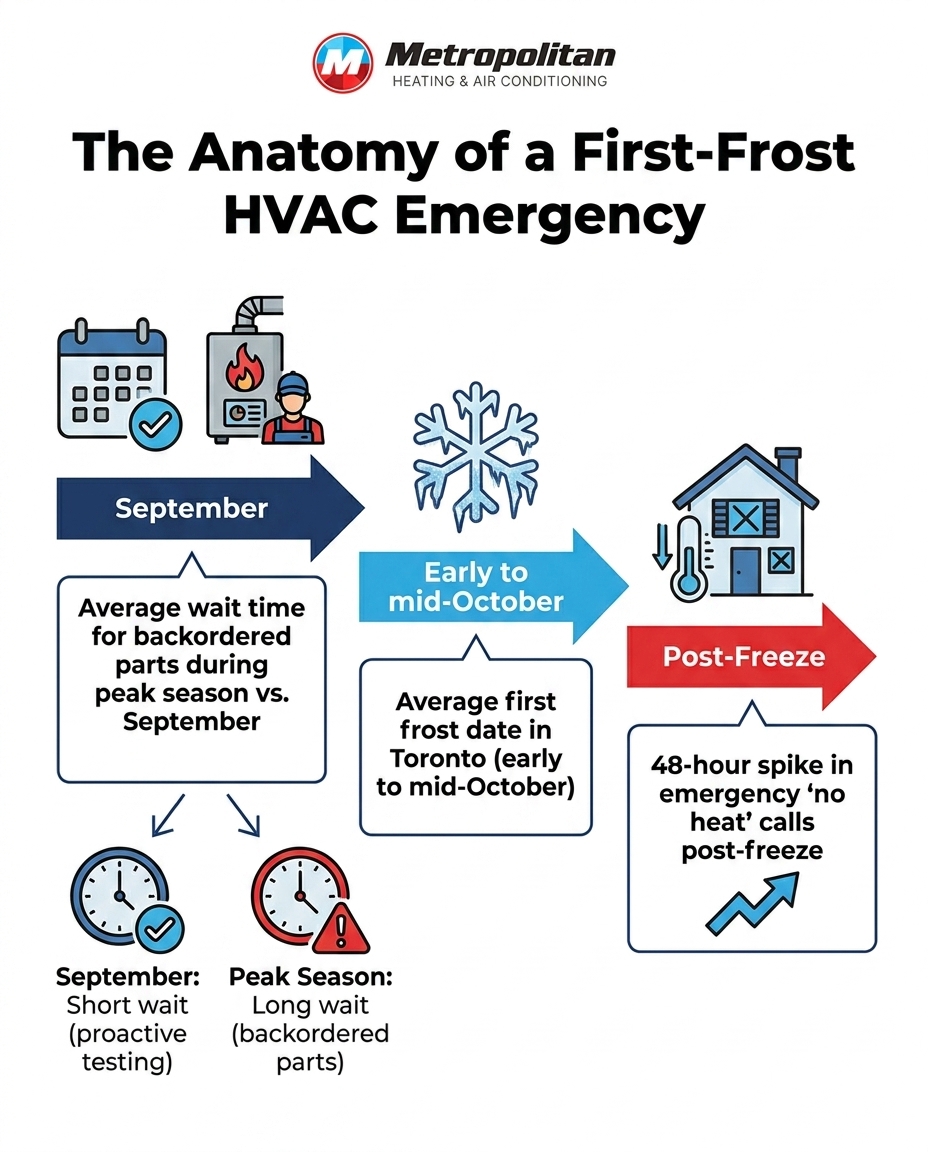
To understand why early testing is so vital, we always tell our customers to look at the historical timeline of local weather patterns. According to Environment Canada data, the average first fall frost in the region typically hits in early to mid-October. This sudden seasonal shift triggers a massive, industry-wide bottleneck that HVAC professionals refer to as the "48-hour phenomenon."
Within the first two days of freezing overnight temperatures, our own dispatch boards light up with an overwhelming spike in "no heat" calls. When thousands of dormant furnaces are turned on simultaneously across the Scarborough and Greater Toronto Area, the percentage of systems that fail to ignite creates a sudden surge in demand. Local dispatch capacities become severely strained, leading to days-long wait times for frantic homeowners who are left shivering in their living rooms.
This is when the need for Toronto heating technicians skyrockets, and those who waited to test their systems find themselves at the back of a very long line. When you require emergency service during this peak window, you are no longer in control of your schedule—you are at the mercy of the dispatch queue.
The Domino Effect of Delayed Testing
Waiting for the first frost to reveal a broken heater sets off a chain reaction of inconveniences. As our technicians can attest, the consequences of this delay extend far beyond simply feeling cold for a few hours:
• Overbooked Technicians: Appointment schedules become saturated within hours of a freeze, pushing standard diagnostic visits days into the future.
• Indoor Discomfort: The stress of navigating freezing indoor temperatures while waiting for service takes a toll on your family's daily routine and overall well-being.
• Premium Rates: Emergency, after-hours dispatch often commands premium rates, turning what could have been a simple tune-up into a costly urgent intervention.
• Compromised Productivity: Rushed technicians managing 15 calls a day have less time to thoroughly evaluate your system's overall health, focusing only on the immediate fix.
Supply Chain Realities: Why Parts Take Longer in Autumn
Diagnosing a broken furnace is only step one of the repair process. Acquiring the necessary replacement parts is where our team sees the real delay happen during the autumn rush. Modern heating systems rely on specific, highly calibrated components to operate safely and efficiently. During the October rush, local supply houses and regional distribution centers become rapidly depleted of common failing components, such as hot surface ignitors, draft inducer motors, and main control boards.
In the September pre-frost window, supply chains are stable and warehouse shelves are fully stocked. If our technician discovers a worn blower motor during an early fall inspection, the replacement part is typically picked up and installed the very same day. Contrast this with late October, where that exact same motor might be on backorder, leaving you waiting weeks for a delivery while your home remains freezing.
The reality of winter breakdowns highlights the importance of timing. A pattern we see often is the frantic winter call: one of our local customers reached out when they had no heat a couple of weeks ago during a harsh winter freeze; our dispatch team sent a technician the same day and repaired the furnace. While our dedicated team can handle these rapid winter responses, relying on emergency availability is a gamble. Proactive action prevents the risk of waiting for a backordered part when the temperature drops below freezing.
Maximizing Your Logistical Leverage Before the Freeze
Approaching your home maintenance strategically means taking advantage of what we call "logistical leverage." This is the ability to choose your service date, time, and scope of work rather than begging for an emergency slot when a crisis hits. The September pre-frost window is the ultimate tool for homeowners to control their scheduling and ensure unbroken comfort.
Testing your system while the weather is still mild allows for stress-free repairs. If you turn on your heater on a 15°C afternoon and notice a strange noise, there is no panic. You can schedule a diagnostic visit with us for the following Tuesday morning, go about your week, and have the issue resolved long before the urgent seasonal shift from cooling to heating demand occurs.
Furthermore, our technicians operate differently when they have logistical breathing room. When a professional isn't rushing to clear a massive backlog of emergency calls, they have the time to perform deep, thorough diagnostics. We can clean flame sensors, calibrate thermostats, and check for micro-cracks in the heat exchanger with meticulous attention to detail. This peace of mind—knowing your system is fully operational and vetted by an expert—is the true value of early preparation.
• Scheduling Flexibility — September Pre-Frost Window: High (Pick your day and time) — October First-Frost Rush: Low (Waitlist for cancellations)
• Parts Availability — September Pre-Frost Window: Fully stocked at local suppliers — October First-Frost Rush: High risk of backorders
• Technician Focus — September Pre-Frost Window: Thorough, unhurried diagnostics — October First-Frost Rush: Rushed, emergency triage
• Homeowner Stress — September Pre-Frost Window: Minimal (Weather is still mild) — October First-Frost Rush: High (House is actively freezing)
How the Scarborough Climate Demands Proactive System Checks
Having served this community extensively, we know firsthand that the weather patterns specific to the Scarborough and Greater Toronto Area make proactive testing even more critical. The region's geography, heavily influenced by the proximity to Lake Ontario, creates unique meteorological conditions in late autumn. Lake-effect weather can cause rapid, localized temperature drops that catch residents completely off guard.
In this region, the transition from "sweater weather" to "furnace weather" often happens overnight. A mild, sunny afternoon can quickly give way to a bitter, biting wind as a cold front moves off the lake. Because these shifts are so sudden, homes lose their retained heat rapidly, accelerating the need for reliable indoor heating.
When these localized drops occur, the surge in service requests for Scarborough furnace experts like us is immediate and intense. Positioning a preliminary test run as your first line of defense against these unpredictable weather patterns ensures that when the lake-effect chill arrives, your home remains a warm, comfortable sanctuary.
Safe System Testing: Recognizing the Early Warning Signs
Taking advantage of the September pre-frost window means conducting a safe, controlled test of your heating system. We always remind our clients that you do not need to be an HVAC expert to perform a basic operational check, but you do need to know what to look for—and what to leave to the professionals. Never attempt to open the cabinet, bypass safety switches, or tinker with internal gas valves yourself. Instead, focus on observing the system's behavior.
One of our local homeowners noticed issues turning on their furnace with cooler fall weather approaching. Because they tested the system early, our technician arrived quickly and efficiently got the furnace working again, long before the real cold hit. You can replicate this success by following a simple observational checklist.
The Homeowner's Pre-Season Checklist
• Initiate the cycle: On a cool morning, turn your thermostat from "Cool" to "Heat" and raise the temperature three to four degrees above the current room temperature.
• Listen for unusual noises: Pay attention as the system boots up. A grinding sound usually points to a failing motor bearing, while a loud bang could indicate delayed gas ignition—a serious issue that requires immediate professional attention.
• Watch for odd smells: A brief, dusty smell is entirely normal as the system burns off settled summer dust. However, if you detect a persistent electrical burning odor or the smell of rotten eggs (gas), shut the system down immediately and call for service.
• Check the airflow: Walk to the furthest vents in your home and ensure warm air is flowing steadily. Weak airflow often indicates a clogged filter or a struggling blower motor.
• Monitor the cycle length: The system should run continuously until the target temperature is reached. If it shuts off after only a few minutes (short-cycling), it is protecting itself from overheating, signaling an internal fault.
Bypassing the Queue: The Strategic Advantage of Structured Upkeep
The ultimate solution to avoiding the October logistical nightmare is to remove yourself from the emergency queue entirely. One-off emergency calls always fall to the back of the line during a crisis, simply because dispatchers must prioritize existing loyal customers and those with active service agreements.
Enrolling in structured maintenance plans secures priority scheduling and prompt local dispatch. When you are a member of a maintenance program with our team at Metropolitan Heating & Air Conditioning, you bypass the frantic waitlist. Your annual tune-up is scheduled during the optimal September window, ensuring your system is vetted before the rush begins. If the unexpected does happen mid-winter, your service request is bumped to the top of the board.
Professional maintenance goes far beyond a simple test run. Our certified technicians optimize efficiency, clean vital sensors, and most importantly, perform rigorous safety checks. Dormant furnaces can develop hairline cracks in the heat exchanger, which pose a severe carbon monoxide risk. A thorough inspection guarantees your family's safety. For those considering an upgrade to improve efficiency further, reviewing a cost comparison of single-stage vs. two-stage furnaces can provide valuable lateral context on how modern systems manage heat distribution.
Frequently Asked Questions About Fall Heating Preparation
When should I turn my furnace on in Ontario?
We recommend turning your furnace on for a test run during the mild days of September. This allows you to verify the system is operational before the freezing weather arrives. By testing early, you avoid the rush of emergency service calls that flood HVAC companies during the first October frost.
What happens if I wait until winter to test my furnace?
Waiting until winter to test your furnace drastically increases the risk of discovering a breakdown when you need heat the most. During the first freeze, HVAC technicians are heavily overbooked, and replacement parts frequently go on backorder. This delay can leave your home freezing for days while you wait for available service.
When is the best time to schedule furnace maintenance in Toronto?
Late summer to early fall is the optimal time to schedule furnace maintenance in Toronto. Booking in September ensures our technicians have ample time for thorough diagnostics and that any needed parts are fully stocked. It also secures your appointment before the massive spike in demand hits in mid-October.
How cold should it be before turning on the heat?
Most homeowners turn on their heat when indoor temperatures drop below 18°C (64°F) to maintain comfort. However, for testing purposes, you should initiate a brief heating cycle on any cool morning in September, regardless of how cold the afternoon might get. The goal is to verify functionality, not to heat the home for the day.
Why is my furnace not turning on after summer?
A furnace may fail to turn on after summer due to a variety of issues, including a tripped circuit breaker, a dead thermostat battery, or a dirty flame sensor. Dust accumulation during dormant months can also clog vital components. If basic troubleshooting like changing the filter and checking the breaker doesn't work, a professional diagnostic from our team is required.
Secure Your Spot Before the October Freeze Hits
The window for stress-free scheduling across the Scarborough and Greater Toronto Area is closing rapidly. Every day that brings us closer to October is a day closer to the industry-wide rush, depleted parts inventories, and overbooked technicians.
Don't wait for the first freezing night to discover your heating system needs attention. The peace of mind that comes with a fully vetted, safely operating heater is invaluable. Take control of your home's comfort today by speaking with our local experts at Metropolitan Heating & Air Conditioning and securing your spot on a proactive maintenance plan before the autumn chill takes hold.
Schedule Expert Service
Or Contact Us
Other Blogs
testimonials
hear what our satisfied clients have to say

where we operate
Service areas
contact us
Let’s get in touch!