

Are You Struggling to Decide Between AC Repair and Replacement?
Is your cooling system actually broken, or is it just struggling to keep up with the heat? When a breakdown happens mid-season, homeowners immediately ask: Is It Cheaper to Repair or Replace an AC Unit in Scarborough? Facing a major system failure during a humid Scarborough summer forces a stressful decision. You need your home comfortable again quickly, but you also want to make a financially sound choice without relying on aggressive sales pitches or confusing estimates.
At Metropolitan Heating & Air Conditioning, we know that making the right call requires a concrete decision framework. In our years of serving Scarborough, we've found that the best choices are based on the age of your equipment, the relative scale of the necessary repair, and the potential for long-term efficiency gains. By evaluating these factors objectively, you can determine whether a quick fix makes sense or if investing in a modern system provides better lasting value.
If you need an immediate professional assessment, explore our air conditioning services or schedule an AC repair in Scarborough.
How Does Age Impact Your Air Conditioner's Viability?
The chronological age of your cooling equipment is the most critical starting point for any repair versus replacement decision. Air conditioners in Ontario endure heavy workloads during the peak summer months, followed by long periods of dormancy during the winter. This extreme operational cycle takes a toll on mechanical components over time.
Our team frequently sees the consequences of this wear and tear. Recently, we responded to a Scarborough homeowner who experienced a complete AC emergency during the hottest day of the summer when their aging system finally gave out. One of our technicians arrived quickly, diagnosed the underlying issues, and successfully got the AC fixed so the customer was back up and running. While rapid emergency repairs can save the day, we often warn our customers that frequent breakdowns on peak heat days are a primary symptom of an aging unit pushed past its design limits.
The 10 to 15-Year Milestone
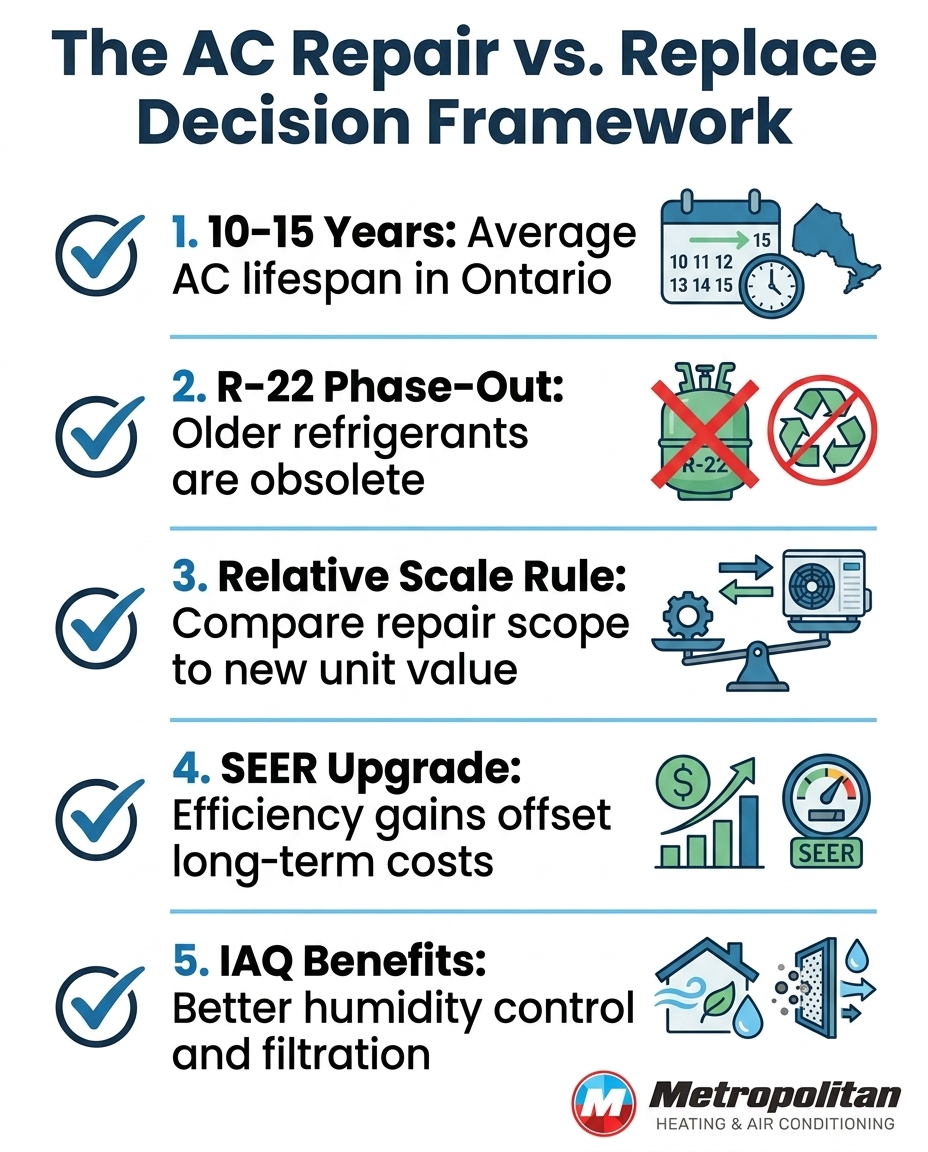
In our experience throughout Ontario, the average lifespan of a central air conditioning unit ranges from 10 to 15 years. Once a system crosses the decade mark, internal components like the compressor, condenser coils, and blower motor begin to degrade. Even with meticulous annual maintenance, the physical wear on these parts means that efficiency drops and the likelihood of major component failure rises.
Signs your aging system is nearing the end of its lifecycle:
• Frequent cycling: The unit turns on and off rapidly without fully cooling the home.
• Inconsistent temperatures: Certain rooms remain stubbornly warm while others freeze.
• Elevated noise levels: Grinding, squealing, or rattling sounds indicate failing internal hardware.
• Rising energy bills: The system must run longer to achieve the same level of cooling it once provided effortlessly.
The R-22 Refrigerant Phase-Out
Age also dictates the type of refrigerant your system utilizes. Older units were manufactured to run on R-22 refrigerant, a substance that has been officially phased out in Canada by Environment and Climate Change Canada due to its environmental impact. Because R-22 can no longer be manufactured or imported, the supply is strictly limited to reclaimed stock.
If our technicians find that an older R-22 system has developed a leak, servicing it becomes increasingly impractical. The framework for deciding your next step shifts dramatically when a repair requires sourcing obsolete refrigerant, making replacement the far more logical and sustainable route.
How Do You Evaluate the Relative Scale of Repair Costs?
When our HVAC technicians diagnose a problem, we want homeowners to have a reliable way to weigh the proposed fix against a complete system overhaul. The best approach is to use a price-free "relative scale" framework. Rather than focusing on arbitrary dollar amounts, look at the repair as a percentage of a brand-new system's overall value.
A common method we recommend is to multiply the age of the unit by the relative severity of the repair. If a minor electrical component fails on an eight-year-old system, the relative scale is low, making a repair highly sensible. However, if the compressor fails on a 12-year-old unit, the repair represents a massive percentage of a new installation's value. Continuing to patch a system that requires major reconstructive work rarely makes long-term financial sense.
When asking, "Is It Cheaper to Repair or Replace an AC Unit in Scarborough?" you must also factor in warranty coverage. Most modern air conditioners come with a manufacturer's parts warranty that lasts up to 10 years, provided the system was registered and properly maintained. If your major component failure is still under warranty, the relative scale of your out-of-pocket repair drops significantly. Conversely, an expired warranty means you shoulder the full burden of aging hardware.
• Minor (Capacitor/Contactor) — System Age: Under 10 Years — Warranty Status: Active — Recommended Action: Repair
• Moderate (Fan Motor) — System Age: 10-12 Years — Warranty Status: Expired — Recommended Action: Evaluate Relative Scale
• Major (Compressor/Coil Leak) — System Age: Over 12 Years — Warranty Status: Expired — Recommended Action: Replace
What Are the Long-Term Benefits of SEER Rating Efficiency Gains?
Modern air conditioning systems are vastly superior to those manufactured just a decade ago, largely due to advancements in energy efficiency. This efficiency is measured by the Seasonal Energy Efficiency Ratio (SEER). The higher the SEER rating, the less electrical energy the unit requires to produce a specific amount of cooling output.
According to Natural Resources Canada (NRCan) energy efficiency guidelines, upgrading from an older, baseline unit to a modern high-SEER system fundamentally changes how your home consumes power. While a new unit requires an upfront investment, the reduced energy usage—often combined with generally available energy rebates for qualifying high-efficiency systems—provides ongoing, month-over-month value that helps offset the initial installation. Be sure to verify current incentive programs with your utility provider or a tax professional.
Understanding SEER Upgrades
Fifteen years ago, a standard builder-grade AC unit might have had a SEER rating of 10. As that unit ages, wear and tear cause its actual operational efficiency to drop even lower. Today's entry-level systems start at much higher SEER ratings, and premium models can reach well into the 20s.
Our installation teams see these SEER rating efficiency gains achieved through advanced technology, such as variable-speed compressors. Unlike older single-stage units that blast cold air at 100% capacity and then shut off, the modern variable-speed systems we install modulate their output. They run continuously at lower, energy-sipping speeds to maintain a perfectly even temperature, eliminating the massive power spikes associated with constant starting and stopping.
Can a New AC Improve Indoor Air Quality and Humidity Control?
Cooling the air is only half of an air conditioner's job; the other half is removing moisture. A humid Scarborough summer puts immense strain on an HVAC system's dehumidification capabilities. Older units gradually lose their ability to effectively extract humidity from the air, leaving homes feeling sticky, clammy, and warmer than the thermostat indicates.
This issue is particularly pronounced in older, post-war Scarborough homes, which our crews service frequently. These homes often lack the tight thermal envelopes of modern construction. An aging AC that short-cycles will shut off before it has the chance to draw moisture out of the indoor air. Upgrading to a new, properly sized system ensures the cooling cycle runs long enough to effectively manage indoor humidity levels.
Furthermore, modern AC installations integrate seamlessly with advanced indoor air quality (IAQ) solutions. With the increasing prevalence of regional air quality alerts, having a robust filtration setup is no longer a luxury. Upgraded air handlers and high-MERV filter cabinets work in tandem with your cooling system, actively shielding your home against wildfire smoke, pollen, and airborne contaminants.
The Repair vs. Replace Checklist for Scarborough Homeowners
Deciding between fixing and upgrading doesn't have to be a guessing game. Our team recently guided a Scarborough homeowner through this exact process; we installed a new AC unit and coil after determining their old system was beyond repair. We completed the installation as scheduled, and the customer was thrilled with the seamless, reliable outcome.
If you are weighing your options, use this concrete checklist to determine if an AC installation is the smarter path forward:
• The age factor: Your current unit exceeds the 10 to 15-year milestone and relies on phased-out R-22 refrigerant.
• The relative scale rule: The proposed repair represents a significant percentage of the value of a brand-new, high-efficiency system.
• The humidity struggle: Your home feels chronically damp and sticky during August heatwaves, indicating the unit can no longer dehumidify effectively.
• The breakdown frequency: You are experiencing multiple emergency service calls per season just to keep the system limping along.
• The IAQ integration: Your household would benefit from a modern system that pairs with advanced air filtration to manage regional smoke and allergens.
Why a Transparent Assessment is Your Best Next Step
Every home, ductwork layout, and HVAC system requires a personalized evaluation. There is no one-size-fits-all answer to cooling problems, which is why working with a trusted provider of Scarborough HVAC services is critical. At Metropolitan Heating & Air Conditioning, our team is committed to established local trust and a transparent assessment process, helping homeowners make a financially sound choice without high-pressure sales tactics.
What to expect during a professional diagnostic visit:
1. Comprehensive System Check: Technicians inspect the compressor, coils, blower motor, and electrical components to pinpoint the exact failure.
2. Refrigerant Evaluation: The system's pressure levels are checked to identify leaks and determine if the unit relies on obsolete R-22.
3. Airflow and Duct Inspection: Professionals verify that the unit is moving air efficiently and that poor ductwork isn't masking a mechanical issue.
4. Options Presentation: You receive a clear, pressure-free breakdown of the repair scale versus the benefits of a modern SEER upgrade.
This transparent approach ensures you have all the facts before making a long-term commitment to your home's comfort infrastructure.
Schedule Your Pressure-Free AC Assessment Today
A clear, price-free decision framework empowers you to make the right choice for your household. By evaluating the age of your equipment, the relative scale of the repair, and the long-term efficiency gains of a new system, you can restore your home's comfort with confidence. Don't wait for a total system failure during a peak heatwave to start exploring your options. Contact the Metropolitan Heating & Air Conditioning team today for a thorough, pressure-free evaluation of your cooling system.
Frequently Asked Questions
How do I know if my AC needs replacing or repairing in Ontario?
The decision relies on assessing the unit's age, repair scale, and efficiency. If your air conditioner is under 10 years old and requires a minor component fix, a repair is usually the route our technicians recommend. However, if the system uses phased-out R-22 refrigerant, requires a major compressor replacement, or struggles to cool your home evenly, upgrading to a new system is often the smarter financial move.
What is the life expectancy of an air conditioner in Ontario?
In our experience servicing Scarborough, most central air conditioning units last between 10 and 15 years. The heavy workload during hot, humid summers followed by idle winters puts significant strain on the mechanical parts. Regular annual maintenance can help a system reach the upper end of this lifespan, but efficiency naturally declines as the equipment ages past a decade.
At what age should you replace your air conditioner?
Our team and industry experts generally recommend considering replacement once a unit reaches 10 to 15 years of age. Beyond this point, the risk of major component failure increases dramatically, and the system's energy efficiency drops. Replacing an aging unit proactively prevents emergency breakdowns during peak summer heatwaves.
Can a new AC improve indoor air quality?
Yes, a modern air conditioning system significantly enhances indoor air quality. New units run longer, more efficient cycles that excel at pulling excess humidity out of the air. Additionally, modern air handlers pair seamlessly with high-efficiency MERV filters and advanced IAQ accessories, effectively trapping dust, allergens, and regional wildfire smoke.
How does the R-22 phase-out affect my older AC unit?
The Canadian phase-out of R-22 refrigerant means this chemical can no longer be manufactured or imported. If your older system develops a refrigerant leak, sourcing reclaimed R-22 to recharge it is incredibly difficult and impractical. This regulatory shift makes replacing older, leaking units the only viable long-term solution.
Does a higher SEER rating actually make a difference in cooling performance?
A higher SEER rating directly translates to better energy efficiency and superior home comfort. High-SEER units often utilize variable-speed technology, allowing them to adjust their cooling output precisely rather than simply blasting on and off. This results in consistent indoor temperatures, superior humidity control, and a noticeable reduction in monthly energy usage.
Schedule Expert Service
Or Contact Us
Other Blogs
testimonials
hear what our satisfied clients have to say

where we operate
Service areas

contact us
Let’s get in touch!