

The Hidden Cost of a Rushed Installation
When homeowners in 1960s and 1970s Scarborough bungalows finally decide it is time to upgrade their heating, a critical detail often slips under the radar. While you might be busy researching 96% AFUE efficiency ratings or looking into generic utility rebates for qualifying upgrades, you must also consider exactly what our installers do with every wire and pipe during a furnace replacement. A new heating system is a major investment, yet at Metropolitan Heating & Air Conditioning, we notice many homeowners focus solely on the equipment brand, assuming every installation is handled the same way. The reality we see every day is that the craftsmanship applied on installation day dictates how well that equipment will perform for the next fifteen to twenty years.
If you are comparing heating systems or scheduling a furnace installation, understanding the methodology behind the equipment is just as important as the model you choose.
In our experience replacing older units, a rushed equipment swap often leaves behind a messy web of wires and poorly routed pipes. This disorganized approach is not just an eyesore; it is a concrete problem that directly causes premature wear, operational vibration damage, and sudden heating failures. Recognizing the critical difference between a hasty install and our meticulous methodology ensures the safety, performance, and longevity of your new system.
• Vibration damage: Unsecured components rattle against metal housings, causing slow but steady deterioration.
• Airflow restrictions: Haphazard duct transitions and piping block critical access points and disrupt air circulation.
• Drainage failures: Improperly leveled condensate lines lead to water pooling and internal rusting.
• Diagnostic nightmares: A tangled "spaghetti" mess of low-voltage wiring makes future troubleshooting incredibly difficult.
Taming the Tangled Web: Why Wire Management Matters
Modern heating equipment relies heavily on complex electrical components and low-voltage control boards. When a furnace is installed without strict wire management protocols, those delicate 24-volt communication wires are left vulnerable to the harsh physical realities of a mechanical system in motion.
The Threat of Operational Vibration
Furnaces are not static appliances. They generate constant operational vibration during their heating cycles as variable-speed blower motors spin up and gas valves cycle open and closed. These continuous micro-movements affect any unsecured components inside the cabinet. If wires are left hanging loosely or draped across sharp sheet metal edges without proper strapping, the compounding effect of this vibration over years of operation becomes a serious liability. The constant rubbing slowly wears away the protective insulation on the wires.
Preventing Electrical Shorts
Once the insulation on a wire is compromised, the exposed copper will eventually touch the grounded metal cabinet of the furnace. This creates a direct electrical short. Electrical faults caused by chafed wires are a leading cause of premature furnace failure, often blowing the 3-amp low-voltage fuse on the control board and shutting the entire system down instantly.
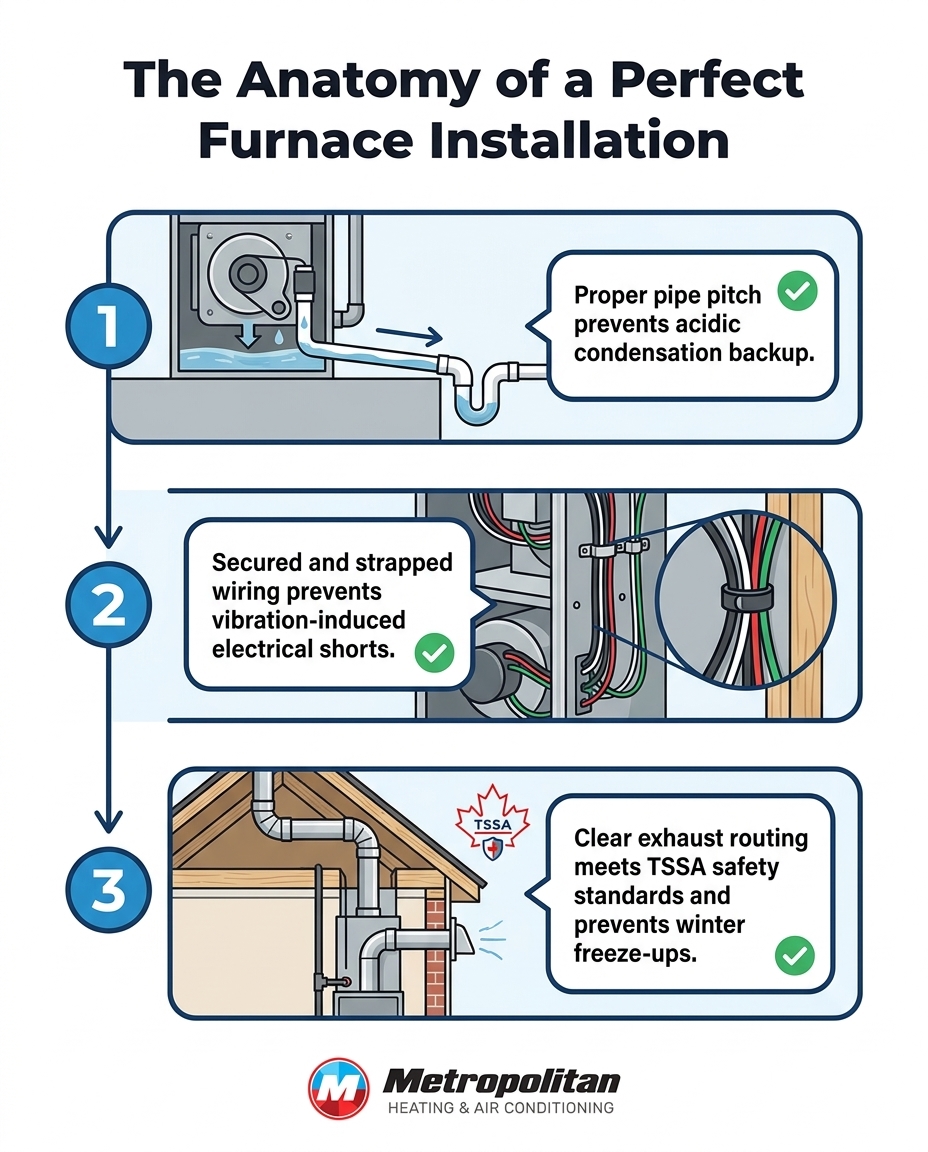
In Scarborough, where reliable heat is a safety necessity rather than a luxury, a simple electrical short from a chafed wire can leave a home dangerously cold in the middle of the night. That is why our extreme attention to detail in wire strapping isn't just for aesthetics—it is a strict methodology our Metropolitan Heating & Air Conditioning technicians use to guarantee reliability for all our HVAC services in Scarborough. Our installers follow strict strapping protocols to secure every wire, isolating them from moving parts and eliminating vibration risks entirely.
• Rushed Swap — Wire Routing Method: Wires left hanging loosely inside the cabinet — Long-Term Outcome: Insulation chafes, leading to blown fuses and system lockouts.
• Meticulous Methodology — Wire Routing Method: Wires zip-tied, bundled, and routed away from metal edges — Long-Term Outcome: Electrical integrity remains fully intact for the lifespan of the unit.
Precision Plumbing: Pitching Pipes for High-Efficiency Gas Furnaces
While electrical integrity is crucial, the plumbing aspect of a modern heating installation requires just as much precision. Upgrading to high-efficiency gas furnaces introduces entirely new plumbing requirements that older, standard-efficiency models never had to deal with.
Managing Acidic Condensation
High-efficiency gas furnaces achieve their impressive ratings by extracting heat from the exhaust gases using a secondary heat exchanger. The byproduct of this highly efficient heat extraction process is condensation. Because this water is formed from combustion gases, it is slightly acidic. This acidic condensation must be safely and continuously drained away from the furnace. Standard plumbing rules are not always enough for furnace condensation; the materials used must be completely resistant to corrosion, which is why specialized System 636 PVC piping is legally required in Ontario.
The Geometry of Perfect Drainage
If these condensate pipes are improperly pitched, gravity cannot do its job. Water will pool in the lines, eventually backing up into the furnace itself. This triggers internal safety switches that cause immediate system lockouts, and if left unchecked, the acidic water will corrode internal components. Precise PVC pipe pitching ensures gravity effectively drains the acidic water away.
Our installation team meticulously calculates a minimum 1/4-inch per foot slope for every inch of PVC pipe. We secure these pipes with specialized hangers to prevent future sagging or shifting as the house settles. By building a rigid, perfectly angled drainage path, we ensure that the internal components of your high-efficiency furnace remain completely dry and free from corrosive backup.
Securing the Exhaust: Venting for Safety and Performance
A furnace is a controlled combustion environment inside your home. Safely expelling the exhaust gases while pulling in fresh air for combustion requires a flawlessly executed venting strategy. Proper venting is absolutely non-negotiable for expelling carbon monoxide and ensuring the safety of everyone indoors.
Adhering to TSSA Standards
In Ontario, the Technical Standards and Safety Authority (TSSA) mandates strict adherence to gas fitting and venting protocols. Intake and exhaust pipes must be routed clearly, securely, and with airtight seals to meet these rigorous standards. Any deviation from these protocols not only violates local codes but also puts household safety at risk. Our licensed installers prioritize these airtight seals, using approved primers and cements to weld the PVC joints together permanently.
Protecting Intakes from Snow and Debris
Harsh Ontario winters and sub-zero temperatures demand perfectly routed exterior vents to prevent ice buildup and snow blockages. Poorly routed exterior pipes that terminate too close to the ground are vulnerable to freezing or blockage from drifting snow. If the 2-inch or 3-inch intake pipe is blocked by a snowdrift, the furnace will starve for air and shut down immediately.
One homeowner reached out to us during the brutal February 2023 polar vortex when their rooftop furnace failed in extreme weather. Our team was dispatched for an emergency replacement, installing a new unit the very next business day while working in sub-zero temperatures. Because we strategically planned the exterior vent terminations, their new heating system was restored safely and remains protected against heavy snowfalls.
Critical venting protocols handled by our licensed gas fitters include:
• Calculating the total equivalent length: We ensure the pipe run does not exceed the manufacturer's maximum length limits, accounting for every elbow and turn.
• Pitching the exhaust back to the unit: We slope the exhaust pipe so any condensation that forms in the flue drains back into the furnace's internal trap rather than freezing outdoors.
• Strategic exterior termination: We place the intake and exhaust caps at the exact required heights and distances from windows, doors, and anticipated Scarborough snow lines.
• Supporting the pipe run: We install heavy-duty hangers at regular intervals to prevent the pipes from sagging over time.
Setting Up for Long-Term Success: How Neatness Simplifies Maintenance
The craftsmanship applied on day one continues to pay dividends for years to come. A tidy, well-organized installation directly extends the overall lifespan of the heating system by making routine upkeep significantly easier. When it comes time for your annual preventative maintenance plan visit, the physical layout of the equipment plays a huge role in how thoroughly the system can be serviced.
Immediate Visual Diagnostics
A clean, orderly layout allows technicians to perform immediate visual diagnostics. When a service technician opens the cabinet of a meticulously installed furnace, they can instantly trace every wire and inspect every sensor. A tidy control board speeds up troubleshooting and allows technicians to spot minor issues—like a slightly loose connection or a dusty flame sensor—before they escalate into major breakdowns.
Unobstructed Access for Technicians
Designing the layout with future servicing in mind is a core part of our methodology at Metropolitan Heating & Air Conditioning. Unobstructed access to filters, blower motors, and control boards makes annual service faster and more thorough. Avoiding the "spaghetti" wire mess means future technicians won't accidentally disconnect critical components while trying to reach a hidden part.
For example, when our crew replaced a leaking, 1998 mid-efficiency furnace for a customer last spring, our installers took the time to explain the new setup and answer questions, leaving behind an incredibly neat and orderly installation. Because the piping and wiring were routed tightly against the cabinet framing, the homeowner now has clear, unobstructed access to change their air filter without wrestling past a maze of PVC pipes.
Beyond Heating: Integrating Air Quality and System Add-Ons
A modern HVAC system rarely operates as just a standalone furnace anymore. Today's mechanical rooms often serve as the central hub for whole-home comfort, incorporating various add-ons that improve indoor environments.
Modern HVAC systems frequently include integrated components like flow-through humidifiers, advanced media air cleaners, or UV air purifiers. A cluttered, poorly planned installation leaves absolutely no room for these future upgrades. If the exhaust pipes are routed diagonally across the return air drop, or if the gas line blocks the only available mounting space, upgrading from a standard 1-inch filter to a 5-inch MERV 16 media cabinet later becomes a costly remodeling project.
Our installers route wires and pipes deliberately to leave space for indoor air quality enhancements. By keeping the exterior of the ductwork clean and accessible, we ensure you have the flexibility to enhance your indoor air quality down the road. Clean integration also ensures seamless communication between the furnace's control board and any auxiliary systems, allowing humidifiers and purifiers to activate in perfect synchronization with the blower motor.
Frequently Asked Questions About Furnace Replacement Details
What is included in a furnace installation?
A comprehensive furnace installation includes the safe removal and disposal of your old equipment, followed by the precise fitting of the new unit. It involves custom sheet metal work to connect the new furnace to your existing ductwork, routing new PVC venting for intake and exhaust, and configuring the condensate drainage system. Finally, it requires meticulous low-voltage wiring, gas line connection, and a complete sequence-of-operation test to verify peak performance.
Why is proper furnace venting important?
Proper venting is critical because it safely exhausts the dangerous byproducts of combustion, including carbon monoxide, entirely out of your home. If vents are improperly sealed, improperly pitched, or blocked by debris, these toxic gases can backdraft into your living space. Additionally, modern furnaces have internal pressure switches that will completely disable the system if they detect a venting restriction.
How does installation quality affect furnace lifespan?
Installation quality determines the physical stress placed on the equipment during its daily operation. If a unit is installed with restricted airflow, poorly pitched drainage, or unsupported wiring, the internal components have to work significantly harder and are subjected to excessive vibration. A meticulous installation minimizes this mechanical wear and tear, allowing the blower motor, heat exchanger, and control board to reach their maximum intended lifespan.
How are high efficiency furnaces vented?
96% to 98% AFUE high-efficiency furnaces use a two-pipe venting system made of specialized PVC or CPVC pipe, rather than the metal flues used by older standard-efficiency models. One pipe pulls fresh combustion air directly from outside, while the second pipe pushes the relatively cool exhaust gases out of the home. Because these exhaust gases are cool enough to condense into liquid, the exhaust pipe must be carefully pitched back toward the furnace to allow the moisture to drain.
What happens to the condensation from a high-efficiency furnace?
The condensation produced by a high-efficiency furnace is collected in an internal trap and then routed out of the unit through a dedicated PVC drain line. Because this water is slightly acidic, it must be directed into a floor drain, a specialized condensate pump, or an acid-neutralizing cartridge before entering the home's main plumbing system. Proper pipe pitching ensures this water flows away continuously without backing up.
Investing in Craftsmanship for Lasting Comfort
A furnace is only as reliable as the quality of its installation. Even the most highly rated, technologically advanced heating equipment will falter if it is hastily connected to your home's ductwork, plumbing, and electrical grid. Meticulous wire and pipe management is the hidden foundation of a long-lasting heating system.
Choosing a team that values craftsmanship prevents future breakdowns, eliminates vibration-induced electrical shorts, and ensures proper drainage for years to come. At Metropolitan Heating & Air Conditioning, we believe that a clear, behind-the-scenes explanation of how meticulous wire and pipe management prevents future breakdowns is exactly what homeowners need to make an informed decision. By prioritizing these microscopic details on installation day, we protect your home's comfort and extend the life of your new furnace.
Schedule Expert Service
Or Contact Us
Other Blogs
testimonials
hear what our satisfied clients have to say

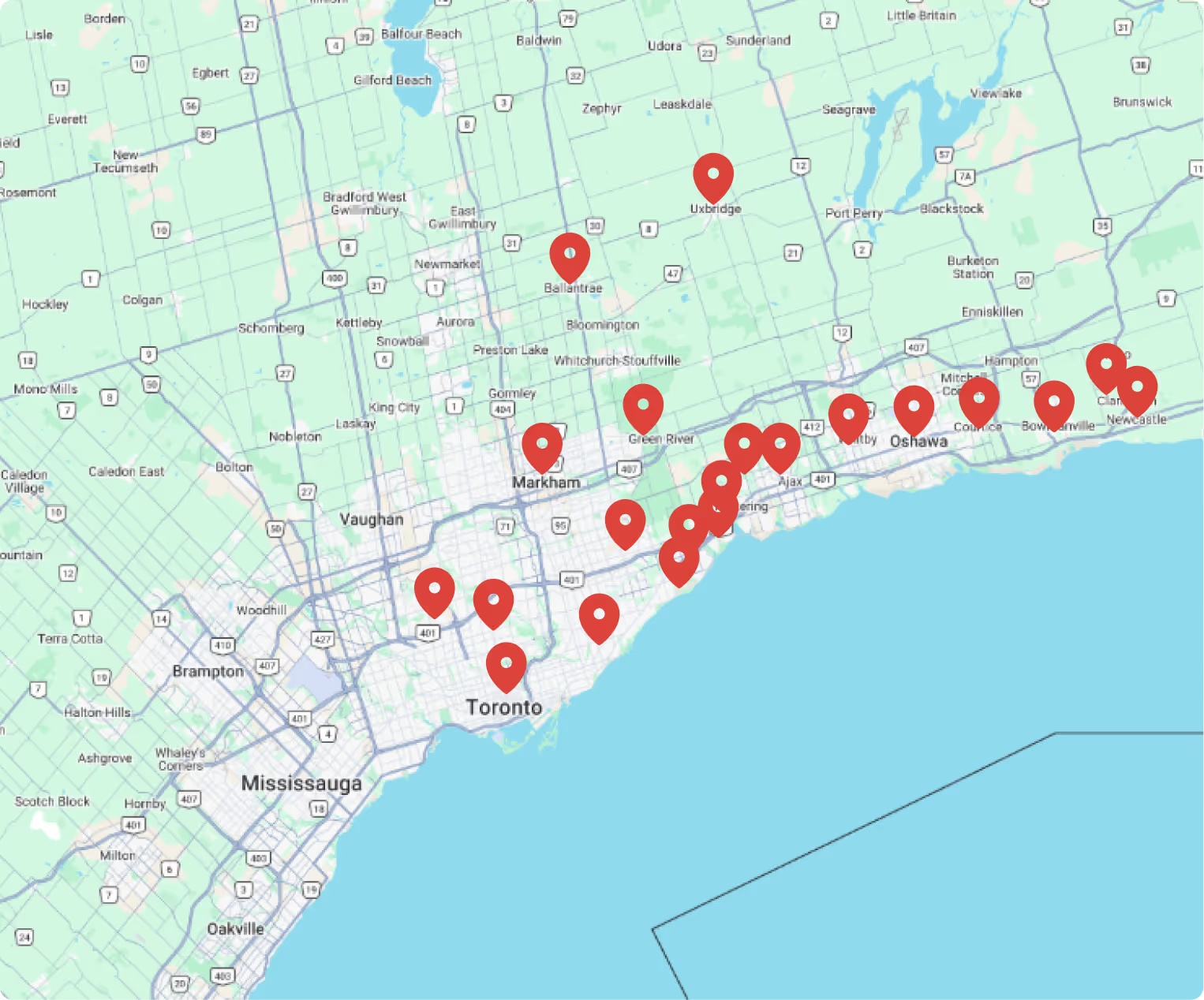
where we operate
Service areas
contact us
Let’s get in touch!