
Facing a Partial System Failure: Should You Upgrade Both Units?
Are you currently asking yourself, "Do I need to replace my AC and furnace at the same time?" when only one of those units has stopped working? You are not alone in asking this question. When one half of your home comfort setup fails, it creates an immediate and stressful dilemma. You are suddenly faced with a broken air conditioner or a dead furnace, and the contractors providing quotes are offering options to replace both units at once. It is completely natural to wonder if this is a genuine mechanical necessity or just an unnecessary upsell.
For most homeowners, the fear of paying for a system upgrade they do not actually need is just as strong as the fear of future system incompatibility. The truth is that the right choice relies heavily on the specific age, condition, and technology of the equipment that is still functioning. If your existing equipment is relatively new, a partial replacement makes perfect sense. However, when dealing with surviving units older than 10-12 years, the conversation shifts from a simple repair to a long-term strategy for your home's infrastructure.
To make the most informed choice for your home, you need a neutral, objective breakdown of how these components interact behind the walls. Your heating and cooling units are not isolated boxes; they work together as a team to condition and distribute the air you breathe. Understanding the shared mechanics of your HVAC systems is the first step in determining whether a dual replacement is the most logical path forward or if your surviving unit still has years of reliable life left to give.
The Hidden Connection: How Your AC and Furnace Share Critical Components
It is easy to look at the metal box sitting in your backyard and the large cabinet sitting in your basement and assume they are entirely separate machines. After all, one provides cooling and the other provides heating. However, they are deeply connected. While the air conditioning condenser sits outside to release heat, it relies entirely on the indoor furnace cabinet to actually circulate the cooled air throughout your living space.
The core of this connection is the indoor air handler and the ductwork system. Sitting directly above or beside your furnace is an A-shaped component called the evaporator coil. When your air conditioner runs, it sends cold refrigerant to this indoor coil. But the coil cannot push the cold air through your home on its own. It requires the furnace's internal blower motor to activate, pull warm air from your rooms, push it over the freezing cold coil, and distribute the newly chilled air through the supply vents.
The critical role of the blower motor:
• Airflow distribution: The blower motor is the "lungs" of your entire HVAC setup, operating during both the heating and cooling seasons.
• Static pressure management: It must push air with enough force to overcome the resistance of your ductwork and air filters.
• Dehumidification: Proper airflow speed over the indoor coil is what allows your system to extract humidity from the indoor air.
Because of this shared workload, a brand-new outdoor AC unit is physically tethered to the performance of the indoor furnace. If you are scheduling an AC installation in Scarborough, the new high-tech outdoor condenser will be forced to rely on whatever blower motor is currently sitting inside your basement. This is why modern matched variable-speed blower systems are so heavily recommended—they allow the new outdoor unit to operate exactly as the manufacturer intended, without being held back by older, less capable indoor components.
Why Mismatched Systems Restrict Energy Efficiency
The Problem With Mismatched Technology
In the HVAC industry, a "matched system" refers to an outdoor air conditioner and an indoor furnace that were engineered, tested, and rated by the manufacturer to operate seamlessly together. When equipment is tested for its SEER (Seasonal Energy Efficiency Ratio) or AFUE (Annual Fuel Utilization Efficiency) ratings, it is always tested as a complete, complementary pair. If you pair a brand-new, ultra-efficient air conditioner with an outdated furnace, you create a mismatched system.
How Outdated Blowers Cause Bottlenecks
The primary issue with a mismatched system lies in the blower motor technology. Older furnaces typically use single-stage blower motors. These motors only have one speed: full blast. Modern air conditioners, however, are designed to run in longer, slower, more energy-efficient cycles. When you connect a new high-efficiency AC to an old single-stage blower, the new unit cannot dynamically adjust its airflow. The outdated blower actively restricts the new AC from reaching its advertised performance, meaning you pay for high-efficiency equipment but continue to get standard-efficiency results on your monthly utility bills.
The Solution: Synchronized Performance
To get the exact efficiency you are paying for, the indoor and outdoor units must speak the same language. This is where matched variable-speed blower systems come into play. A variable-speed motor can ramp up and down in tiny increments, perfectly matching the cooling output of the outdoor unit. This synergy reduces wear and tear on both units and provides superior humidity control.
One Scarborough homeowner reached out during the summer when they needed a new AC unit and coil installed. The installation team completed the job, setting up the new cooling components to integrate flawlessly with the home's infrastructure, and cleaned up the job site perfectly. Because the new coil and the existing blower were properly assessed for compatibility before the work began, the new air conditioning system was able to deliver the precise cooling performance the homeowner expected. If you are comparing single-stage and two-stage furnaces as part of your upgrade, remember that the type of blower inside that furnace will directly dictate how well your summer cooling performs.
The Age Factor: When to Keep Your Surviving Unit
Knowing the mechanical relationship between your heating and cooling equipment is helpful, but you still need clear, objective criteria to make a final decision. The most reliable deciding factor is the age of the unit that has not yet broken down. There is a distinct timeline that dictates when a dual replacement is a smart investment versus when it is perfectly safe to replace only the broken unit.
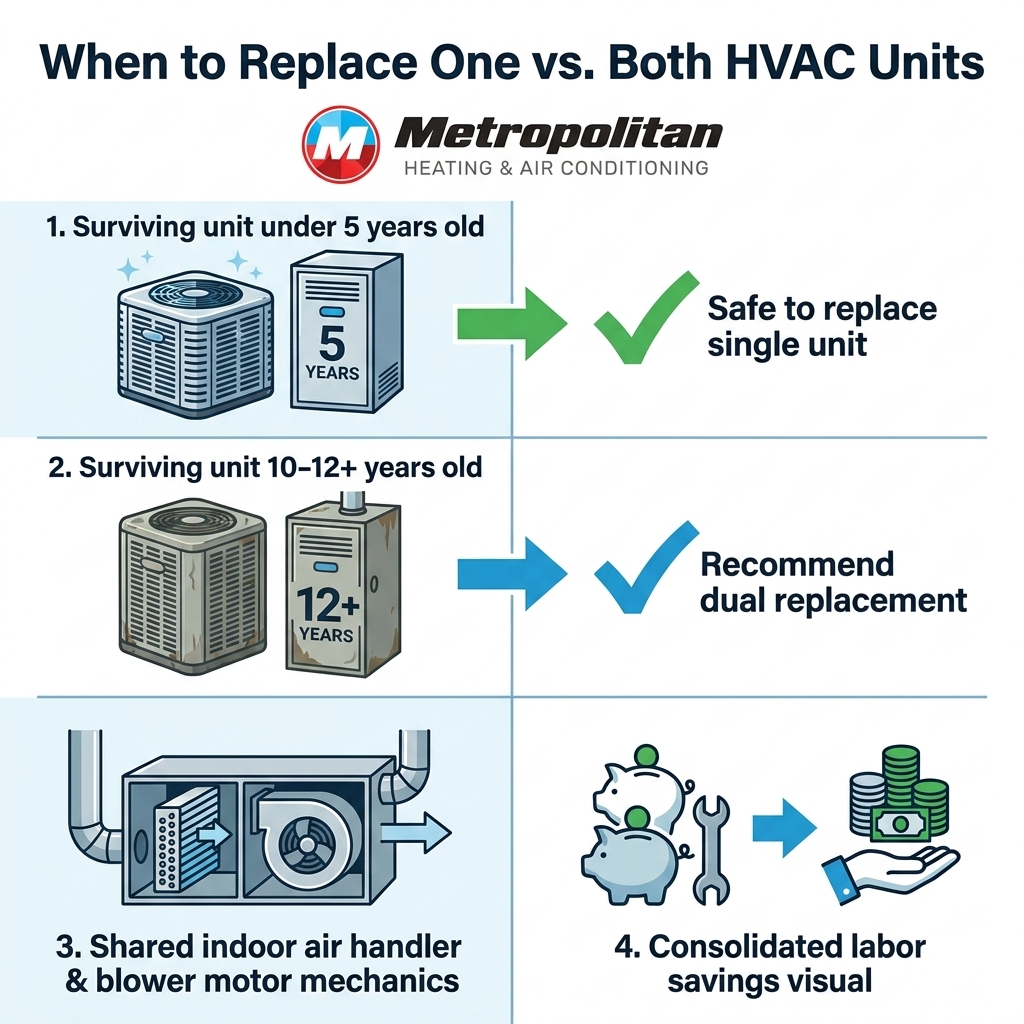
The Baseline Rule: If your surviving unit is under 5 to 7 years old, it is generally safe to keep it. Equipment in this age bracket was built using modern manufacturing standards and is highly likely to be compatible with a brand-new counterpart. In these cases, replacing both units would not yield enough additional efficiency to justify the immediate cost.
However, the risks increase significantly as the equipment ages. Pairing a brand-new system with a unit nearing the end of its lifespan is a gamble. The older unit lacks the technological advancements of current equipment, making electronic and mechanical integration difficult. Furthermore, if the older unit fails two years from now, you will be forced to undergo a second major installation project.
Checklist: Signs you should upgrade both units:
• Age threshold: You are dealing with surviving units older than 10-12 years.
• Refrigerant compatibility: Your old system relies on phased-out R-22 refrigerant, which is incompatible with modern R-410A or R-454B systems.
• Frequent repairs: The surviving unit has required multiple service calls over the past three heating or cooling seasons.
• Warranty status: The manufacturer's warranty on the surviving unit has completely expired.
To make this evaluation easier, consider the following breakdown of when to keep versus when to replace your equipment during a reliable heating replacement or cooling upgrade.
• 0 to 5 Years — Compatibility Risk: Low — Recommended Action: Replace only the broken unit. The surviving unit is modern.
• 6 to 9 Years — Compatibility Risk: Moderate — Recommended Action: Evaluate based on repair history and specific blower motor type.
• 10 to 12+ Years — Compatibility Risk: High — Recommended Action: Replace both units simultaneously to ensure system synergy.
Analyzing Labor Overlap and Long-Term Installation Costs
When evaluating the scope of an HVAC upgrade, it is vital to look beyond the cost of the physical equipment and consider the labor required to put it in place. The installation process for heating and cooling systems involves a significant amount of overlapping labor. Understanding this overlap is the key to understanding why a dual installation is often positioned as a long-term cost-saving strategy rather than an upfront upsell.
The overlapping steps of a standard installation:
1. System drainage and disconnection: Technicians must safely evacuate refrigerants, shut off gas lines, and disconnect high-voltage electrical wiring.
2. Accessing the plenum and coil: To replace an AC evaporator coil, the technicians must open the sheet metal plenum directly above the furnace.
3. Sheet metal modification: Custom sheet metal work is required to ensure an airtight seal between the new components and the existing ductwork.
4. System calibration and testing: Once installed, the entire system's airflow, static pressure, and temperature drops must be tested and calibrated.
If you choose to replace your air conditioner today and your furnace two years from now, a professional installation crew will have to perform all of these complex labor steps twice. They will have to drain lines, cut sheet metal, and recalibrate the system all over again. By replacing surviving units older than 10-12 years at the same time as the broken unit, you consolidate the labor into a single day.
At Metropolitan Heating & Air Conditioning, we focus on honest, long-term solutions, helping homeowners understand when a dual installation genuinely saves them money on future labor versus when it is unnecessary. A consolidated installation minimizes disruption to your home, ensures a seamless setup, and guarantees that you are not paying for the same exact labor steps twice in a short period of time.
How Scarborough's Extreme Weather Impacts Shared HVAC Components
The geographical location of your home plays a massive role in how quickly your heating and cooling equipment degrades. The climate dictates the workload, and in this region, the workload is notoriously heavy. Scarborough experiences extreme temperature swings, moving from hot, humid, and sticky summers directly into freezing, harsh, and punishing winters.
Because of these extreme seasonal shifts, your HVAC system does not get much of an off-season. More importantly, the shared indoor blower motor is forced to run almost continuously year-round. In July, it is working overtime to push heavy, conditioned air through your ducts to combat the humidity. In January, it is working just as hard to distribute heated air to keep your pipes from freezing and your living spaces comfortable.
The impact of regional weather on older units:
• Accelerated wear and tear: A 10-year-old blower motor in a mild climate might still have plenty of life left, but a 10-year-old motor in Scarborough has endured significantly more operational hours.
• Humidity control demands: High summer humidity requires the blower to operate in precise cycles. Older motors lose the torque needed to manage this effectively.
• Thermal stress: The constant cycling between extreme heating and extreme cooling demands takes a toll on the electrical components and bearings within the air handler.
This heavy regional workload means that an older surviving unit has likely endured more wear than a similar unit in a milder, more temperate climate. It highlights the importance of matched variable-speed blower systems, which are specifically designed to handle these demanding conditions efficiently. To keep systems operating under this kind of stress, proactive care is non-negotiable. Enrolling in an ongoing maintenance plan ensures that your blower motor, whether new or aging, is cleaned, lubricated, and inspected before the extreme weather hits.
Frequently Asked Questions About Dual HVAC Replacements
Can you replace just the AC and not the furnace?
Yes, it is mechanically possible to replace only the air conditioner without touching the furnace. However, this is only recommended if the existing furnace is relatively new (typically under 5 to 7 years old) and fully compatible with the new AC's efficiency standards. If you pair a new outdoor unit with an old indoor unit, you risk bottlenecking the new system's performance. The decision ultimately comes down to the condition and technological capabilities of the surviving indoor equipment.
What happens if I don't replace my furnace with my AC?
If you do not replace your furnace, the new AC will be forced to rely on the older furnace's existing blower motor to circulate cold air. This can lead to reduced energy efficiency, decreased overall cooling performance, and poor humidity control. Furthermore, if the old blower motor struggles to push air adequately, it can cause the new indoor evaporator coil to freeze over, leading to potential premature failure of your brand-new air conditioning components.
What is a matched HVAC system?
A matched system is an air conditioning condenser and an indoor furnace that were designed, tested, and rated by the manufacturer to operate seamlessly together as a single unit. Matched systems ensure optimal airflow, maximum SEER and AFUE energy efficiency ratings, and longer equipment lifespans. Upgrading to matched variable-speed blower systems guarantees that the indoor and outdoor components communicate perfectly, providing superior comfort and lower monthly utility costs.
How long does a furnace and AC last?
Air conditioners typically last between 10 and 15 years, while furnaces generally have a slightly longer lifespan of 15 to 20 years, depending heavily on the quality of routine maintenance they receive. Because of this slight offset in life expectancy, one unit almost always fails before the other. This staggered failure timeline is exactly what prompts the dual-replacement dilemma for most homeowners when their system reaches the decade mark.
Is it cheaper to buy AC and furnace together?
While the upfront cost is undeniably higher, buying both units together is generally cheaper in the long run if the surviving unit is already aging. Homeowners save significantly on overlapping labor costs by consolidating the work into a single project. You avoid paying two separate installation fees, two separate sheet metal modification fees, and two separate call-out charges. Over a ten-year horizon, a dual replacement is often the more financially sound choice.
Will a new AC still cool my house if my old furnace has a standard blower?
It will cool the house, but it will not operate at its peak efficiency or deliver the comfort you expect from a modern system. A standard, single-stage blower cannot dynamically adjust airflow like modern variable-speed systems can. This often leads to uneven cooling, hot spots in certain rooms, poor dehumidification, and higher energy bills because the system is forced to run at 100% capacity every time it turns on, regardless of the actual cooling demand.
Make a Confident Decision on Your Next HVAC Upgrade
Deciding how to handle a partial system failure does not have to be a guessing game. By looking at the objective criteria, the decision ultimately comes down to the age of the surviving unit, your long-term energy efficiency goals, and the financial logic of labor overlap. If you are dealing with surviving units older than 10-12 years, investing in a complete, matched system is the most effective way to protect your home from future breakdowns and wasted energy.
You now have the objective knowledge needed to confidently evaluate any quotes you receive. You understand how the indoor blower motor dictates outdoor cooling performance, and why paying for labor twice is a poor long-term strategy. Do I need to replace my AC and furnace at the same time? Not always, but when the conditions point to a dual replacement, it is the best way to secure a clear, objective set of criteria to help you make a confident go/no-go decision. Reach out to a trusted local professional to assess the specific compatibility of your current system and build a comfort strategy that will last for years to come.
Schedule Expert Service
Or Contact Us
Other Blogs
testimonials
hear what our satisfied clients have to say

where we operate
Service areas
contact us
Let’s get in touch!