
Is It Time to Repair or Replace Your Commercial HVAC Setup?
Are you pouring maintenance funds into an aging setup, wondering if you need a comprehensive Commercial HVAC Systems: Service, Maintenance, and Installation Guide to figure out your next steps? For facility managers and commercial property owners, making the right call on aging equipment is a high-stakes balancing act. You have to weigh the immediate capital expenditure of a new unit against the ongoing operational costs of keeping an older system running. Ask the critical question: Is ongoing maintenance enough to keep your building comfortable, or is it time for a complete system overhaul?
At Metropolitan Heating & Air Conditioning, the primary challenge we see facility managers face when evaluating commercial systems is the intense demand placed on equipment by extreme weather. Building operators must constantly evaluate how their current HVAC systems are holding up under these pressures. Making an objective decision requires weighing the very real threat of operational downtime against the long-term energy efficiency gains of modern equipment. In our years servicing Scarborough businesses, we've seen firsthand how the extreme Ontario winter and summer temperature swings make the stress on commercial climate control systems even more pronounced.
To make the best choice for your property, you need a comprehensive comparison framework. This framework will guide the next steps for business properties, ensuring that capital investments are made strategically rather than reactively. By analyzing the current condition of your equipment, the frequency of recent repairs, and the projected energy costs, you can move away from guesswork and build a data-driven strategy for your facility's mechanical infrastructure.
The Operational Impact of Commercial HVAC Failures
Unexpected system failures do more than just make a building uncomfortable; they directly cause business downtime and financial disruption. When a Commercial Rooftop Unit (RTU) goes offline, the ripple effects are felt across the entire organization. Employee productivity drops significantly in an unconditioned space, customer comfort is compromised, and sensitive inventory can be permanently damaged by sudden temperature shifts. For retail spaces, restaurants, or office buildings, a compromised indoor environment can quickly lead to lost revenue and damaged reputations.
The ripple effect of emergency repairs on a facility's operational budget is another major concern. Unplanned service calls, expedited shipping for replacement parts, and after-hours labor rates can quickly consume maintenance budgets. Contrast the unpredictable nature of sudden breakdowns with planned, proactive equipment management. When you schedule your commercial cooling services and heating upgrades in advance, you control the timeline, the budget, and the impact on your daily operations.
During one particularly harsh winter cold stretch with a -30 windchill, our emergency response team was called to a local facility that experienced a complete rooftop furnace failure. Because we dispatched a crew immediately, a new unit was installed the next business day, restoring heat before sensitive inventory was compromised. This illustrates the absolute necessity of rapid emergency response when critical rooftop systems fail during severe weather.
Why Downtime is Not an Option for Commercial Spaces
Business Closures: A complete loss of climate control can force business closures, leading to direct revenue loss and disrupted operations for tenants.
Inventory Protection: Sensitive inventory, IT server rooms, and specialized equipment require stable temperatures to function safely and avoid catastrophic loss.
Emergency Urgency: Emergency replacements carry a much higher urgency than planned upgrades, often limiting your options to whatever equipment is currently in stock locally rather than the ideal high-efficiency model for your specific building layout.
Evaluating the Lifespan of Commercial Rooftop Units
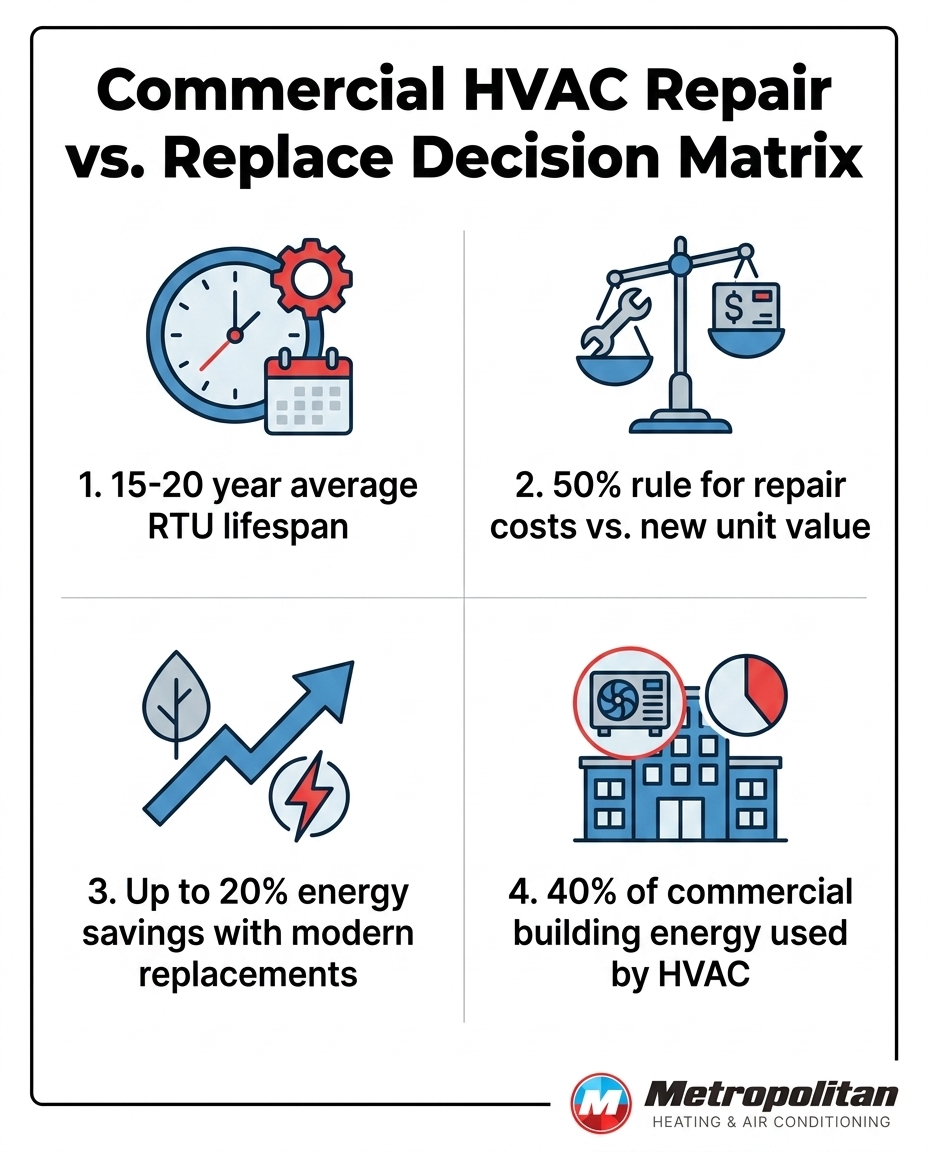
Understanding the expected longevity of your equipment is the first step in proactive facility management. In our experience, the baseline average lifespan of a commercial system, particularly a Commercial Rooftop Unit (RTU), is generally 15 to 20 years with proper, documented care. However, that timeline is not a guarantee; it is heavily dependent on the operational environment and the consistency of seasonal upkeep.
Our technicians know that local climate plays a massive role in accelerating component wear. Scarborough experiences extreme temperature swings, with freezing winters and hot, humid summers. These drastic shifts dictate rigorous seasonal transitions for commercial RTUs to maintain efficiency. Severe temperature fluctuations cause thermal expansion and contraction within the metal components of the unit. Over time, this constant expanding and contracting stresses heat exchangers, weakens electrical connections, and degrades seals.
The specific components we see most vulnerable to these harsh seasonal shifts include the compressor, the condenser coils, and the blower motors. During the Ontario extreme winter and summer temperature swings, these parts work overtime to overcome the ambient outdoor temperatures. When historical maintenance records are kept meticulously, facility managers can track the degradation of these specific components. Reviewing past service tickets helps predict the remaining functional lifespan of the unit, allowing you to forecast capital expenditures accurately rather than waiting for a catastrophic failure.
Repair vs. Replace: A Decision Framework for Facility Managers
When a Commercial Rooftop Unit (RTU) begins to falter, we advise facility managers to use an objective evaluation framework to compare maintenance versus a full installation. One of the most reliable metrics is the "50% rule." If the cost of targeted repairs approaches or exceeds half the value of a new unit, replacement is almost always the better long-term financial decision. Continuing to patch a failing system often results in throwing good money after bad.
You must also compare the ongoing costs of frequent minor fixes against the upfront investment of a high-efficiency installation. While a new system requires significant capital, aging units drain resources through constant service calls, degraded performance, and operational interruptions. When evaluating the energy consumption differences between aging 15-year-old units and modern replacements, the data is compelling. Modern commercial systems can offer up to 20% savings on energy consumption, which translates to a massive reduction in overhead for a large facility.
Finally, assess the reliability factor for critical business operations during peak seasons. Partnering with our team for reliable commercial HVAC services ensures that you have the data needed to make this call confidently. The table below breaks down the primary indicators for both paths.
• Equipment Age — Indicators for Targeted Repair: Unit is under 10 years old and well within its expected lifecycle. — Indicators for System Replacement: Unit exceeds 15 years of continuous, heavy use.
• Repair Frequency — Indicators for Targeted Repair: Issues are isolated to easily replaceable, minor components. — Indicators for System Replacement: Experiencing multiple major breakdowns in a single season.
• Energy Efficiency — Indicators for Targeted Repair: Monthly utility bills remain relatively stable year over year. — Indicators for System Replacement: Noticeable, sustained spikes in energy costs without operational changes.
• Performance Quality — Indicators for Targeted Repair: System maintains consistent temperatures across all building zones. — Indicators for System Replacement: Significant drop in indoor air quality or temperature consistency.
When to Choose Targeted Repairs
Targeted repairs make the most sense when the unit is relatively young, typically under a decade old. If the mechanical issues are isolated to easily replaceable components—like a worn belt, a faulty capacitor, or a clogged drain line—a repair is the logical choice. In these scenarios, the system still operates efficiently, and energy bills remain relatively stable, meaning the core infrastructure is still sound.
When to Invest in a New Installation
A new installation becomes the clear choice when the unit exceeds 15 years of continuous use and the repair costs begin to mount. If you are experiencing multiple breakdowns in a single season, the system is signaling that it has reached the end of its functional life. Furthermore, a significant drop in indoor air quality or the inability to maintain temperature consistency across different zones means the unit can no longer meet the fundamental needs of the building.
The Role of Preventative Maintenance in Risk Mitigation
Customized maintenance plans serve as the ultimate risk-mitigation tool to prevent unexpected downtime. These plans must be tailored specifically to a business's operational needs and building size in the GTA. A generic checklist is not enough for complex commercial infrastructure; you need a proactive approach that addresses the unique demands of your specific facility layout and usage patterns.
Routine inspections are designed to catch minor leaks, loose electrical connections, and airflow restrictions before they cause system-wide failure. When technicians monitor the system regularly, they can identify wear and tear on critical components long before a breakdown occurs. The value of this proactive approach is clear. During a routine annual checkup last summer, one of our technicians discovered a slow refrigerant leak in a commercial system. Because it was caught early during the inspection, the leak was resolved quickly under warranty service, preventing a total shutdown during the peak cooling season.
A thorough commercial checkup involves rigorous testing and cleaning. Maintaining a preventative maintenance plan also ensures that you remain in warranty compliance through documented professional service. Manufacturers require proof of regular upkeep to honor parts warranties. Furthermore, proactive care stabilizes commercial energy consumption throughout the year, counteracting the stress of Ontario extreme winter and summer temperature swings.
• Coil Cleaning: Removing dirt and debris from evaporator and condenser coils to ensure optimal heat transfer and prevent the compressor from overheating.
• Belt Tensioning: Inspecting and adjusting blower belts to prevent slipping, which reduces airflow and strains the motor.
• Refrigerant Checks: Verifying exact refrigerant charges to ensure the system is neither undercharged (causing freezing) nor overcharged (risking compressor failure).
• Electrical Inspections: Tightening connections and testing contactors to prevent arcing and electrical fires.
• Airflow Verification: Checking ductwork and dampers to ensure balanced air distribution across all commercial zones.
Navigating Commercial System Installations and Upgrades
When replacement is the only viable option, understanding the installation planning process is vital for facility managers. Upgrading a Commercial Rooftop Unit (RTU) is a major logistical undertaking that requires precise engineering and careful execution. Modern commercial HVAC systems account for approximately 40% of total energy usage in commercial buildings, which means that upgrading to high-efficiency equipment directly and significantly improves the bottom line.
The process begins long before the old unit is removed. It requires comprehensive planning, structural evaluations, and coordination with daily business operations to minimize disruption. Qualifying energy-efficient commercial upgrades may also be eligible for general energy rebates and tax incentives (facility managers should verify current programs locally with their utility providers). Navigating these upgrades requires working with local experts who deeply understand regional building codes, structural load requirements, and zoning laws.
When providing professional HVAC services in Scarborough, our installation team insists on following a strict, phased approach because skipping steps can lead to undersized or oversized equipment, which guarantees poor performance and a shortened lifespan.
1. Comprehensive Load Calculation: Performing detailed engineering calculations to determine the exact heating and cooling demands of the building, accounting for occupancy, windows, insulation, and heat-generating equipment.
2. Ductwork and Structural Assessment: Evaluating existing ductwork for leaks or sizing issues, and verifying that the roof structure can support the weight and vibration of the new RTU.
3. Equipment Selection: Choosing the right unit based on energy efficiency ratings (IEER/SEER), fuel type, and specific zoning requirements.
4. Logistics and Craning: Coordinating heavy equipment, road closures, and crane operators to safely remove the old unit and hoist the new system into place with minimal business interruption.
5. Final Commissioning: Rigorously testing the newly installed system across all operating modes, balancing dampers, and calibrating thermostats to ensure it performs exactly to manufacturer specifications.
Warning Signs That Immediate Service is Required
Even with the best maintenance protocols, mechanical systems can develop sudden issues. Facility managers and staff should be trained to recognize the early warning signs of equipment distress. Catching these symptoms early can mean the difference between a minor repair and a catastrophic failure of a Commercial Rooftop Unit (RTU).
Waiting too long can lead to critical operational halts. On one of the hottest days of a recent summer heat wave, a local business called us with a sudden AC emergency. Fortunately, our rapid response team was able to fix the unit quickly, getting the facility up and running again before the indoor environment became unsafe for employees and customers. To avoid emergency shutdowns, watch for these critical triggers that require professional attention.
• Unusual noises: Grinding, squealing, or heavy rattling sounds often indicate mechanical wear, failing bearings, or loose internal components.
• Inconsistent temperatures: Hot and cold spots across different zones of the commercial property suggest failing dampers, duct issues, or a struggling blower motor.
• Sudden utility spikes: A sharp increase in monthly utility costs without a corresponding change in operational hours means the system is working exponentially harder to produce the same results.
• Visible leaks: Moisture buildup, pooling water, or refrigerant stains around the unit indicate clogged condensate drains or compromised refrigerant lines.
• Frequent short-cycling: If the system turns on and off rapidly during peak heating or cooling demands, it is failing to complete a full cycle, which severely damages the compressor.
FAQ
When should I replace my commercial RTU?
We recommend replacing your commercial RTU when it exceeds 15 years of age and requires frequent, costly repairs. A good rule of thumb is the 50% rule: if a repair costs half the price of a new unit, replacement is the smarter financial move. Additionally, if the unit can no longer maintain consistent indoor temperatures or causes unexplained spikes in energy bills, it is time for an upgrade.
How often should commercial HVAC be maintained?
Our team typically recommends that commercial HVAC systems receive professional maintenance at least twice a year, usually in the spring and fall, to prepare for extreme weather transitions. Facilities with high-demand environments, such as restaurants or manufacturing plants, often require quarterly inspections. Consistent maintenance prevents unexpected downtime, ensures optimal energy efficiency, and keeps manufacturer warranties valid.
What is the lifespan of a commercial HVAC unit?
The average lifespan of a commercial HVAC unit is between 15 and 20 years, provided it receives regular, professional maintenance. Factors such as harsh local climates, heavy operational demands, and poor initial installation can significantly shorten this timeframe. Tracking the repair history and performance metrics of the unit will help you anticipate when it is nearing the end of its functional life.
What is the difference between commercial and residential HVAC?
Commercial HVAC systems are significantly larger, more complex, and often modular (like rooftop units) compared to residential systems. They must manage multiple zones, handle heavier ventilation requirements, and integrate with complex building management controls. Additionally, commercial systems deal with much higher heating and cooling loads due to building size, occupancy levels, and internal heat generation from equipment.
Are there energy rebates for upgrading commercial HVAC systems?
Yes, qualifying energy-efficient commercial HVAC upgrades may be eligible for general energy rebates and tax incentives. These programs are designed to offset the initial capital investment of high-efficiency equipment that reduces grid strain. Facility managers should always verify current programs with their local utility providers or a tax professional before finalizing an installation plan.
How does extreme weather affect commercial rooftop units?
Extreme weather forces commercial rooftop units to run continuously at maximum capacity, accelerating mechanical wear and tear. Severe temperature swings cause thermal expansion and contraction, which stresses heat exchangers, electrical connections, and refrigerant lines. Proactive seasonal maintenance is critical to fortifying these systems against the stress of freezing winters and humid summers.
Navigating the complexities of commercial climate control requires a clear understanding of your building's unique demands. Whether you are scheduling routine maintenance to protect your current investment or planning a high-efficiency system upgrade, having a structured approach prevents costly operational downtime. Make the right decision for your facility by prioritizing proactive care and relying on our professional expertise to keep your business running smoothly year-round.
Schedule Expert Service
Or Contact Us
Other Blogs
testimonials
hear what our satisfied clients have to say

where we operate
Service areas
contact us
Let’s get in touch!