
When the Temperature Plummets: Triaging a Winter Surge
A standard home can lose one to two degrees Celsius per hour when the outdoor thermometer plunges, which is exactly why understanding how our dispatch team prioritizes 'no heat' calls during a deep freeze is so critical for local homeowners. In our years of keeping homes warm across Scarborough, we've seen firsthand how a severe winter event creates a massive, simultaneous surge of emergency calls. Homeowners are understandably stressed, watching their thermostats drop while the wind howls outside. The reality of a Scarborough deep freeze / extreme winter storm is that hundreds of residents may find themselves without heat at the exact same time.
If you are currently experiencing a total system failure and need immediate help with your HVAC systems, our emergency heating services team at Metropolitan Heating & Air Conditioning is ready to assist.
Behind the scenes, our dispatch center transforms into a high-speed triage unit. The core operational challenge we face is figuring out how to route a finite number of technicians to an overwhelming number of cold houses. We cannot simply operate on a passive, first-come, first-served waitlist. Doing so would leave families in dangerous situations waiting days for help. Instead, our team relies on a strict, radically transparent triage process to determine who gets a same-day dispatch and who is safely scheduled for the next available slot. By understanding this process, you can know exactly what to expect when you pick up the phone during a winter storm.
The Anatomy of a Deep Freeze: How Fast Does a House Cool Down?
To understand why rapid dispatch is necessary, you have to look at the physics of indoor heat loss. When outdoor temperatures plummet, your home's thermal envelope is immediately put to the test. Heat naturally moves toward cold, and without a functioning furnace to constantly replace that lost thermal energy, your indoor air temperature will begin a steady, inevitable decline.
This timeline is step one in our dispatch team's triage process. We monitor local weather patterns closely, especially when Environment Canada issues Extreme Cold Warnings for the area. These warnings typically trigger our peak emergency dispatch protocols because the risk to property and safety escalates rapidly. As our heating experts often note on service calls, older homes, or those lacking modern insulation, will experience a much faster temperature drop than newly built, tightly sealed properties.
The Hidden Danger of Frozen Pipes
The most immediate threat to a home without heat isn't just discomfort—it is the catastrophic damage caused by frozen plumbing. When temperatures are dropping below -15°C outside, the risk of pipes freezing inside unheated exterior walls accelerates dramatically.
• The critical threshold: Pipes can begin to freeze when outdoor temperatures sit below -6°C for extended periods.
• The danger zone: Once temperatures drop below -15°C, the timeline for pipes freezing shrinks from days to mere hours.
• The cascading damage: Water expands as it freezes, exerting immense pressure on copper and PEX piping. A single burst pipe can cause extensive water damage, ruining drywall, flooring, and electrical systems.
This is why our dispatchers at Metropolitan Heating & Air Conditioning will always ask you about your current indoor temperature and whether your water is still flowing normally during that initial phone call. We are actively assessing the timeline before your home reaches the freezing threshold.
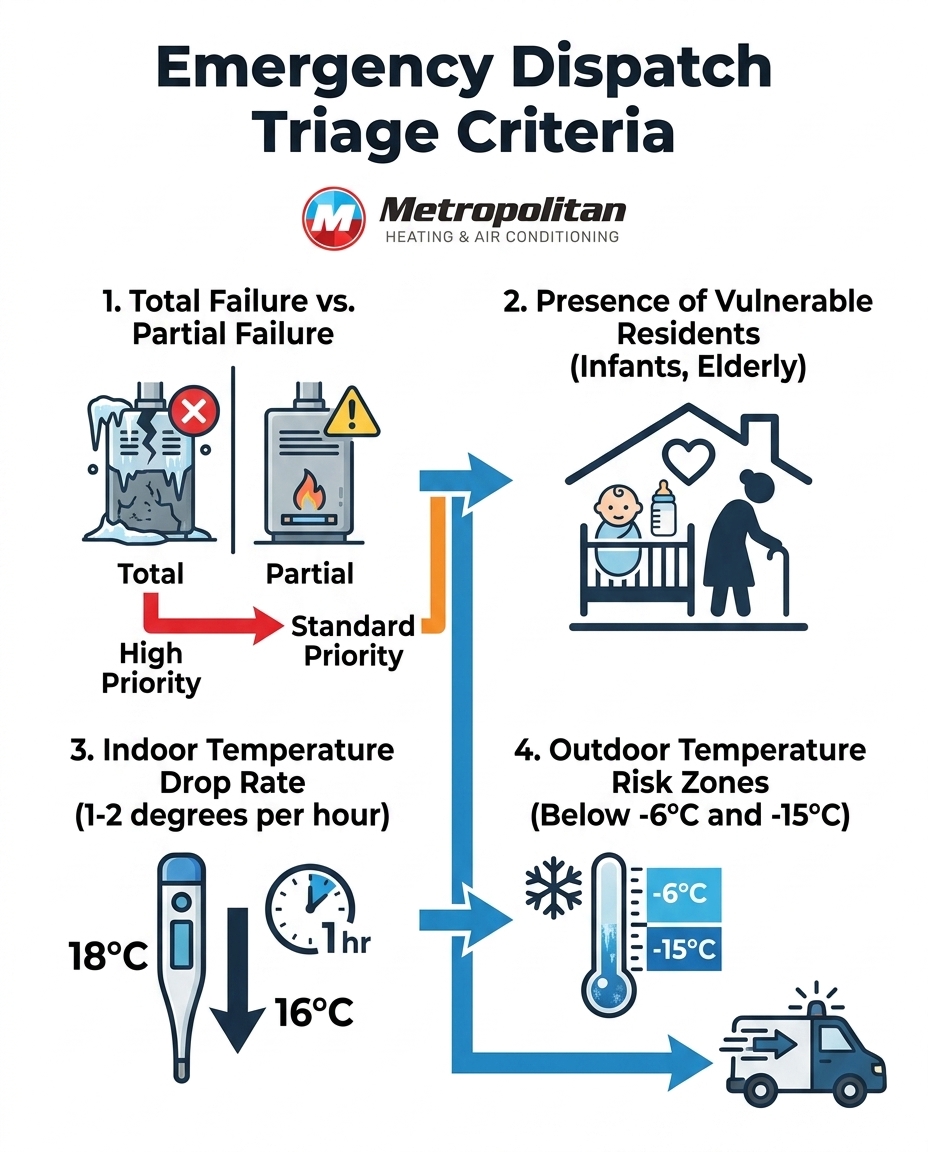
Total Failure vs. Partial Heating: Defining a True Emergency
When the phone rings during a Scarborough deep freeze / extreme winter storm, our dispatchers must quickly categorize the severity of the situation. The most critical distinction we make is between a total system failure and a partial heating issue. Both are urgent, but our experience handling local winter extremes dictates that they require entirely different dispatch responses.
Total failure means the heating system is completely dead. The furnace refuses to ignite, the blower motor is silent, or the vents are actively blowing cold air into the house. In these scenarios, the home has zero thermal input. Total failures automatically move to the top of our same-day routing queue because the house is on a direct path to freezing.
One recent example highlights how this plays out in real life. During a brutal stretch of winter weather with windchills hitting -30, a local homeowner's rooftop furnace completely failed. Because this was a total shutdown in extreme cold, our dispatch team flagged the situation as a top priority. A Metropolitan technician provided emergency service, and when the unit was deemed unrepairable, a new system was installed by the next business day, getting the household back in operation and out of a tight spot.
Partial failure, on the other hand, means the system is still running but struggling to reach the set temperature. The furnace might be cycling on and off too quickly, or it might be maintaining the house at 16°C while the thermostat is set to 21°C. While uncomfortable, a partial failure means the house is not in immediate danger of freezing. These calls are highly prioritized, but basic safety dictates that we handle complete shutdowns first.
• Total Failure — Common Symptoms: No power to furnace, blowing cold air, constant lockout — Dispatch Priority Level: Immediate / Same-Day Triage
• Partial Failure — Common Symptoms: Short-cycling, struggling to reach set temp, noisy operation — Dispatch Priority Level: High Priority / Next Available
• Maintenance Issue — Common Symptoms: Dirty filter, squeaky belt, minor thermostat glitch — Dispatch Priority Level: Standard Scheduling
Prioritizing Vulnerable Residents and Health Risks
The human element of our triage process is just as important as the mechanical side. When temperatures are dropping below -15°C, a cold house is more than just an inconvenience—it becomes a legitimate health hazard. We strictly follow health and safety guidelines to dictate our dispatch decisions during a surge.
World Health Organization guidelines state that indoor temperatures below 15°C pose respiratory and cardiovascular health risks, particularly to sensitive populations. Because of this, our dispatchers are trained to screen every emergency call for vulnerable residents. We will ask who is currently in the home to properly assess the human risk factor.
Populations that trigger an immediate priority escalation include:
• Infants and toddlers: Young children cannot regulate their body temperatures as effectively as adults.
• The elderly: Older adults are at a significantly higher risk for rapid-onset hypothermia in a cooling house.
• Immunocompromised individuals: Those recovering from illnesses or surgeries require stable, warm environments to heal safely.
• Medical equipment users: Residents who rely on specific medical devices often need a stable room temperature for the equipment to function properly.
If a household with vulnerable residents experiences a total heating failure, that call is flagged for immediate, top-tier priority. We firmly believe in a commitment to Scarborough's community safety over a simple first-come, first-served business model. It is the only ethical way to manage a severe weather crisis.
Intelligent Routing: Dispatching Technicians in Real-Time
Handling a massive influx of "furnace repair toronto" and "furnace repair scarborough" searchers calling in at the exact same time requires more than just a list of names. It requires intelligent, active triage. Our rapid same-day emergency dispatching isn't achieved by making technicians drive faster; it is achieved through highly efficient, geography-based intelligent routing.
During a Scarborough deep freeze / extreme winter storm, driving conditions are often terrible. Sending a technician from the far east side of the city to the far west side and back again wastes precious hours that could be spent fixing furnaces. Instead, our dispatch board is dynamically updated as new emergencies are triaged. We cluster calls geographically, keeping technicians in specific zones so they spend less time navigating icy local roads and more time in front of broken equipment.
Just a couple of weeks ago during a sudden cold snap, a homeowner reached out with absolutely no heat. Because our dispatchers could group this call with another nearby emergency using our intelligent routing system, one of our Scarborough heating experts was rerouted the same day, repaired the furnace, and restored the home's heating before evening.
Adjusting on the Fly
Our dispatch board is a living, breathing puzzle during a storm. Technicians communicate with dispatchers constantly to update their status. If a repair goes faster than expected, the dispatcher immediately pulls the next highest-priority call in that geographic zone and routes the technician there.
Parts availability also plays a massive role in this process. Our trucks are heavily stocked with universal winter repair parts—ignitors, flame sensors, and blower motors—so that when a Metropolitan technician arrives at a total failure, they have a high probability of fixing it on the spot without needing to leave for a supply house.
Preventing the Freeze: Safe Steps While You Wait
Once your call is logged and a technician is on the way, the waiting game begins. When temperatures are dropping below -15°C, every minute counts. We always advise our clients that there are several safe, actionable steps you can take to slow down the heat loss in your home while you wait for our team to arrive.
1. Lock down the thermal envelope: Keep all exterior doors and windows tightly closed. Check for drafts and roll up towels to block the gaps under exterior doors. Keep your blinds and curtains closed to add an extra layer of insulation against the cold glass.
2. Use space heaters safely: If you have portable electric space heaters, use them to warm a single, closed-off room where the family can gather. Never leave space heaters unattended, plug them directly into the wall (no extension cords), and keep them at least three feet away from anything flammable.
3. Protect your plumbing: If the indoor temperature is dropping dangerously low, go to the sinks located on exterior walls and leave the taps dripping slightly. Moving water is much harder to freeze than standing water, and relieving the pressure in the pipes can prevent a catastrophic burst.
4. Avoid harmful indoor air: Do not use outdoor heating equipment like camp stoves, propane heaters, or charcoal grills indoors. These produce deadly carbon monoxide. If you are using a wood-burning fireplace, ensure the flue is open and working properly. Maintaining safe air is just as important as keeping warm, much like how you would shield against wildfire smoke during the summer months.
A strict warning regarding repairs: Never open the furnace cabinet to attempt unlicensed DIY repairs. Modern furnaces deal with high voltage, combustible gas, and complex safety switches. Poking around inside the unit can turn a simple sensor replacement into a dangerous situation or a permanently ruined control board. Leave the diagnostics to the licensed professionals.
Frequently Asked Questions About Winter Heating Emergencies
What is considered a no heat emergency?
A true no heat emergency occurs when your heating system suffers a total failure during freezing or sub-freezing weather. If the furnace will not turn on at all, is blowing cold air, or the indoor temperature is dropping rapidly, it is an emergency. Situations involving vulnerable residents, like infants or the elderly, automatically elevate a heating failure to an emergency status.
How long can a house go without heat before pipes freeze?
The timeline depends heavily on outdoor temperatures and your home's insulation, but pipes can begin to freeze within 24 hours if the outdoor temperature is consistently below -6°C. If temperatures plummet below -15°C, pipes in uninsulated exterior walls can freeze in just a few hours. Leaving a slow drip on your faucets can help extend this timeline while you wait for a repair.
How do HVAC companies prioritize emergency calls?
HVAC companies prioritize calls based on the severity of the failure and the risk to the occupants. Total system shutdowns take precedence over systems that are partially working but struggling to maintain temperature. Dispatchers also factor in the presence of vulnerable residents and use geographic routing to group nearby calls for faster, more efficient service.
How fast does a house cool down without a furnace?
A standard, well-insulated home typically loses one to two degrees Celsius per hour during a deep freeze. Older homes with drafty windows or poor insulation can lose heat much faster, sometimes dropping three to four degrees an hour. Wind chill also accelerates this heat loss by stripping away the protective layer of stagnant air around the exterior of the house.
What should I check before calling for emergency furnace repair?
Before calling, check the simplest solutions first to rule out a false alarm. Verify that the thermostat has fresh batteries and is set to "heat." Check your electrical panel to ensure the furnace breaker hasn't tripped. Finally, look at your furnace filter; a severely clogged filter can cause the system to overheat and shut down as a safety precaution.
Does turning up the thermostat help a struggling furnace during a cold snap?
No, turning up the thermostat will not make a struggling furnace produce warmer air or heat the house faster. A thermostat is just an on/off switch, not a throttle. If your system is running constantly but failing to reach the set temperature, cranking the thermostat higher will only force the system to run longer, potentially causing it to overheat or wear out completely.
Your Comfort and Safety Are Our Top Priorities
At Metropolitan Heating & Air Conditioning, behind every dispatch decision we make during a winter storm is a deep commitment to community safety. When temperatures are dropping below -15°C, extreme weather requires extreme operational precision. We know that waiting for a technician in a cold house is stressful, but we hope that understanding our intelligent routing and triage process gives you peace of mind that true emergencies are handled with the urgency they deserve.
Our goal is to ensure that no family is left in a dangerous situation during a deep freeze. If your system has been acting up, don't wait for a total failure to get it looked at. We encourage you to schedule a professional evaluation before the next major winter storm hits, ensuring your equipment is ready to handle whatever the season brings.
Schedule Expert Service
Or Contact Us
Other Blogs
testimonials
hear what our satisfied clients have to say

where we operate
Service areas
contact us
Let’s get in touch!